Aspirational crafting
Lemma: A "perfect" craftable item must be reachable but rarely reached. Determinism in crafting is a bug the design tolerates only in regulated doses; whenever a crafting subsystem makes top-tier items easy, it gets nerfed. The chase is the game.
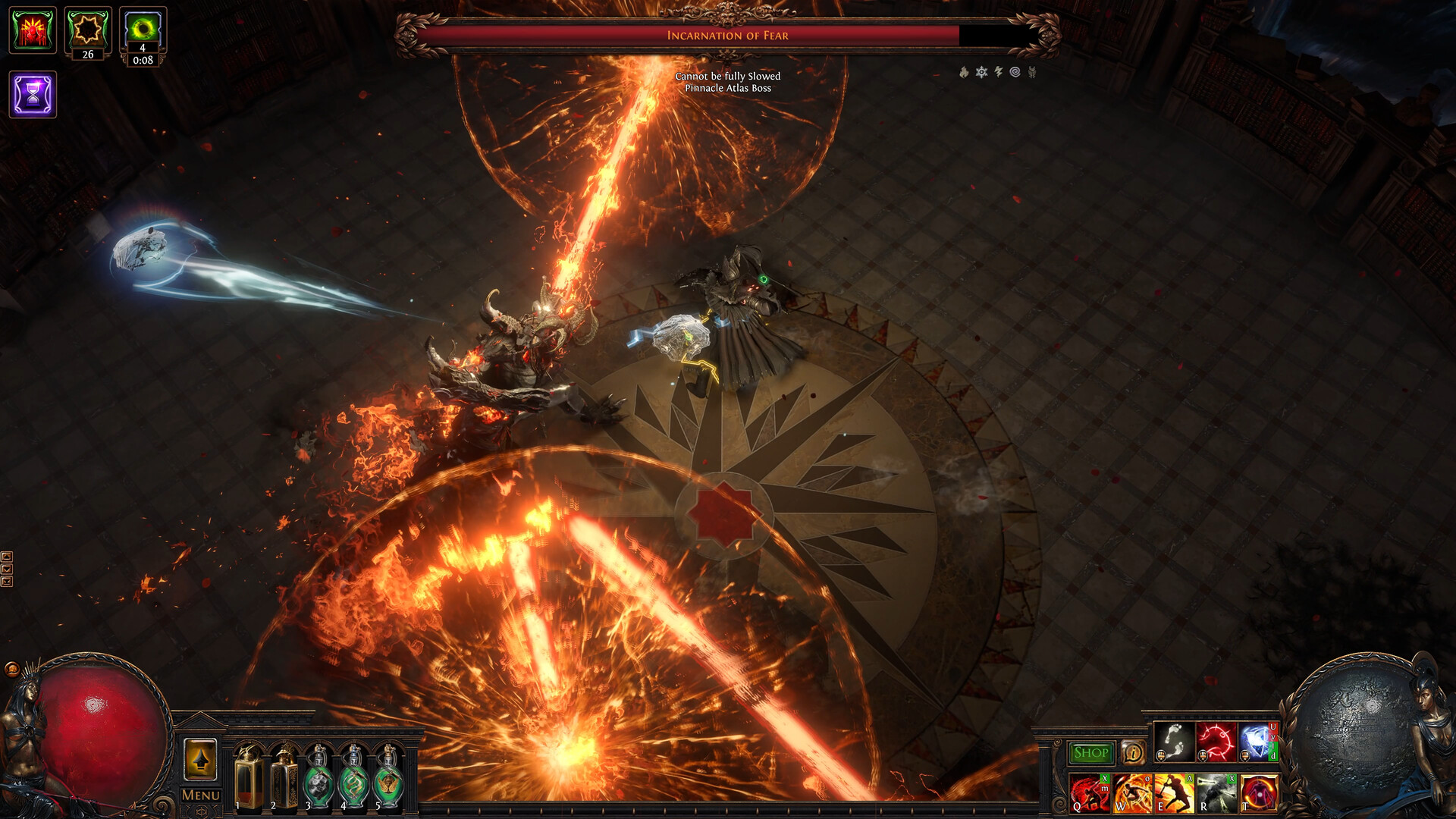 PoE pinnacle-boss combat: the wall the perfect-rolled gear is for. Aspirational crafting only earns its keep if there's a chase tall enough to need the asymptote-tier item. Pinnacle bosses are that wall. Source: Steam.
What it solves
The naive design move for crafting is: "give players control over their items." Add deterministic mods, targeted reforges, copy-paste affixes. Players celebrate.
Three months later, every player has the same near-perfect item. The chase is gone. Trade volume collapses (everyone crafts their own). The endgame is solved.
Aspirational crafting refuses this drift. The thesis: the asymptote (a mirror-tier item) should exist, but reaching it should require real effort, not just gold. Crafting subsystems get a calibrated "deterministic ceiling" (how close to perfect you can get with effort vs. luck), and that ceiling is held intentionally below "trivial."
When a new subsystem ships at too-high a ceiling, the design accepts the short-term player joy and the long-term fix is a nerf. The cycle ("ship deterministic system → 6–18 months → nerf it") is treated as the design pattern, not a bug.
Variants across games
| Game | The asymptote | Cycle that protects it | Player position |
|---|---|---|---|
| Path of Exile | A 6-mod rare with 4 influence-exclusive T1 affixes; mirror-tier items as the absolute ceiling | Harvest (3.11 → nerfed 3.13/3.14); Recombinator nerfs; Aisling/Veiled tightenings; Bench restrictions. Roughly 18-month ship-and-nerf rhythm. | Top 1% reaches near-perfect items via real currency investment; mid-tier players buy crafted items rather than crafting them. The 99% interact with crafting as a price tag. |
| Path of Exile 2 | Same asymptote (mirror-tier items). EA-stage simplification removed Bench, Vorici, sockets/links. | Ships with fewer subsystems; Recombinators and rune-sockets fill the deterministic-craft slot but are constrained. GGG has stated the nerf cycle will continue. | Sequel reset of the deterministic-creep that PoE1 accumulated over 12 years. |
The distinguishing feature of aspirational crafting vs. ordinary crafting RNG is the explicit philosophy: GGG has stated the position multiple times in manifestos and interviews:
"We were concerned by how deterministic some Harvest Crafts are and how easily players can craft near-perfect items." , Harvest crafting changes manifesto
This isn't accidental friction. The design is articulated, defended publicly, and nerfs are timed to protect it.
When to use this pattern
- Long-running ARPGs / looters where the chase is the engine of replay.
- Trade-economy games where personal crafting and player-to-player trade compete for the same currency.
- Games with a stated thesis: see
vision-driven-iteration. Aspirational crafting is downstream of a vision-driven studio; you can't run the nerf cycle without taking community pain on philosophy grounds.
Avoid when:
- The game is closed-form (no live patches). A single-player puzzle game can ship deterministic crafting and call it done.
- The audience is general-mass and engagement metrics dominate. Nerfing beloved crafts is a metrics catastrophe; it's defensible only with a vision-driven studio willing to absorb the hit.
Pitfalls
- The cycle alienates players who learned the nerfed system. Harvest's nerf produced one of the largest community revolts in PoE history. The studio accepts this as the cost of the philosophy; that doesn't make the pain less real.
- Difficult for new players to grok. "This crafting layer used to do X but was nerfed in 3.13" is fan-wiki vocabulary. New players show up to a labyrinth of subsystems with implicit ceilings they have to learn through community lore.
- Pushes mid-tier players toward trading instead of crafting. A frictioned craft system means the median player buys the crafted item rather than crafting it; this concentrates crafting expertise in the top 1%, which can feel hostile to anyone trying to learn.
- Requires a parallel trade economy that works. If trade is also frictioned (PoE's lack of in-game auction house), buying a crafted item is itself a hassle. Aspirational crafting + trade friction stacks the friction.
Adjacent patterns
random-perfect-roll-economy: the natural endpoint of aspirational crafting, where per-item uniqueness becomes a market commodity. PoE's mirror-tier items + Warframe's god-roll Rivens are the same shape.currency-as-crafting: currencies ARE the crafting verbs in PoE; preserving the asymptote keeps every currency drop meaningful instead of inflationary.vision-driven-iteration: the upstream philosophy. Aspirational crafting requires a studio willing to nerf beloved systems; that requires a stated thesis the community can debate.
Why this matters as a design lesson
The studio's stance is the chase IS the game, not a bridge to "the game." If you ship a system that closes the chase, you've removed the game's engine. Aspirational crafting is the discipline of holding the asymptote in place even when players (and engagement metrics) ask you to move it closer.
For your own designs: pick a stance early. If you want a frictionless "gear for everyone" experience (Diablo 3 era), don't ship a 12-year ARPG, the math will catch up. If you want a long chase, the cycle of "ship determinism → nerf it" is the price.