Subtractive deckbuilding
Lemma: A deck that's too big is worse, because every card dilutes the chance of drawing the cards you actually want. The strongest play is carving out a tight loop, not stacking power on top of stuff. Skipping a card is a first-class option; removing one is a power move.
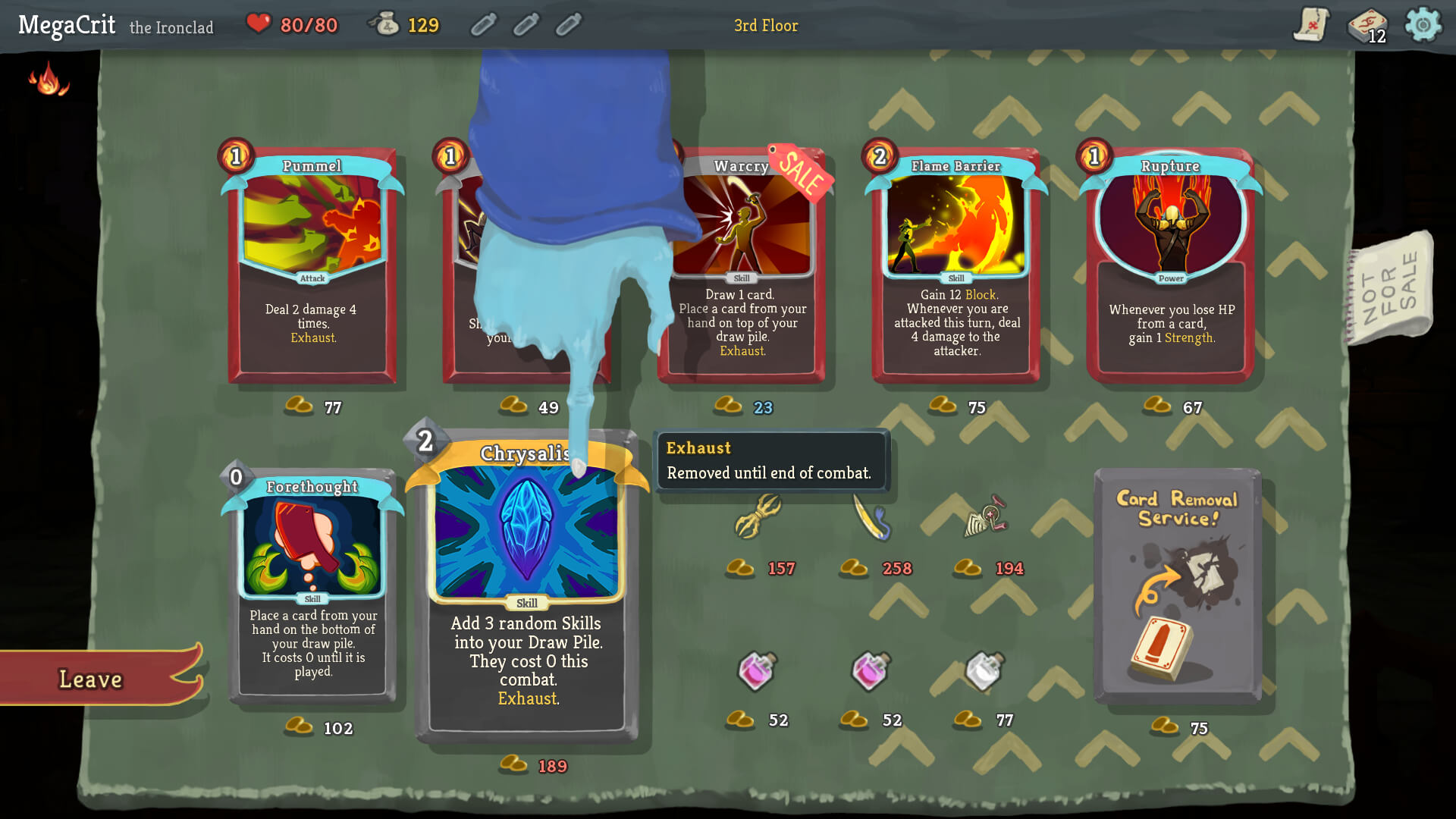 Spire's Card Removal Service. Pay gold to make your deck smaller. The escalating cost is the design's pulse: removing one card is cheap, removing five is the run's economy. Source: Steam.
What it solves
The instinctive deck-shape in TCGs (Magic, Hearthstone) is build up: add the strong cards, fill to deck size, win. Modern roguelike-deckbuilders inverted this: the deck has a starting size, additions dilute it, and the winning strategy is thinning to the synergies you've committed to.
This solves several problems at once:
- Forces commitment. You can't take "good" cards in 18 directions and still draw your synergies; you must pick a direction and prune.
- Makes drafting genuinely interesting. "Pick 1 of 3 or skip" only matters if skipping is sometimes correct. With subtractive thinking, skip is often correct.
- Makes the random hand draw deterministic-feeling at the strategic timescale. A 15-card deck cycles fast and reliably draws its synergies; a 35-card deck draws random junk.
The inversion is what defines the modern roguelike-deckbuilder genre.
Variants across games
| Game | Starting deck | What "subtractive" means | Tools for thinning | Co-play / hand mechanic |
|---|---|---|---|---|
| Slay the Spire | 10 starter cards (mostly basic Strikes/Defends) | Literally fewer cards = better draws. A 15-card deck dominates a 35-card deck even at lower power. | Shop card-removal (escalating cost, capped per visit), events that exhaust/remove, Exhaust archetype (cards self-remove during play), Innate cards | 5-card hand drawn from the deck each turn; deck reshuffles when empty |
| Mega Man Battle Network | 30-chip Folder (fixed size) | Size is fixed, so subtraction is in code spread. Mono-code or name-stacked Folders draw co-playable hands; spread-code Folders draw uncoordinated hands. | Letter-code coherence, name-stacking (4 of one chip), ★ wildcards as flex slots | Opening 5-chip Hand drawn from Folder; the letter-code rule gates which Hand chips are co-playable per turn |
| Balatro | 52-card standard poker deck | Subtraction is mutation + thinning: Tarots destroy cards (Hanged Man); Spectrals destroy and replace (Familiar / Grim / Incantation); the deck shrinks AND mutates per modifier dimension (Enhancement / Edition / Seal) | Hanged Man Tarot, Spectral Cards (which cost a slot but destroy 1 + add 4 enhanced), planet+joker thinning effects, draws of 8 from the deck | 8-card hand draws from the live deck each round; the deck IS the build, with three modifier dimensions per card |
The two cases sit on opposite ends of the constraint axis but converge on the same insight: focus dominates breadth. Spire achieves it through deck-size shrinkage; BN achieves it through code-coherence within a fixed-size deck. Same effect, different lever.
Visual contrast
| Slay the Spire: Compendium | Mega Man Battle Network: Folder editor |
|---|---|
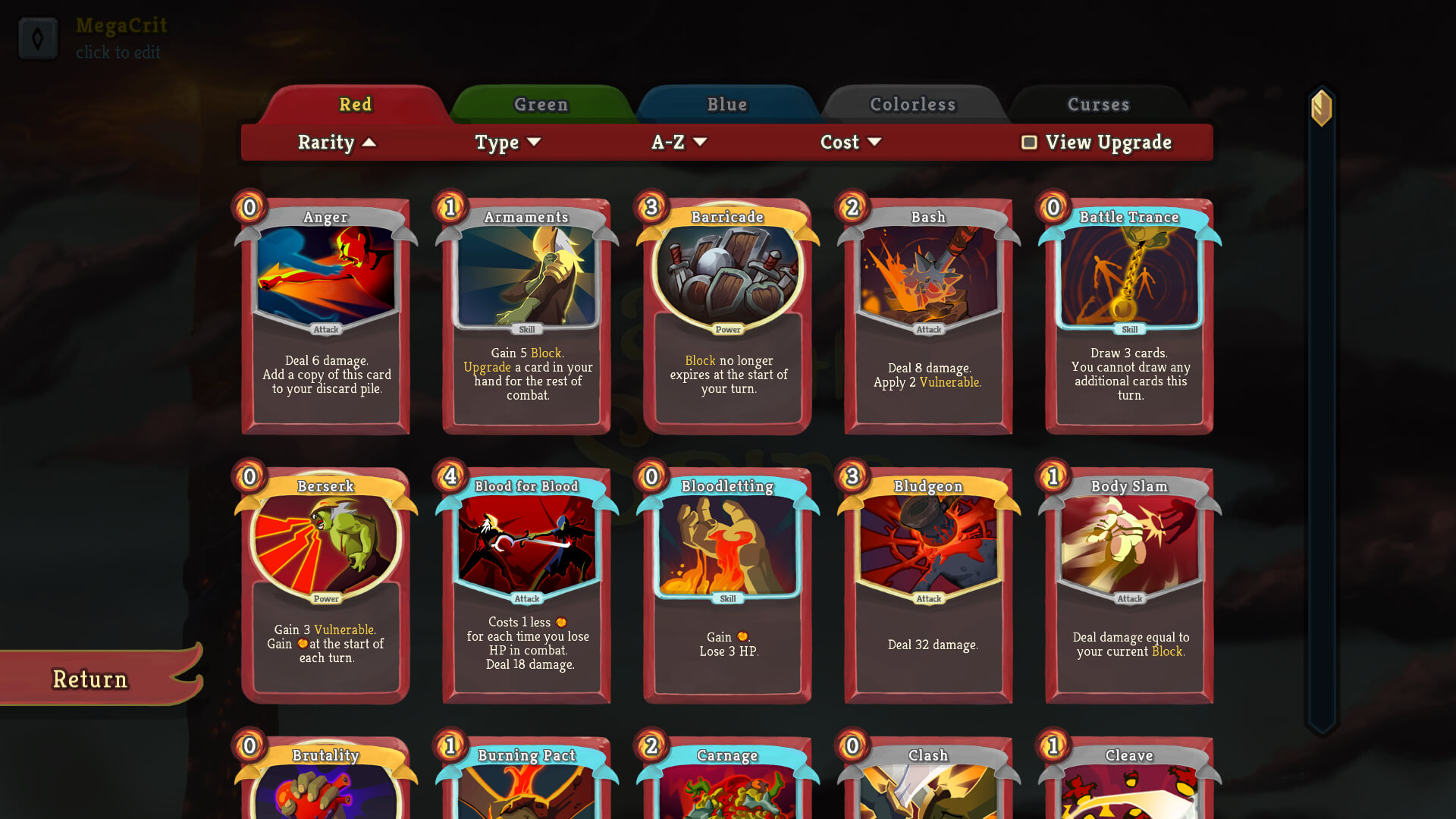 | 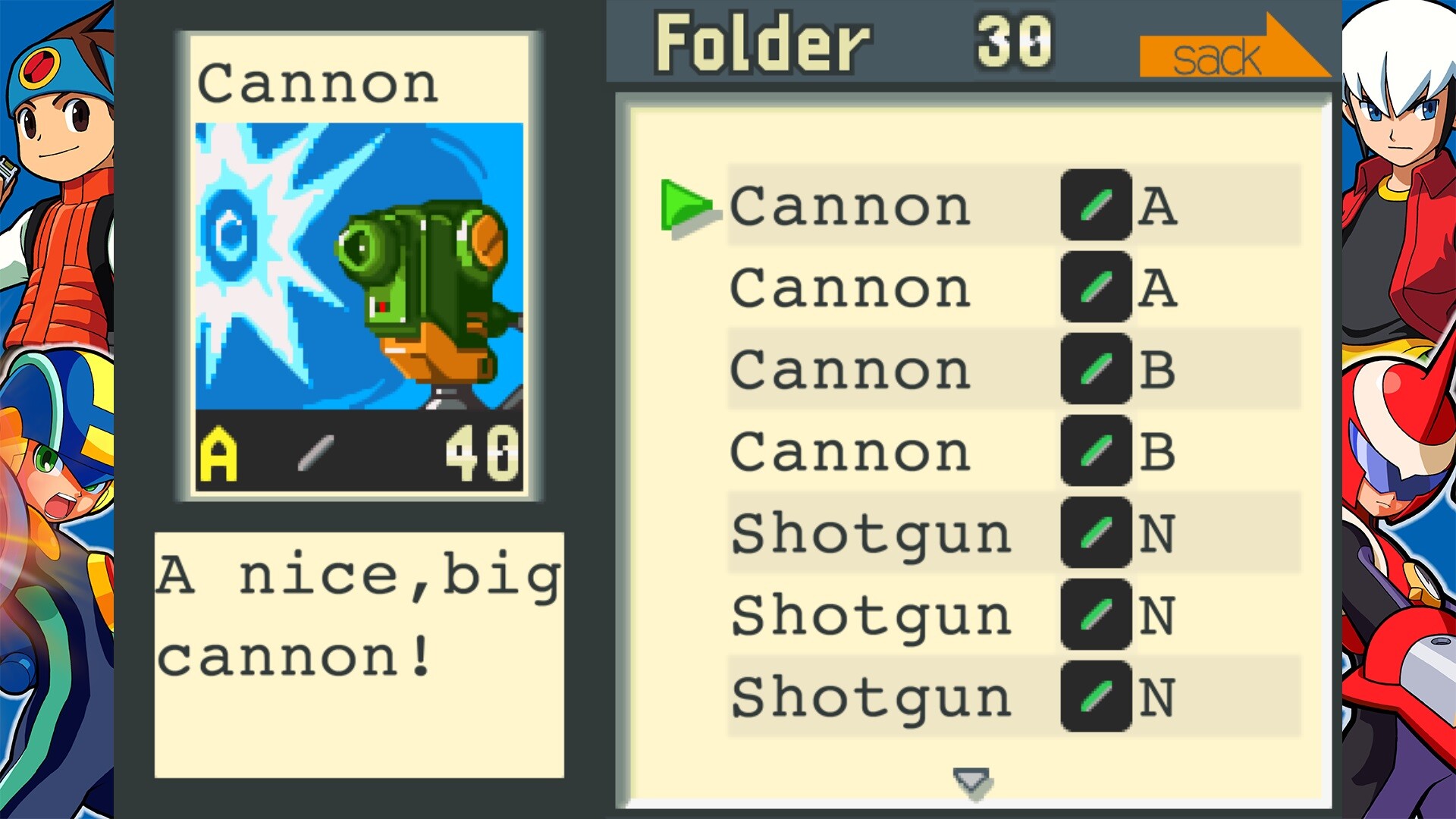 |
| ~75 cards per character; the run's deck is 15–20. Subtraction is literal: pay to remove. | 30 chips per Folder, fixed. Subtraction is in the code spread: stack one letter to make hands play together. |
When to use this pattern
- Roguelike / roguelite deckbuilders where each run wants a distinct identity. Subtractive thinking forces commitment, which produces archetypes.
- Hand-draw card games with a small per-turn budget (energy, mana that doesn't ramp). The smaller the energy budget, the more the draw quality matters.
- Games where draft choices are the loadout decision. Spire's "pick 1 or skip" only earns its keep if skipping is genuinely sometimes correct.
Avoid when:
- The genre expects build-up TCG semantics (Hearthstone, MTG). Players coming from those games will reflexively want to add and resist removing.
- The deck has no random-draw element. Without random hands, deck thinning loses its statistical edge: every card always plays at the right moment.
Pitfalls
- Card removal must be reachable but not free. Spire's escalating shop cost is the canonical balance: removing one card is cheap, removing five is the run's economy. If removal is too cheap, every run converges on the same minimum-deck shape; too expensive and the pattern doesn't bite.
- The "skip" option must be a real choice. If every offered card is strictly better than not picking, you've smuggled additive logic back in. Spire's tightness comes from "this card is fine but adding it dilutes my Strength scaling, skip" being a correct play.
- Onboarding wall. The new-player intuition is "more cards = more power." Spire's earliest-Ascension difficulty is partly the player learning to not take cards. This is a real cost; tutorials usually can't telegraph "skip more often."
- Subtractive doesn't mean monotonic. A deck thinned too aggressively can lose flexibility: you draw the same 5 cards every turn and lose to anything those 5 don't answer. The pattern is tight, not minimal.
Adjacent patterns
loadout-as-budget: the parent pattern. A subtractive deck is a combinatorial budget: hand size + deck size + draw consistency are the budget axes.card-draft-with-skip: the in-run mechanic that operationalizes subtractive thinking. Without skip-as-first-class, drafts are forced additions.opportunity-cost-loadout: every card you take is a card not skipped; every code you commit to is a code you're not committing to elsewhere. Same shape one level up.code-constrained-deckbuilding: Battle Network's specific lever. Letter codes as a co-play constraint that operates on a fixed-size deck.
Why this matters as a design lesson
The genre move was inverting the additive instinct. Building up a deck is the obvious design; thinning it is counter-intuitive but produces tighter, more identity-driven runs. The math is universal (drawing from a 15-card pool is statistically different from drawing from a 35-card pool) but the design language to expose that math to the player is the contribution.
For your own designs: if your deckbuilder has a random-hand draw and a small per-turn budget, ask whether removing cards is a power move. If it isn't, you've shipped a TCG; if it is, you've shipped a roguelike-deckbuilder.