Tile-shuffled world
Lemma: Author rooms / tiles / chunks by hand; let the procedural layer decide which tiles connect and where. Each descent feels like a fresh map, but the moments inside it are still hand-tuned. Cheaper than full PCG; more variety than fully static.
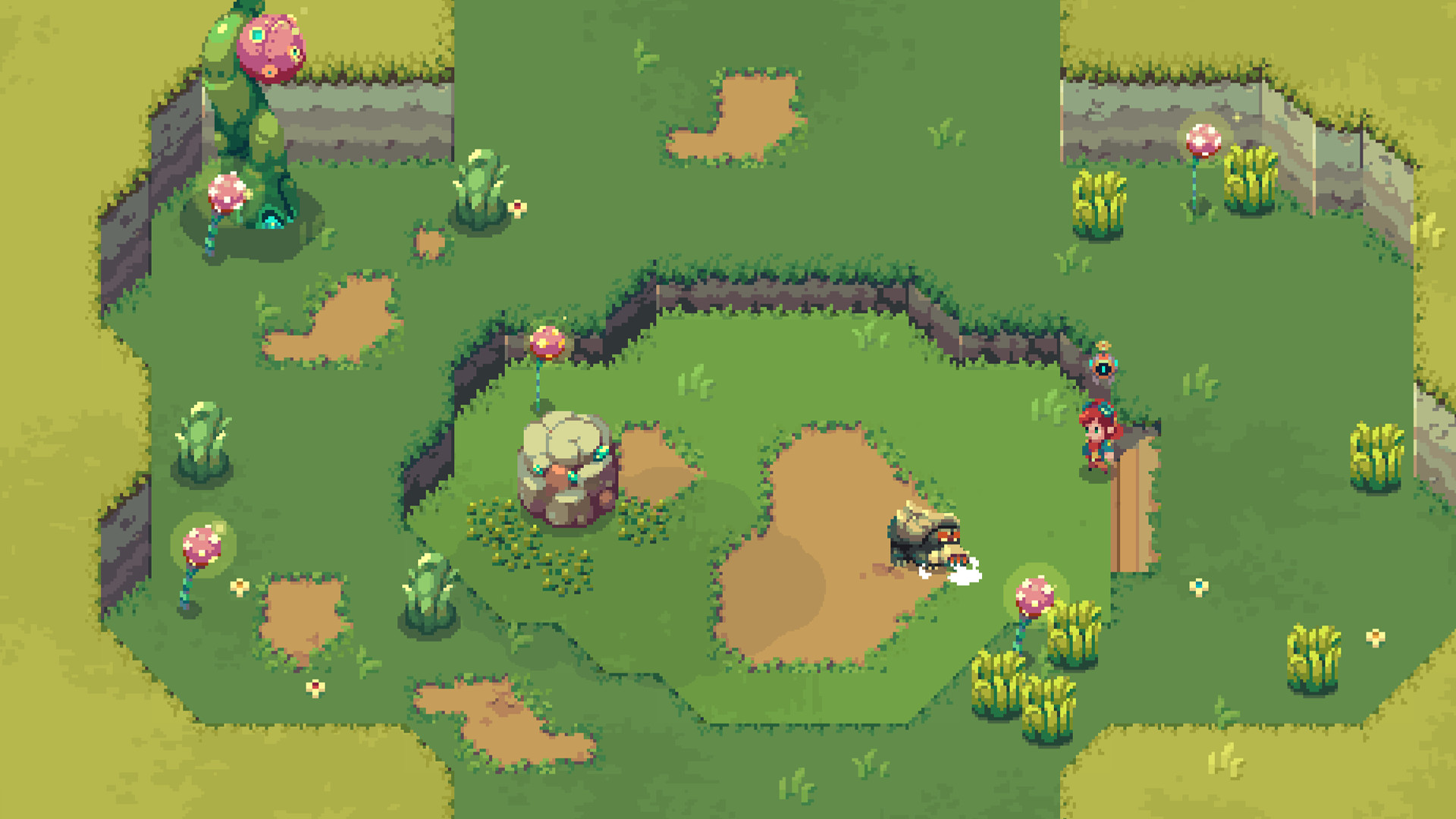 Sparklite's Vinelands: one of five biomes, each composed of hand-authored tiles shuffled into a fresh layout each descent. The tile content is static (this trap room, this NPC encounter); the positions shift. Source: Steam.
What it solves
Two opposite failure modes for repeatable level content:
- Fully procedural. Every layout is unique, but the moments inside (puzzles, set-pieces, encounter beats) are weak: the procedural layer can't author elegant Zelda-style progressions or detailed trap rooms. Devs of PCG dungeon games have repeatedly hit this wall.
- Fully static. The first run is great; the tenth feels like memorization. The "game world" is solved.
Tile-shuffled splits the difference. Authoring happens at the tile / room / chunk level, where humans are good at it (a single trap gauntlet, a furnace mini-dungeon, a Grineer asteroid corridor with the Captura room visible through the window). Randomization happens at the layout level, where humans are bad at it (which 8 of 30 rooms get connected this run, in what order, with what bonus rooms branched off the spine).
The result feels fresh-each-run because the map is fresh, while preserving the moment-quality the developers can author.
Variants across games
| Game | Authored unit | Shuffle layer | What stays static / what shifts |
|---|---|---|---|
| Sparklite | Hand-crafted tile rooms (trap gauntlets, vault puzzles, NPC-encounter rooms, biome-specific furnaces) | Each death reshuffles the tile layout; biome direction relative to the central grasslands stays fixed | Tiles reuse across runs (same room types); biomes' compass orientation stays; specific positions shift each descent |
| Warframe | Hand-crafted tile rooms per faction (Grineer asteroid, Corpus ship, Infested ship, Earth forest, Orokin tower …) | Procedurally connected tile-paths per mission; mission type (Survival, Defense, Capture) sets the objective | Tile aesthetics + room layouts are static; which tiles connect, in what order, varies per mission instance |
Worth flagging: Warframe shipped this approach in 2013; Sparklite shipped it in 2019. Sparklite's devs explicitly named the design choice: they rejected procedural-dungeon generation because "very few puzzles work well in a repeated context and procedurally reproducing the elegant progression of puzzles you see in a Zelda dungeon is not something we wanted to tackle." That's the cleanest articulation of the pattern's motivation.
Visual contrast
| Sparklite: Vinelands | Sparklite: Shifting Sands | Warframe: in-mission |
|---|---|---|
| 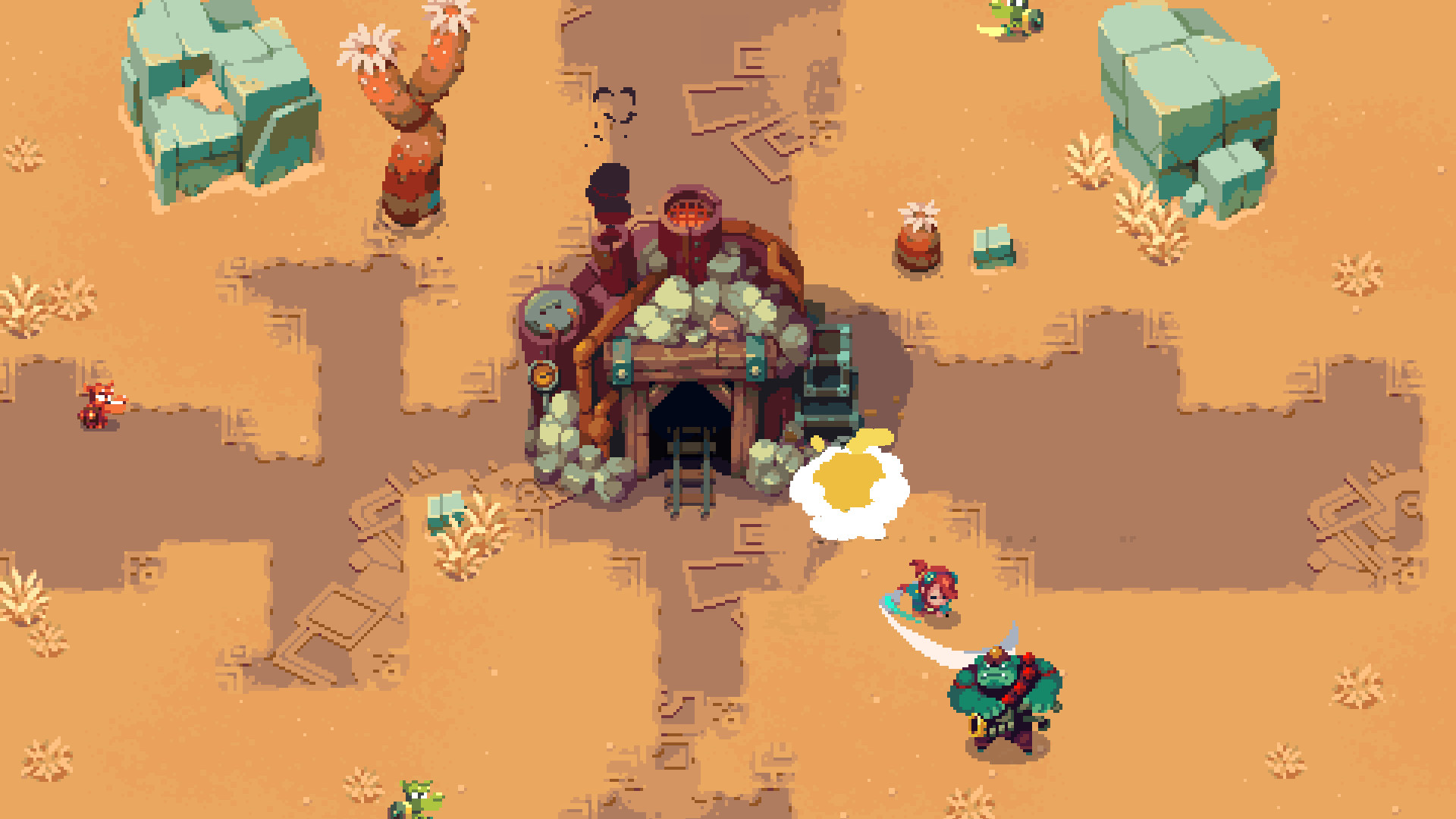 | 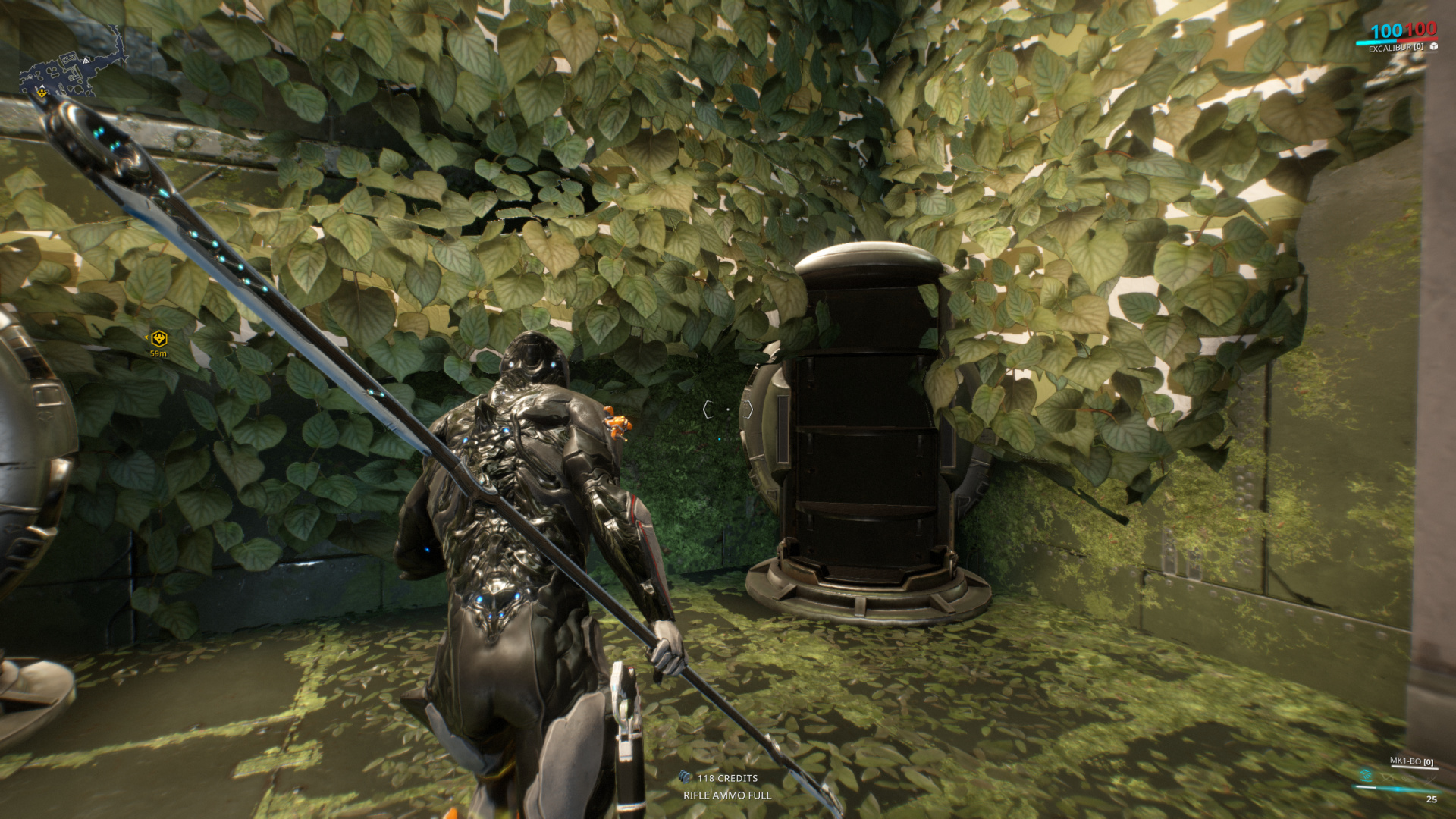 |
| Each biome has its own tile pool. The biome is fixed (compass direction); the layout shuffles per descent. | A different tile pool, same shuffle algorithm. Same fresh-feeling, same authored set-pieces. | Tile-set procedurally connected on every mission. Mission type (Survival, Defense, Capture) sets the objective; tile-set sets the aesthetic. |
When to use this pattern
- Roguelites where each run wants a fresh-feeling world but where the design team can author quality moments (puzzles, set-pieces, ambient detail).
- Live-service games with tile-set-able content: Warframe's faction tile-sets, mission objectives layered on top, can produce thousands of layout permutations from a few hundred authored rooms.
- 2D top-down or 3D corridor games where rooms have natural "doorways" and the connection topology is straightforward.
Avoid when:
- The game depends on contiguous-feeling open world (Elden Ring, Breath of the Wild). Shuffled tiles will read as "tile boundaries"; players notice the seams.
- The room set is too small. ~10 rooms shuffled is just memorization with extra steps; the pattern wants ~30+ authored rooms per biome to produce meaningful variety.
Pitfalls
- The variety is shallow. Reviewers of Sparklite consistently noted that the same enemies/puzzles appear in the same room types, just in different positions, and players coming from full PCG (Spire, Hades, Isaac) called the variety superficial. The pattern is fresh-feeling, not fresh.
- Onboarding suffers if biome compass shifts. Sparklite kept biomes in fixed compass directions for a reason: if "Vinelands is north" sometimes and "Vinelands is south" other times, the player's mental map collapses. Locking some coordinates is part of making the shuffle navigable.
- Tile boundaries can be visible. Mismatched lighting, unrelated music transitions, or jarring tilt at room seams break immersion. Warframe spends real engineering on streamed tile transitions; smaller teams may not be able to.
- Authoring cost is non-trivial. "We'll just make 30 tiles per biome" is real human-months. Cheaper than full procedural, more expensive than a hand-crafted contiguous map.
Adjacent patterns
handcrafted-pcg-hybrid: the broader category. Tile-shuffled is a specific spatial implementation; handcrafted-PCG also covers card / encounter / event variants (Spire's room-type DAG is the same idea at a different granularity).permalife: pairs naturally with tile-shuffled. If the world reshuffles every death, permalife means "your character keeps everything; only the world resets." Sparklite's exact implementation.
Why this matters as a design lesson
The pattern's value is shifting authoring cost from where humans are bad to where humans are good. Designing an elegant trap-gauntlet room is a craft skill; designing a trap-gauntlet layout generation algorithm that produces consistently elegant gauntlets is research-grade engineering. Tile-shuffled lets a small team ship "fresh-feeling worlds" without the algorithmic-content R&D budget.
For your own games: if you find yourself trying to procedurally generate puzzles, stop. Author the puzzles, shuffle the layout. The moments are what players remember; the layout is what makes the moments feel non-repetitive.