Combat
Less novel than the meta systems, but worth a page because it's the fun, and because the damage-type matrix is a genuinely strong combat-design pattern.
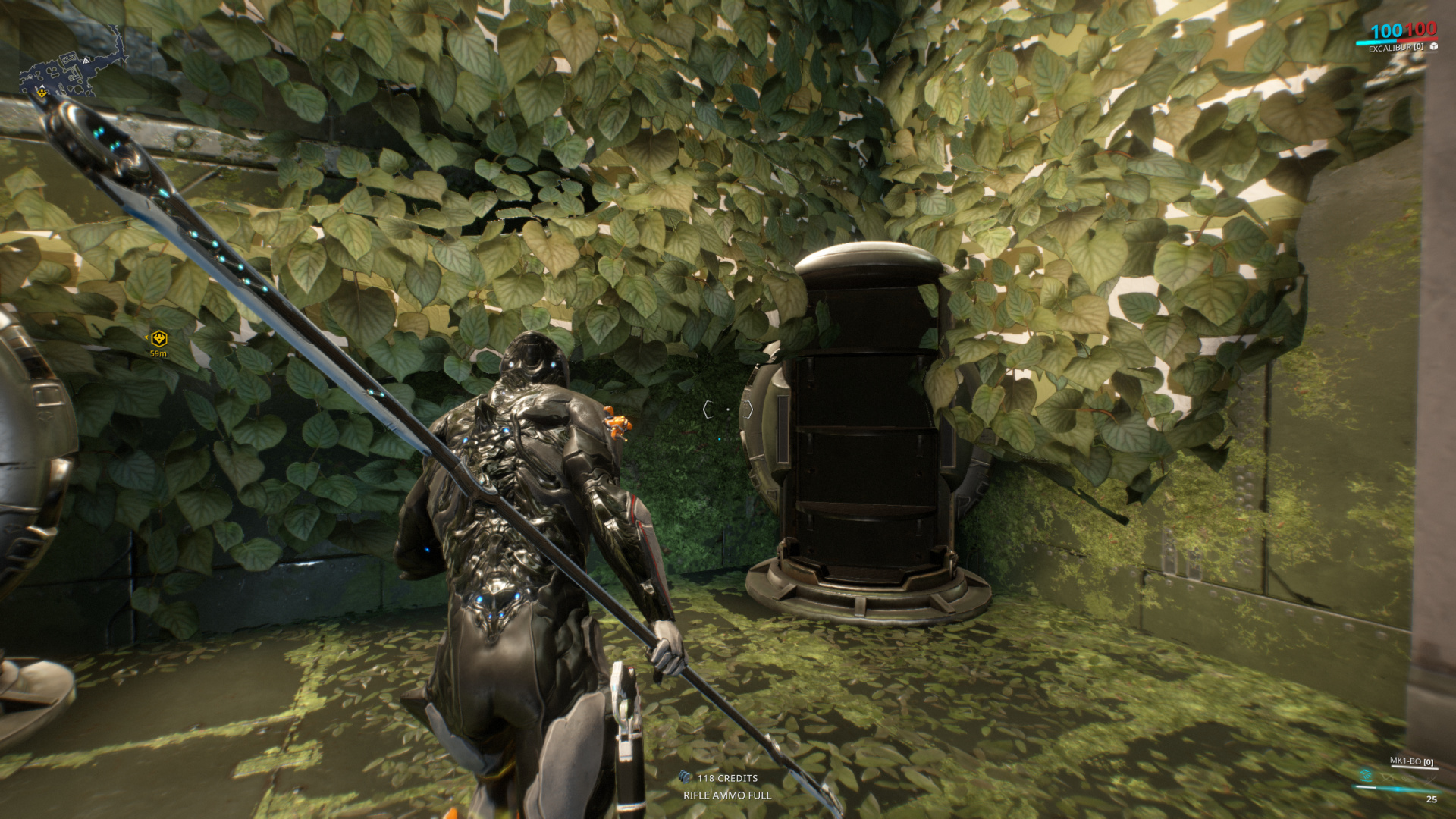 In-mission HUD. Shields (blue), health (red), energy (yellow), 4-ability bar (bottom-left), minimap, waypoint markers. Tile-set procedural levels under the action layer. Source: Game UI Database.
Movement is its own minigame
Crouch + jump = a directional bullet jump dash. Aim-glide, wall-latch, slide. Movement feels closer to Tribes / Quake than to most looter-shooters.
Combat that asks for fast movement plus big AoE plus power-fantasy abilities = a kinaesthetic pull most loot games don't have.
Three weapons + abilities
- Primary (rifle, bow, sniper, etc.).
- Secondary (pistols, throwing weapons).
- Melee (sword, hammer, polearm, gunblade, whip-claw, …).
- 4 frame abilities consuming Energy.
Cycle freely between them. Most missions reward switching, heavy gunners for crowd, melee for heat-wave room clears, abilities for boss debuff windows.
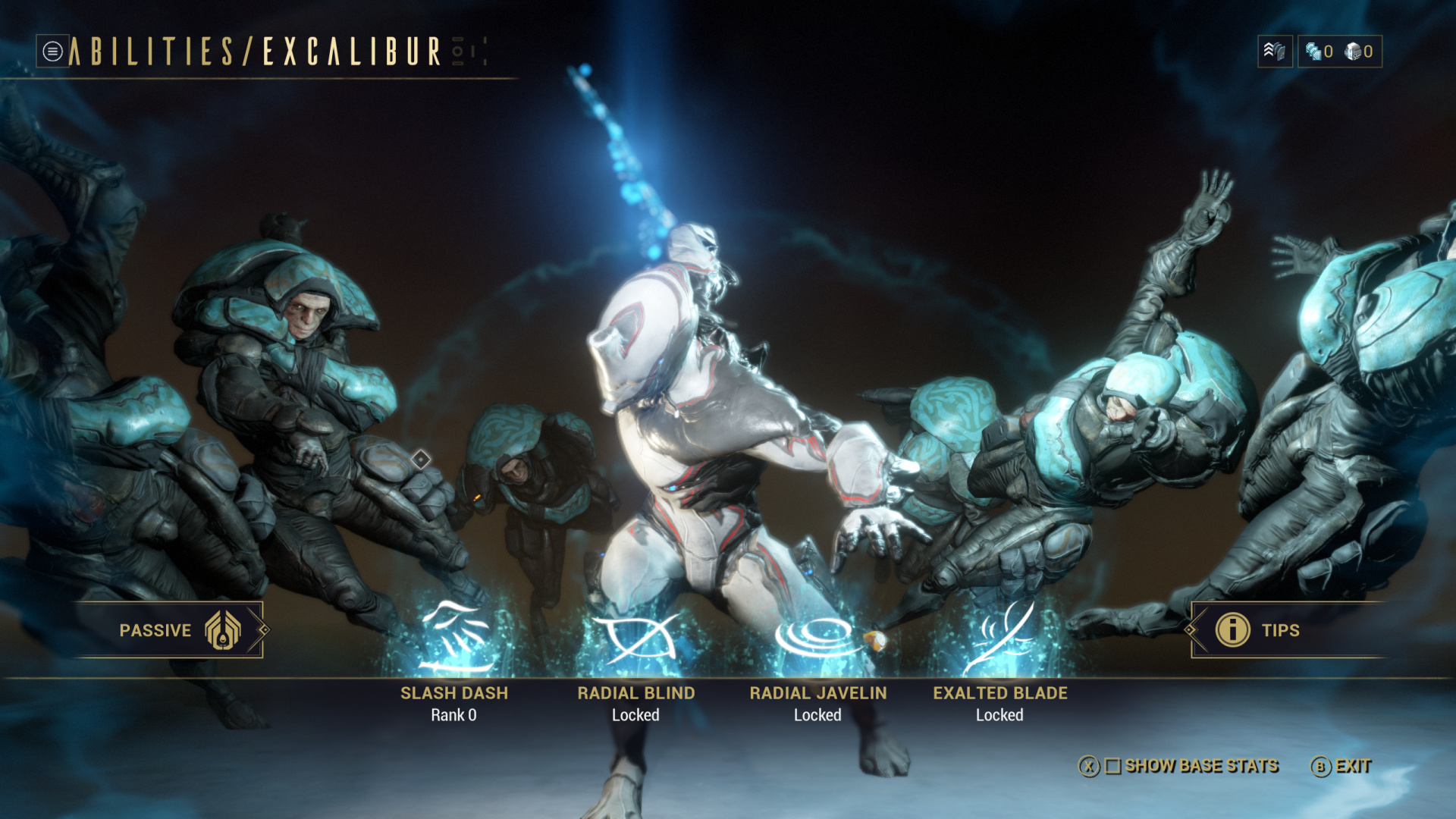 The 4-ability bar: every frame has exactly four. Excalibur shown: Slash Dash (mobility burst), Radial Blind (CC), Radial Javelin (AoE damage), Exalted Blade (channeled signature ult). Each ability has its own Energy cost and tactical role; ability order across frames is a hidden language ("4 is the ult, 1 is the cheap one"). Source: Game UI Database.
Damage type matrix
The actual combat-design depth lives here.
Physical damage types:
- Impact (best vs Shields)
- Puncture (best vs Armor)
- Slash (bleed status, ignores armor)
Elemental:
- Heat, Cold, Electric, Toxin
Combined elements (mix two basics):
- Heat + Cold = Blast
- Toxin + Cold = Viral (4× damage to Flesh)
- Toxin + Electric = Corrosive (strips Armor)
- Heat + Electric = Radiation (best vs Alloy Armor)
- Heat + Toxin = Gas
- Cold + Electric = Magnetic (best vs Shields)
Each enemy faction (Grineer / Corpus / Infested / Sentient / Murmur) has its own armor/flesh/shield distribution with rock-paper-scissors weaknesses.
Build crafting is partly choosing which elements to layer. A weapon with Toxin + Cold mods does Viral, ignores armor scaling, and demolishes Grineer flesh: but is mediocre against Corpus shields. So players carry multiple builds or pick the loadout per mission.
The depth isn't raw damage, it's damage type. See damage-type-matrix.
Status effects as build-defining tags
Each damage type has its own status effect:
- Slash → bleed (DoT, ignores armor).
- Heat → ignite (DoT + strips armor).
- Viral → 4× damage multiplier to flesh.
- Corrosive → strips armor stacks.
- Electric → chain damage + AoE proc.
Many builds chase a status not a damage number. "Slash priming" or "Viral spam" are recognized playstyles. The pattern: status effects become an alternative scaling axis to raw damage. Players tag a build by its status, not by its DPS.
See damage-archetype-via-tags (concept page TBD).
Tile-set procedural levels
Hand-authored tile-sets, procedurally connected.
The exact same trick Sparklite uses for its biomes, Warframe shipped it 6 years earlier. Mission types (Survival, Defense, Disruption, Capture, …) define objectives; tile-sets (Grineer asteroid, Corpus ship, Infested ship, Earth forest, …) define aesthetic and layout vocabulary. The procedural piece is which tiles get connected this run; the hand-crafted piece is what's inside each tile.
4-player co-op
Up to 4 players per mission. Enemy stats scale with player count. Friendly fire off. No PvP in core loop (Conclave exists but is largely abandoned).
The power fantasy intent is explicit. Maxed builds melt entire rooms, by design, but DE periodically nerfs frames whose room-clearing removes other players' ability to participate. Tension between "I'm a god" and "I'm part of a squad" is unresolved and likely permanent. See design tensions.
Patterns this exemplifies
damage-type-matrixhandcrafted-pcg-hybrid