Character kits
Six playable characters, and each one runs a different resource subsystem on top of the shared AP/parry chassis. This is the game's answer to "why keep playing new party members": a new character is not a stat block with different animations, it's a new mini-game. New kits keep arriving deep into the campaign, which gives the game some of the late-introduced-mechanics energy this site documents in Xenoblade.
Gustave: Overcharge
A 0–10 gauge on his prosthetic arm that charges from dealing damage, dodging, and parrying. His signature skill dumps the whole gauge as single-target Lightning damage that scales with charges spent. Support skills (Lumière Assault) generate extra charges on crits.
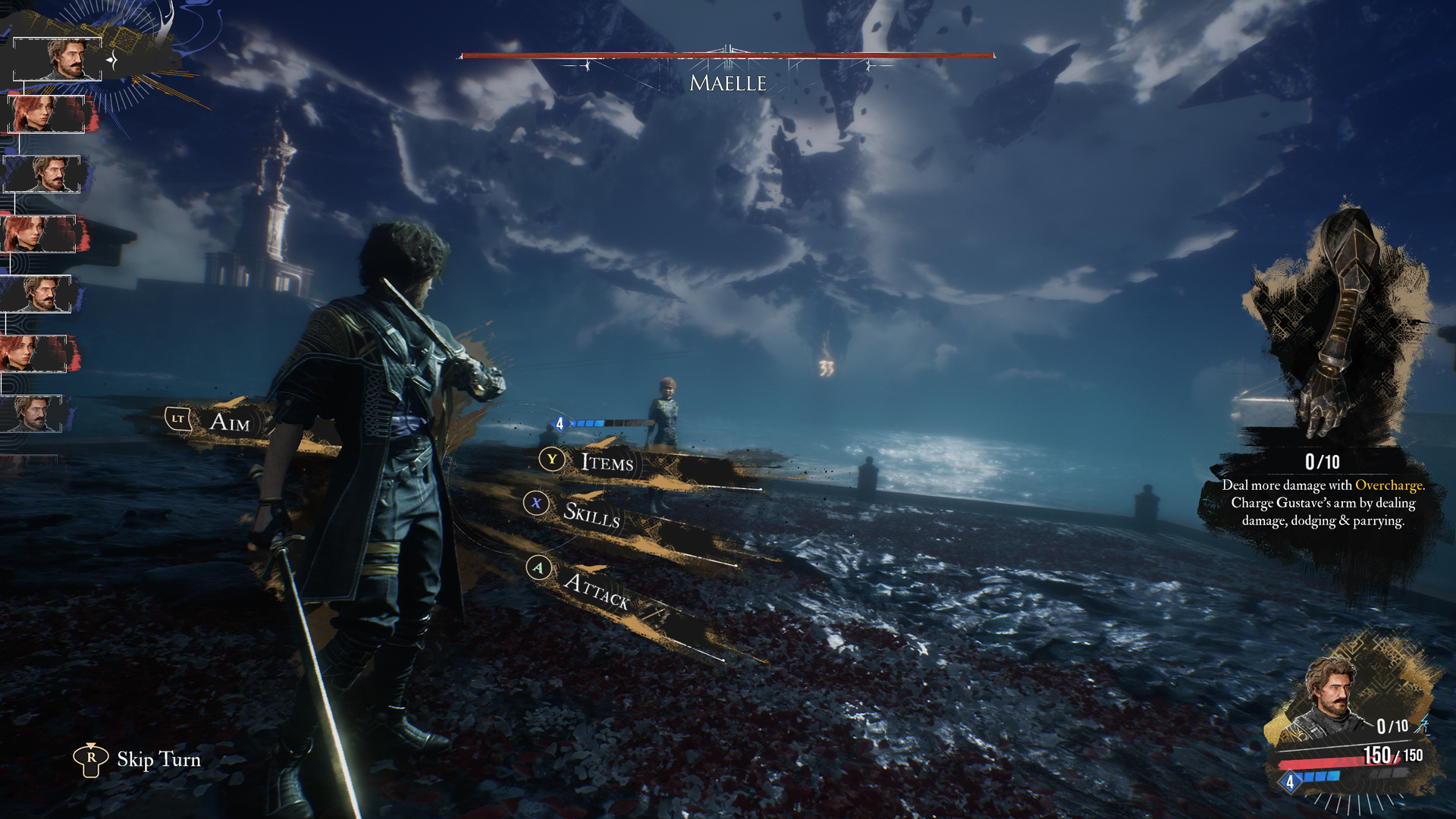 The arm on the right edge is the gauge. Playing defense well literally charges the payoff, the reactive layer feeding a character resource. Source: Game UI Database.
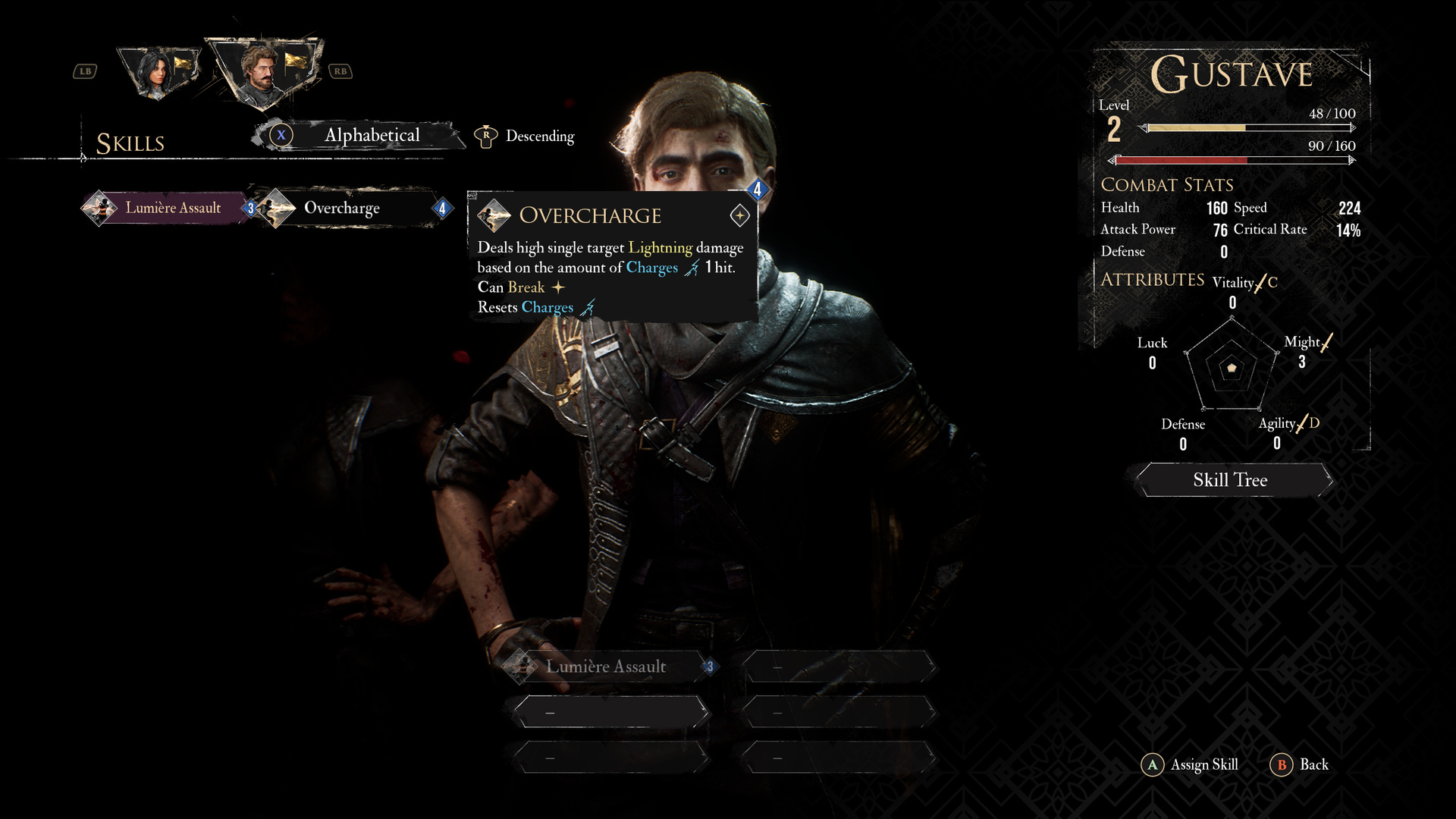 "Deals high single target Lightning damage based on the amount of Charges. Can Break. Resets Charges." One sentence, one build-around. Source: Game UI Database.
Lune: elemental Stains
Casting an elemental skill leaves behind a Stain of that element. Other skills consume Stains for amplified or altered effects; her tooltips read like a two-step combo language (Immolation: 3 Burns, 2 more if the target is Marked, "Consumes [Stain] for increased damage"). Playing Lune well means sequencing spells so each one sets up the next: a solitaire chain inside a party game.
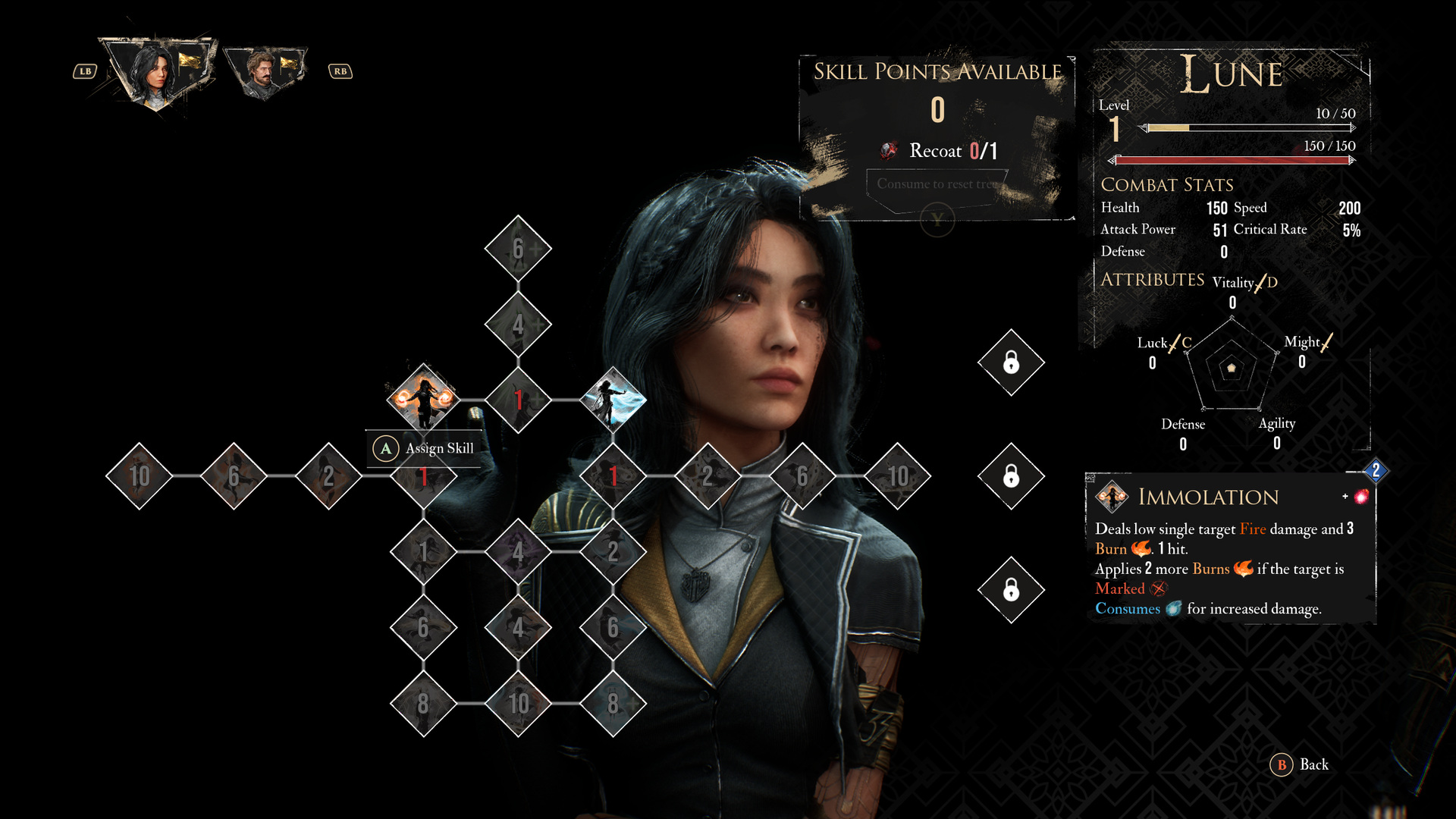 Immolation's full text shows the kit grammar: element, status, Mark synergy, Stain consumption. A post-launch patch added colorblind-friendly Stain icons, evidence the subsystem carried real cognitive load. Source: Game UI Database.
Maelle: fencing stances
Skills move her between stances: Offensive (hit harder), Defensive (take less, safer), and Virtuose, the payoff stance where her next skill deals multiplied damage (the community's endgame builds were built entirely around living in Virtuose). The kit plays like a rhythm of entering and cashing stances, and it produced both the game's most celebrated build ceiling and its most famous balance patch (the Stendhal one-shot; see design tensions).
Sciel: Foretell and Twilight
Her scythe skills stack Foretell on enemies, delayed damage that other skills then detonate. Alongside it runs a Sun/Moon charge cycle that, when both sides are filled, tips her into an empowered Twilight state. She is the "invest now, collect later" kit: damage as a futures contract.
Verso: Perfection ranks
A performance grade (D up to S) that climbs as he executes well: perfect parries and dodges, crits, clean play, and drops when he gets hit. Higher ranks empower his abilities. Verso grafts a fighting-game judge onto the party: his damage output is a direct readout of how well you are playing the reactive layer.
Monoco: the Bestial Wheel
The wildcard. Monoco learns his skills from defeated Nevron enemies (each drops its move for his roster) and gets no normal skill points at all. In battle, a wheel cycles through skill categories with every cast; skills matching the wheel's current segment fire empowered. He is a monster-collection subsystem and a tempo puzzle stacked together, and he joins late enough that learning him is a fresh mid-game chapter.
Why this works
- The chassis is shared. AP, parry timing, timed hits, Pictos and Luminas apply to everyone, so a new kit never resets your fundamentals.
- The kit is one sentence each. Charge a gauge; leave Stains; dance stances; stack Foretell; hold a grade; spin a wheel. Everything else in each kit elaborates its sentence.
- Kits point at different player skills. Verso rewards execution, Lune rewards sequencing, Sciel rewards planning, Maelle rewards commitment. Party selection becomes a statement about which game you want to play this fight.
Patterns this exemplifies
per-character-subsystem: each party member owns a private resource loop over a shared combat chassis.reactive-turn-based: several kits (Overcharge, Perfection) are direct readouts of defensive execution.