Path of Exile 2: The Endless Vault
Not a sequel, a parallel canvas. GGG kept PoE1 running with its own team and league cadence, then built PoE2 to revisit decisions PoE1 had drifted from. Combat slowed, screen-clearing meta walked back, weapons telling you how to play, one-death maps. The same Vision, re-rendered for a 2024 audience that had grown up on Souls games rather than 2012-era ARPGs.
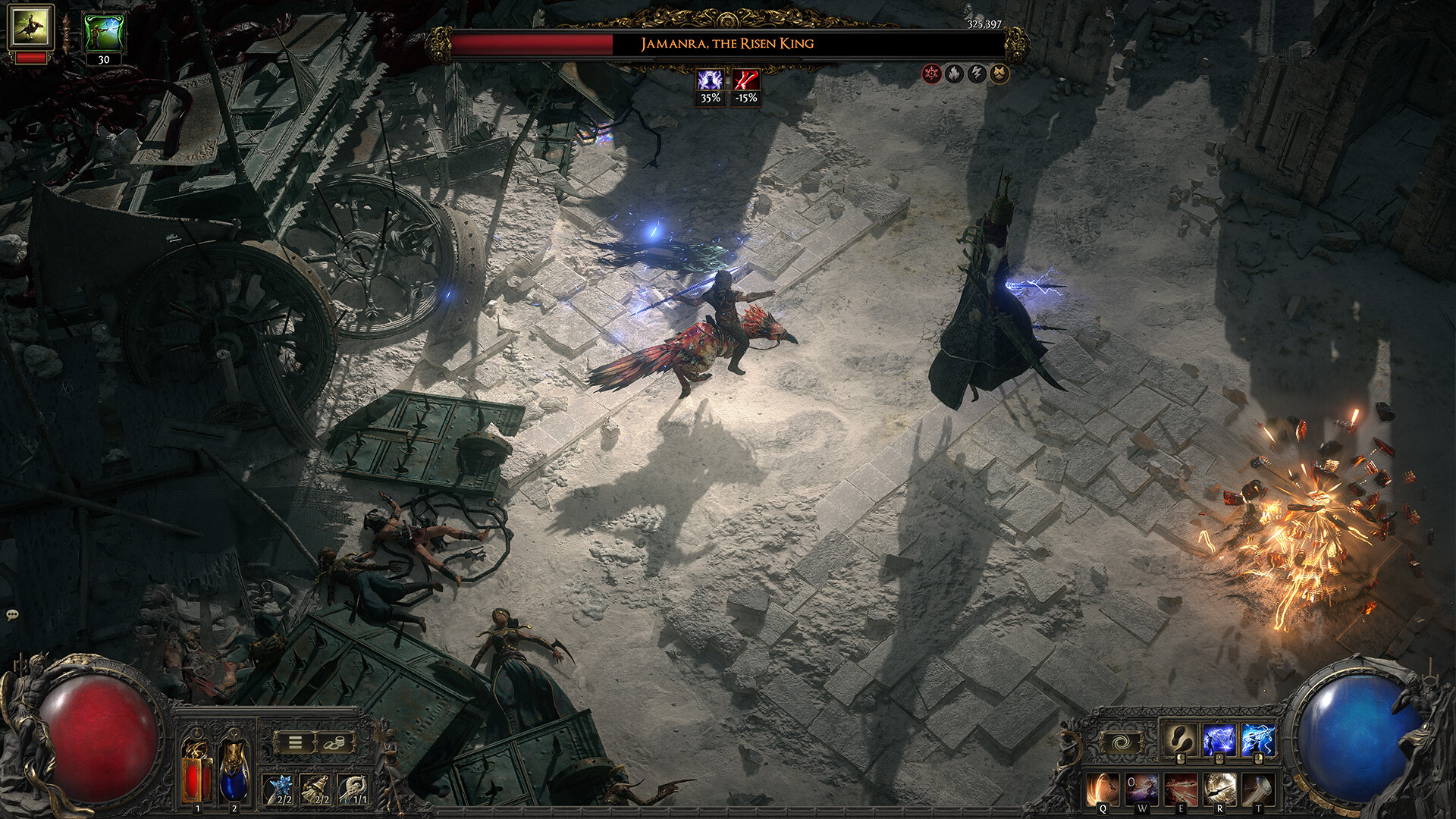 Jamanra, the Risen King: Act 2 boss, the canonical "PoE2 is harder than PoE1's campaign" benchmark for early-access players. Source: Steam.
Snapshot
| Studio | Grinding Gear Games |
| Released | December 6, 2024 (Early Access; 1.0 still pending as of April 2026) |
| Platforms | PC, PS5, Xbox |
| Run length | Campaign: ~25–40 hours skilled. Endgame map: ~5–15 min |
| Iconic mechanic | Slowed combat + weapon-grants-skills |
| Core dialectic | Re-litigating PoE1's drift toward speed-clearing |
| Business model | F2P (with PoE1's same Ethical-MTX stance: cosmetics + stash tabs only) |
| Sibling project | Path of Exile 1: still active, still gets leagues, treated by GGG as a parallel game not a predecessor |
Macro loop
Campaign (Acts 1–3 then Cruel, same acts, harder)
  → ~25–40 hours skilled
  → significantly harder bosses than PoE1's campaign
  → ascendancy via Trial of the Sekhemas (skill check) or Trial of Chaos (RNG)
  → Cruel difficulty replaces PoE1's old "three full playthroughs" structure
  → endgame unlock at end of Cruel Act 3
  → World Map (the Atlas equivalent), single contiguous map graph
    → maps are nodes on the map; complete to unlock adjacent
    → ONE attempt per map. Die → map gone, loot lost, atlas progression for that node lost.
    → no portals to reset; no "second try"
  ← death is permanent for that map
Mechanic deep-dives
- Combat philosophy: the slowdown, dodge roll, weapon-swap, the soulslike turn.
- Weapons grant skills: the major break with PoE1.
- Skill gem rework: uncut gems, unique-per-character supports, no 6-link.
- One-death maps: the controversial endgame stake.
- Crafting pulled back: what carried over, what was simplified, the bench is gone.
Through other lenses
- Ludonarrative reading: these mechanics read through the resonance lens. Verdict: split, combat layer reaches for resonance with the exile fiction; meta-loop stays orthogonal in PoE1's tradition. Deliberate partial-resonance.
What this game teaches
- Sequels can re-litigate. PoE2 is what GGG would do with PoE1's positioning if they got to start over with everything they've learned. It's not "PoE1 + new content": it's "PoE1's Vision, applied differently."
- Speed-meta drift is real, and walking it back is hard. PoE1 became a screen-clear simulator; PoE2 is GGG's surgical attempt to make individual encounters matter again. Mixed reception.
- One-death maps are a stake-restoration design choice with massive cost. EA reception is split: purists love it, casual players bounce off it. Worth its own concept.
- Weapons-grant-skills closes a build-space. PoE1's "any skill on any weapon" maximised player creativity and opacity. PoE2's "your weapon is your build" is more legible to new players but constrains theorycrafting.
- Parallel games as a design strategy. Rather than abandoning PoE1's audience to ship the new vision, GGG ran two games. This is unusual; the cost is split team focus, the benefit is no betrayal of either audience.
See lessons for the longer take.