Pokémon Ruby / Sapphire / Emerald (Generation III)
Game Freak's third-generation Pokémon games for Game Boy Advance, Ruby & Sapphire (2002 JP, 2003 EN) and the third-version revision Emerald (2004 JP, 2005 EN). The Hoenn region is, on its surface, a kids' adventure about catching 200 monsters and beating eight gym leaders. Underneath, it is the entry that finalised competitive Pokémon's math: Abilities, Natures, redesigned EVs, weather-as-ability, double battles, and held-item strategy all crystallised here. Everything modern Pokémon battling assumes was decided in this generation.
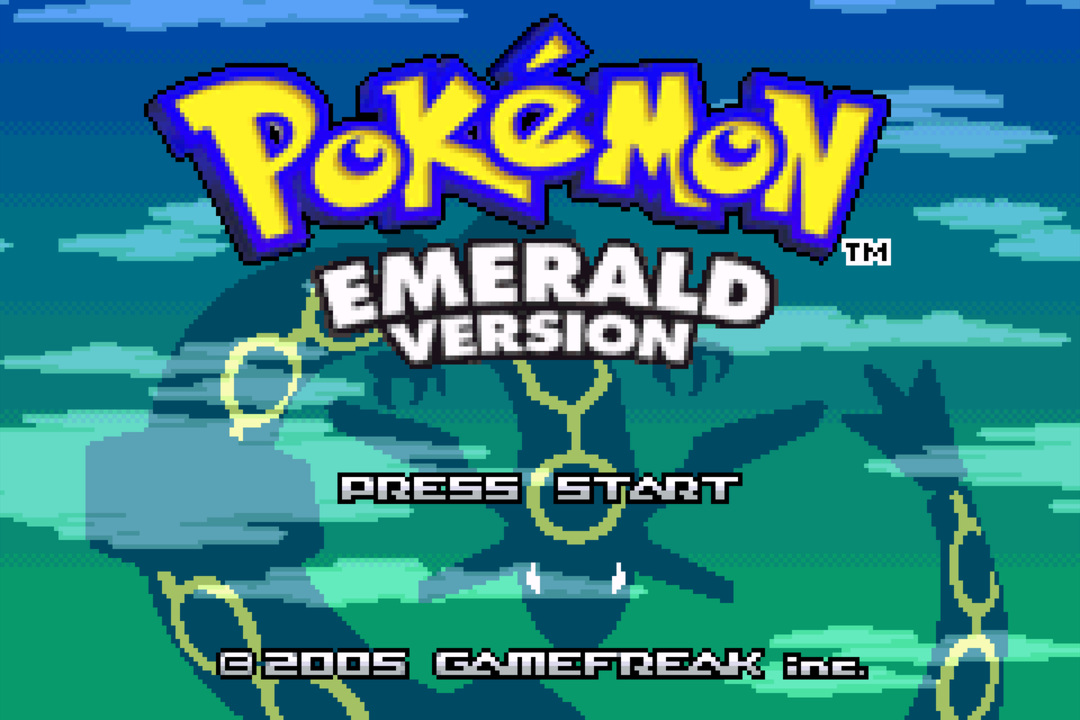 Pokémon Emerald: the canonical Gen 3 entry, published 2004 in Japan and 2005 worldwide. Rayquaza, the third legendary that mediates between Ruby's Groudon and Sapphire's Kyogre, is shown as a silhouette behind the logo. Source: Game UI Database.
Snapshot
| Studio / publisher | Game Freak (developer) · Nintendo / The Pokémon Company (publisher) |
| Director | Junichi Masuda: first directing job after composing the music for the previous five Pokémon games |
| Released | Ruby + Sapphire: Nov 2002 (JP) / Mar 2003 (EN) · Emerald: Sep 2004 (JP) / Apr-May 2005 (EN) · FireRed/LeafGreen (Gen 1 remakes on the same engine): Jan 2004 (JP) / Sep 2004 (EN) |
| Platform | Game Boy Advance (with Game Boy Player & GameCube link compatibility) |
| Genre | Monster-collector RPG; turn-based command battles; overworld JRPG with side-systems |
| Business model | Premium: two-version-exclusive cartridge ($30 each at launch) + "complete edition" Emerald 2 years later |
| Iconic mechanic | 17-type rock-paper-scissors × 4-move loadout × permanent stat profile (Nature + Ability + IVs + EVs) |
| Core dialectic | Math under cute: a six-axis stat optimisation sim packaged as a kids' adventure |
| Hours to credits | ~25h main story; ~50h with full Hoenn Pokédex; ~100h with Battle Frontier (Emerald only) |
| Region | Hoenn: Junichi Masuda's design based on Kyushu rotated 90°, a place his grandparents lived and he visited as a child |
| Sales | Ruby + Sapphire 16M+ · Emerald 7M+: among the best-selling GBA titles |
What's new in Gen 3 (vs Gen 1/2)
The defining-generation framing is earned. Gen 3 introduced almost every mechanic that defines competitive Pokémon as it exists today:
| New in Gen 3 | What it changed |
|---|---|
| Abilities | Each species has 1–2 possible Abilities: passive effects that fire on switch-in, on hit, on weather, etc. (Blaze, Levitate, Drought, Intimidate.) Now species-defining, not just stat blocks. |
| Natures | 25 fixed personalities (Adamant, Modest, Timid, etc.): each gives +10% to one stat / −10% to another, or is "neutral." Set at capture, permanent. |
| EVs reworked | Gen 1/2's "Stat Experience" (huge per-defeated-Pokémon gains) replaced with Effort Values capped at 252 per stat / 510 total, gained from specific opponents. Build commitment becomes finite and intentional. |
| IVs widened | Hidden per-stat genetic values went from 0–15 (Gen 1/2's "DVs") to 0–31, doubling the optimisation surface. |
| Weather as ability | Drought (Groudon), Drizzle (Kyogre), Sand Stream (Tyranitar): abilities that summon permanent weather that boosts one type and weakens another. The first time the world-state was a build choice. |
| Double Battles | Two Pokémon per side, simultaneously. Spread moves, redirection, ally-targeting: a second whole battle layer. |
| Held Items expanded | Choice Band, Leftovers, type-boost items, Berries that auto-trigger. Now a full sub-loadout. |
| Bag pockets | From 3 (Items / Key / Balls) to 5 (added TMs & HMs, Berries): itemisation became too dense for one bag. |
| Contests | Hoenn-signature side-system: Cool / Beauty / Cute / Smart / Tough categories, judged by a second attribute layer per move, fed by Pokéblocks. |
| Secret Bases | Find a marked tree/wall, use Secret Power, build a personal hideout you decorate over time. The first player-customised space in mainline Pokémon. |
| Battle Frontier (Emerald only) | Seven post-game challenge facilities: Tower, Dome, Palace, Arena, Factory, Pike, Pyramid: each with its own ruleset and Frontier Brain. The blueprint for every Pokémon endgame since. |
The four-game contrast, Gen 1 had types and 4 moves; Gen 2 added held items and weather; Gen 3 layered Abilities + Natures + redesigned EVs + Doubles on top, is what made Gen 3 the competitive math generation. It is the moment Pokémon stopped being a children's RPG with optional depth and became a depth game with a children's surface.
Macro loop
loop:
  enter route / town
  encounter wild Pokémon (random in tall grass, water, caves) OR trainer
  battle:
    pick from 4 moves × 6 party slots
    consider type matchup (17×17 chart) + Abilities + held Items + weather + status
  on win:
    earn EXP → Pokémon level up → stat growth (formula: base + IV + EV/4 + Nature × Level)
    sometimes unlock new move or evolve
  on loss:
    black out → wake at last Pokémon Center, lose half your money
  every 5–10h: gym leader fight → badge → unlocks (HM use, higher-level obedience, new area)
  endgame: Pokémon League (4 Elite Four + Champion) → credits
post-credits (Emerald):
  unlock Battle Frontier → 7 facilities × ~30h each
  side-systems: Contests → Pokéblock farming → Berry trees
  Secret Bases → decorate via mini-shop economy
  trade-only: dual-version + cross-region (Colosseum / FR/LG) → complete National Dex
Mechanic deep-dives
- Type chart + dual typing: the 17-type RPS matrix, immunities, and the dual-typing multiplication that makes Skarmory/Aggron a defensive fortress and Heracross a glass cannon.
- Stats: IVs + EVs + Natures + Abilities: the four-axis "permanent stat profile" added to every Pokémon. The math layer that turned competitive Pokémon into a real optimisation game.
- Weather, doubles, and held items: the global-modifier and side-loadout layers added over Gen 1's bare combat. Weather Wars, Drought Groudon, Choice Band Heracross.
- Two-version exclusivity + trade-as-content: the cartridge-pair business model and trade-only evolutions. Why every Pokémon game ships in two versions even now.
- Hoenn signature side-systems: Contests (Cool/Beauty/Cute/Smart/Tough), Secret Bases, Berry growing, and the Pokénav. Hoenn's "more verbs" design.
- Series evolution: R/S → Emerald: what the third version added (Battle Frontier, merged Magma/Aqua plot, animated sprites, refined gym leaders) and the third-version pattern this established.
Through other lenses
- Ludonarrative reading: these mechanics read through the resonance lens. Verdict: split, Hoenn-as-nature and starter-pick land hard; the optimisation math is honestly orthogonal to the "be a Pokémon trainer" fiction.
What this game teaches
- A 4-slot loadout is enough constraint to drive ten years of optimisation. The Pokémon moveset is the canonical
loadout-as-budgetat the smallest possible grain: 4 slots, hundreds of moves, type-tagged. Sparseness is the design. - Permanent unrolled stats turn a casual game into a build sim. Natures + Abilities + IVs + EVs aren't per-run (the run never ends): they are per-individual, immutable once set. So competitive players hatch hundreds of eggs to roll the right combination. The cost is the game.
- Two-version exclusivity is a 25-year-old monetisation pattern that still works. Trade is content. Sapphire owners cannot catch Groudon without a Ruby trader. The design forces a social network on a single-player game.
- A "third version" is a separate product. Emerald isn't a patch or a directors-cut DLC: it's a $30 cartridge, with new content, that sells to people who already own R/S. The blueprint Game Freak has reused for every gen since (Crystal, Emerald, Platinum, B2W2, USUM, etc.) until they shifted to dual-flagship-only in Gen 8+.
- The math layer can be deep without being visible. A casual player who never reads about IVs can complete Emerald comfortably. The optimisation tail exists for those who go looking. The right design move is not to surface the depth in onboarding.
See lessons.md for the longer take.
See also
- Design tensions: Masuda quotes on Hoenn-as-Kyushu, the "all new Pokémon" plan, and Battle Frontier's late conception
- Patterns: full pattern table
- Sources: bibliography