Acquisition pipeline
How do you get a Warframe? Five-day-real-time chain across multiple sub-systems. The structure repeats for most loot in the game.
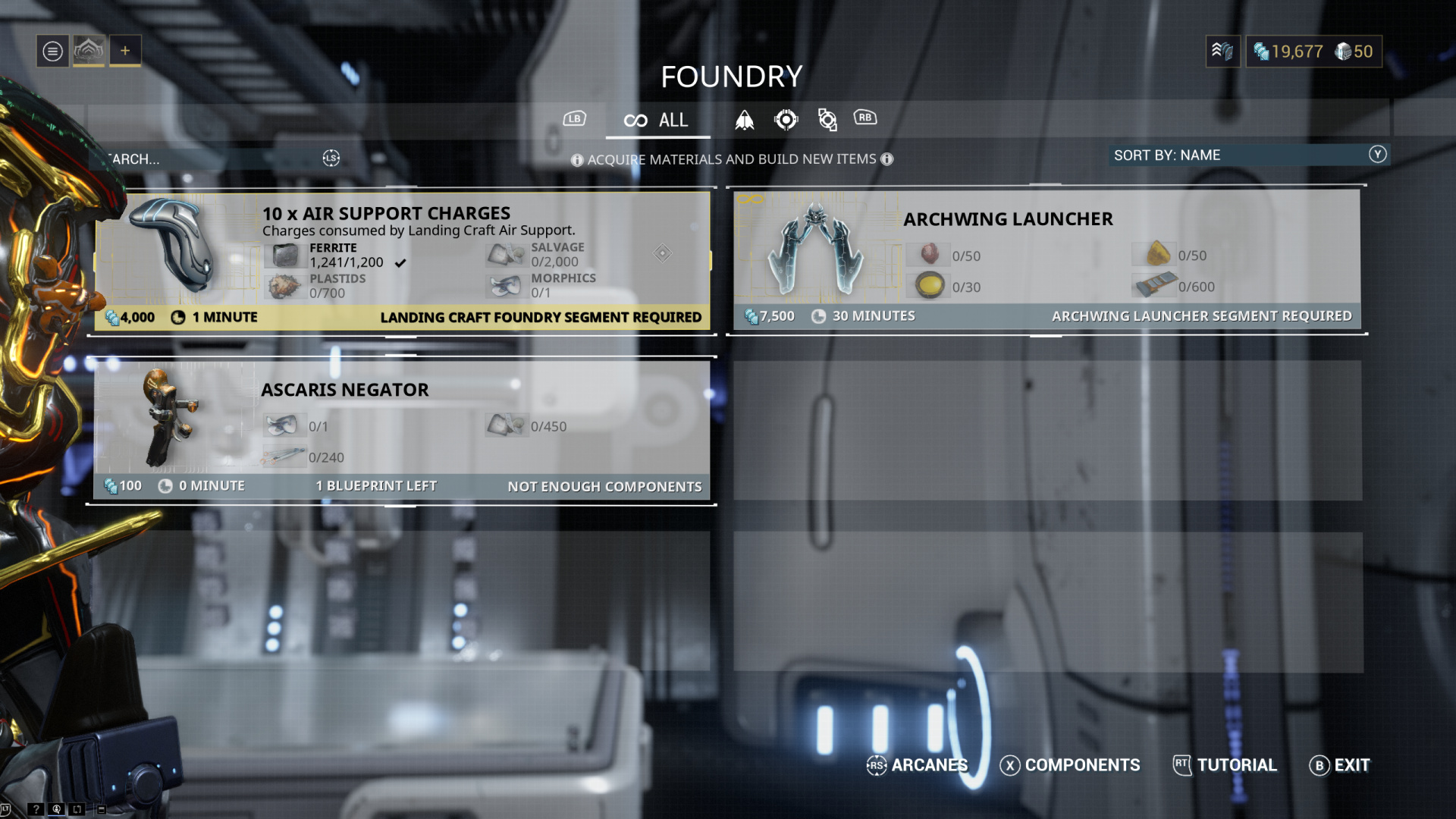 The Foundry. Three concurrent builds in different states: one ready to start (1 minute timer, all materials present), one gated on a segment unlock (which is itself a separate quest reward), one stalled on missing components. The whole acquisition pipeline routes through this screen: every Warframe, weapon, gadget, and upgrade resource passes through a Foundry queue with real-time timers. Source: Game UI Database.
A standard (non-Prime) frame
Every frame has four parts:
- Main blueprint
- Neuroptics (head)
- Chassis (body)
- Systems (organs)
Each acquired separately, each via a different RNG-gated path.
star-chart progression → unlock the planet
  → unlock the boss node
    → run the boss N times for RNG drops (typically 4 distinct drops needed)
      → buy main BP from Market for credits
        → submit all 4 to Foundry → 12h × 3 + 72h main = ~5 days real time
          → frame appears in inventory at rank 0
            → grind affinity in missions to rank 30
              → install Orokin Reactor (rare drop / 20 plat)
                → mod, polarize with Forma (1+ runs of 0→30 per Forma)
                  → fully built
That's not one task. It's a chain of tasks across multiple sub-systems, deliberately spread over real-world days. The chain is the design.
Prime frames: the Void Relic system
Prime variants replace the boss-drop step with a squad-driven Relic pipeline:
- Relics drop from specific mission types: Lith / Meso / Neo / Axi (early → late game tiers).
- Refine a relic with Void Traces (25 / 50 / 100) to bias drop rarity.
- Crack the relic in a Void Fissure mission (typically 4-player). Everyone's relic shows one drop; the squad picks one each.
- Each relic has 3 commons / 2 uncommons / 1 rare drop slot.
- A Prime frame's parts are scattered across multiple relics.
The squad mechanic is intentional: solo players grind harder, group players see each other's drops. And because Prime parts can be traded between players for Platinum, the entire Relic system is the supply side of Warframe's player-driven F2P economy. See /games/warframe/monetization.
Crafting timer as pacing
12h weapons / 12h parts / 72h frames. Bypassable with Platinum.
This timer does two jobs:
- Anti-rush pacing. You finish the boss but can't immediately use the reward. The dopamine spreads across days, and you keep playing while waiting because the next thing is also queued.
- Soft monetization. Impatient players pay Platinum to skip.
DE has openly walked the timer back over time. The Koumei release (2024) shipped with a 24h timer as an experiment, they're considering reducing 72h → 24h game-wide, suggesting they think the original timer is too long for the modern audience.
Vault rotation: the scarcity engine
After ~1–2 years, older Prime frames get vaulted, pulled out of the active relic pool. They can still be traded between players, but they can't be farmed fresh.
This drives both populations:
- Paying customers who buy Prime Access or Prime Vault bundles for instant access.
- Grinders who farm relics aggressively before vaulting (creating market scarcity later).
It also rotates the player base's attention to current content rather than letting old Primes dominate forever. See vault-rotation-economy.
Patterns this exemplifies
crafting-timer-as-pacingvault-rotation-economy