Ludonarrative reading
Applying the resonance lens: describe the loop without the fiction; does it still read as a story about these characters?
Verdict: affirms, densely. Expedition 33 is one of the tightest fits on this site between what the systems do and what the story claims. The premise: a godlike Paintress erases everyone of a given age each year, counting down; expeditions of the soon-to-die sail out to stop her, and all 67 before you have failed. Nearly every system restates that premise.
The systems are inherited from the dead
Describe the structure fictionlessly: you traverse hostile ground using rest points someone else placed, wearing equipment someone else carried, reading route notes someone else wrote, and when you die, the screen says the attempt failed, not that you did.
- Expedition flags, the bonfire equivalents, are planted by Expeditions 84, 81, 68... Your checkpoint infrastructure is the graveyard of prior runs.
- Pictos are salvage, frequently looted off battlefield corpses of earlier expeditions; the Lumina system then converts that salvage into permanent knowledge, mechanizing the game's stated theme ("we continue" as accumulation across failures).
- Expedition journals, the main collectible line, are the diaries of your predecessors dying along the exact route you're walking.
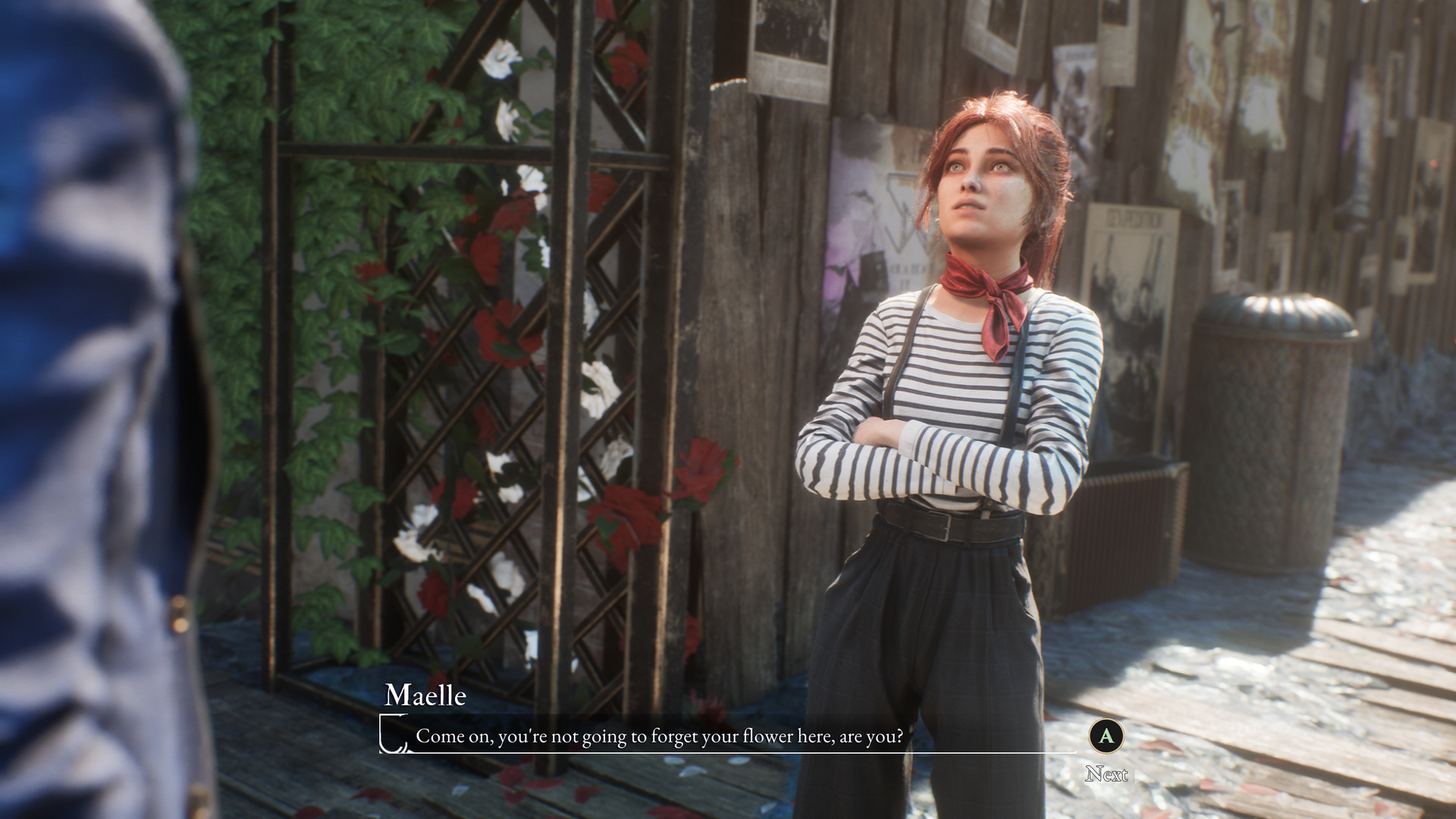 The prologue in Lumière is a festival on the day the Paintress erases everyone aged 34: petals fall, portraits of the erased line the walls, and the tutorial duel is a sparring match between two people who have a year left. The mechanics lessons and the premise arrive in the same scene. Source: Game UI Database.
Failure states speak in-world
A party wipe is "Expedition Failed", and the victory-screen continue button is "We Continue", the expedition motto. Death and persistence, the two poles of the roguelike-adjacent structure, are both named in the fiction's voice. Even the counter banner reads "Expedition 33 performs a Counter": the group, not the hero, is the protagonist unit.
The economy is made of paint
The systems vocabulary is a single extended metaphor: Chroma (currency), Chroma Catalysts (upgrades), Tints (potions), Recoat (respec), Luminas and Colour of Lumina (passives and their budget), a world with painted borders and a Paintress for an antagonist. This is the Battle Network move (fiction-as-mechanics with no translation step) executed in oils instead of software.
The strongest beat is structural
Mid-game, a protagonist dies permanently, and the kit you invested in leaves the party with him, replaced by a newcomer whose mechanics you must learn from scratch while the narrative is also about replacing him. Loss is delivered as a build event, not a cutscene: the game deletes your mastery to make you feel the plot. Very few games spend mechanical investment as narrative currency this directly (Nier: Automata's Ending E is the sibling case on this site).
The honest seams
- The reactive combat layer itself is resonant only loosely (expedition members parrying god-monsters with fencing sabers is genre logic, not theme), it affirms tone (desperation, precision) more than premise.
- The endgame break-the-game culture (billion-damage builds) runs directly against the fiction's fatalism, which the devs resolved by blessing it as player-chosen ("we still want you to be able to break the game").
One line for the concept index: the checkpoint system, the loot, the failure screen, and the respec menu all speak the premise; the game's grief plot is delivered partly as a forced kit deletion.