Hades
A two-game series from Supergiant Games: Hades (2020) and Hades II (2024 EA → 2025 1.0). The series's load-bearing innovation: dying advances the story. Each death triggers fresh dialogue from the gods, family, and mentors who can't help but comment on Zagreus's (or Melinoë's) ongoing escape, making the roguelite's defining failure state into the narrative engine.
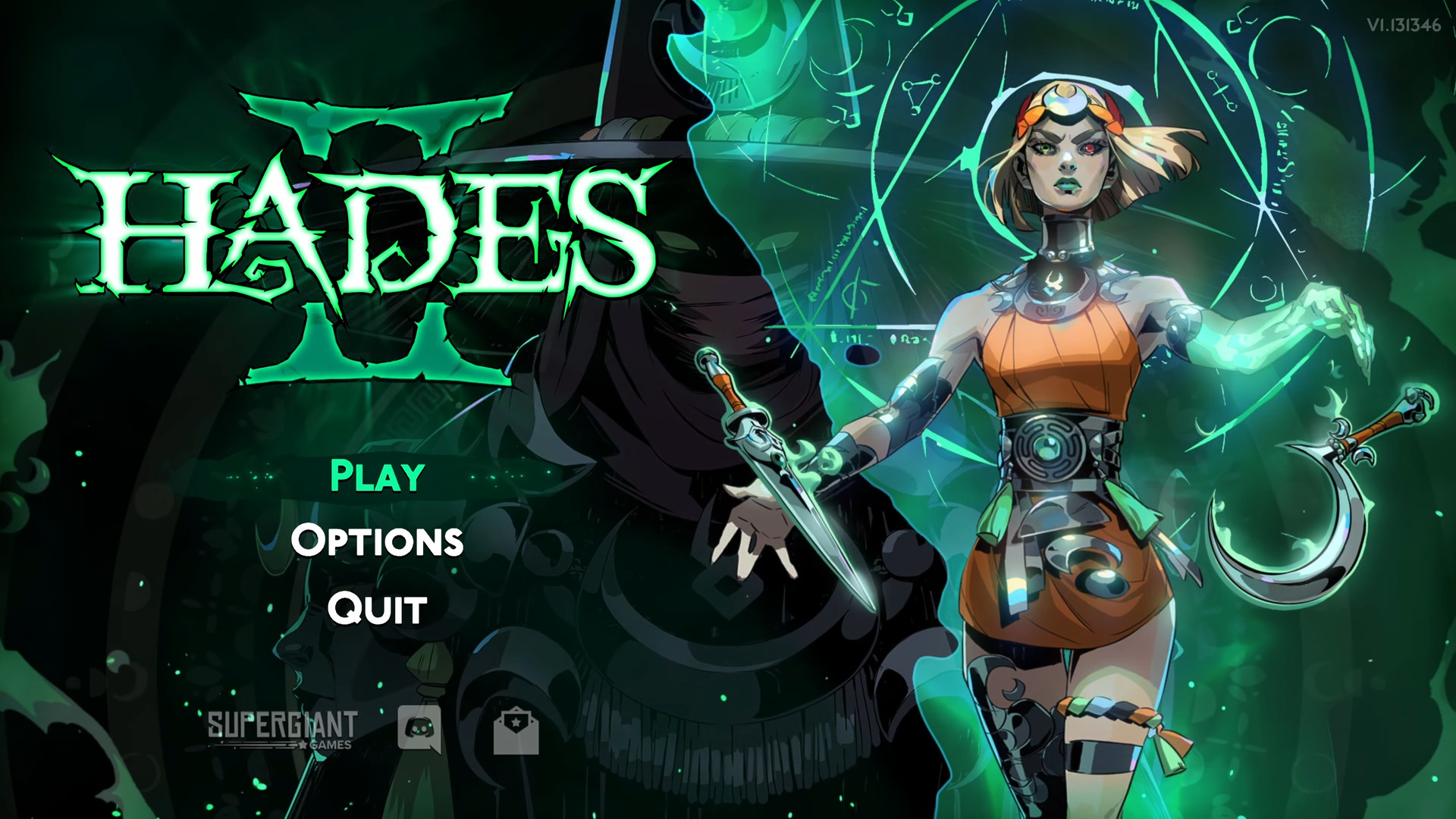 Hades II: Melinoë, princess of the underworld, on a quest to defeat Chronos. The series's signature visual style: hand-painted character portraits over moody pixel-painted environments. Source: Game UI Database.
Snapshot
| Studio / publisher | Supergiant Games |
| Series span | 2020 (Hades 1) → 2024 EA / 2025 1.0 (Hades II) |
| Genre | Action roguelite, isometric, single-player |
| Business model | Premium, single-purchase. EA period precedes 1.0 |
| Iconic mechanic | Pick-1-of-3 boon draft + dialogue advances per death |
| Core dialectic | Death as story progression vs. roguelite "lose the run" framing |
| Hours to credits | Hades 1 ≈ 30–40h to credits; ~80–100h to "true ending" |
The two entries
| Entry | Year | What's new |
|---|---|---|
| Hades | 2020 (EA from 2018) | The original. Zagreus's escape from the Underworld through 4 biomes (Tartarus → Asphodel → Elysium → Styx). Boons of the Olympian gods. Mirror of Night for meta-progression. Pact of Punishment for difficulty. Bounded campaign with a real ending. |
| Hades II | 2024 EA / 2025 1.0 | The sequel. Melinoë (Zagreus's sister) versus Chronos. Two paths instead of one (descent into Tartarus + ascent to Olympus). New systems: Magick resource, Cast/Hex spells, Arcana cards (replaces Mirror), 4 weapons each with Aspects, Crossroads hub instead of House of Hades. |
Macro loop (shared)
Crossroads / House hub: chat with characters, advance hub progression
  → pick a Nocturnal Arm (weapon)
  → step through the door → start a run
    → enter chamber → fight enemies → clear → pick a reward door
      → reward types: boon, magick, gold, hammer-upgrade, healing, urn
    → repeat ~12-20 chambers per biome
    → fight biome boss (Sisyphus → Megaera → Theseus → Hades, etc.)
    → next biome OR die
  → return to hub: dialogue advances based on what happened in the run
  → spend currency at Mirror / Arcana / Pact for next run
The return to hub step is the genre innovation. In most roguelites, dying = "try again". In Hades, dying = "what does Achilles say to me about how that run went?"
Mechanic deep-dives
- Boons & gods: pick-1-of-3 boon draft, ~12 Olympian gods, rarity tiers, duo boons, hammer rare upgrades.
- Chamber paths: branching DAG within each biome; the player picks the run's shape via reward-door icons.
- Death as narrative: the series's signature design innovation. Dialogue tracks per-character, advances per death, locks new lines behind run conditions.
- Meta-progression: Mirror of Night → Pact of Punishment (H1), Arcana grid + Resource Cards (H2). Variety unlocks > raw stat bumps.
- Series evolution (H1 → H2): what H2 adds: Magick, Cast/Hex, two paths, Arcana grid.
Through other lenses
- Ludonarrative reading: these mechanics read through the resonance lens. Verdict: affirms. Dying is how the plot moves.
What this game (series) teaches
- Failure-as-content. The death-resets-the-run loop is the genre default. Hades's contribution is making each reset narratively productive. Other roguelites should ask whether their failure state can become something the player wants to see.
- Boon draft = Spire-pattern transposed to action combat. Pick-1-of-3 with skip is Spire's draft language. Hades imports it intact and proves it generalizes outside deckbuilding.
- Hub-as-character-roster. The Crossroads / House of Hades is where the writing lives. Each NPC is a recurring conversation partner; their dialogue files are bigger than most JRPG side characters'. The hub structure makes that volume of writing encounterable in tiny doses.
- Bounded roguelite with a real ending. Hades 1 is unusual: it has credits, a "true ending" arc, and even an explicit finished state. Not infinite escalation.
See lessons.md for the longer take.