Map & node types
Each act is a procedurally generated DAG (directed acyclic graph) of nodes from bottom to top. The player picks a starting node from the bottom row and travels along connected paths, paths can branch and merge but never go down.
The iconic Spire map view (a vertical DAG of node icons) isn't yet captured locally, the Steam screenshot set doesn't include it. See the Slay the Spire wiki, Map Locations for examples until we have a local copy.
Seven node types
| Icon | Node | Reward |
|---|---|---|
| (sword) | Monster | 10–20 gold + card draft (3 cards, pick 1 or skip) + occasional potion |
| (skull) | Elite | A relic (always), 25–35 gold, card draft |
| (merchant) | Shop | Spend gold on cards, relics, potions, or remove a card from your deck |
| (campfire) | Rest Site | Choose: heal 30% max HP OR upgrade a card (some relics add other options) |
| (chest) | Treasure | Open a chest, get a relic |
| ? | Event | Flavor + decision; often a real cost-benefit. May resolve as Monster/Shop/Treasure |
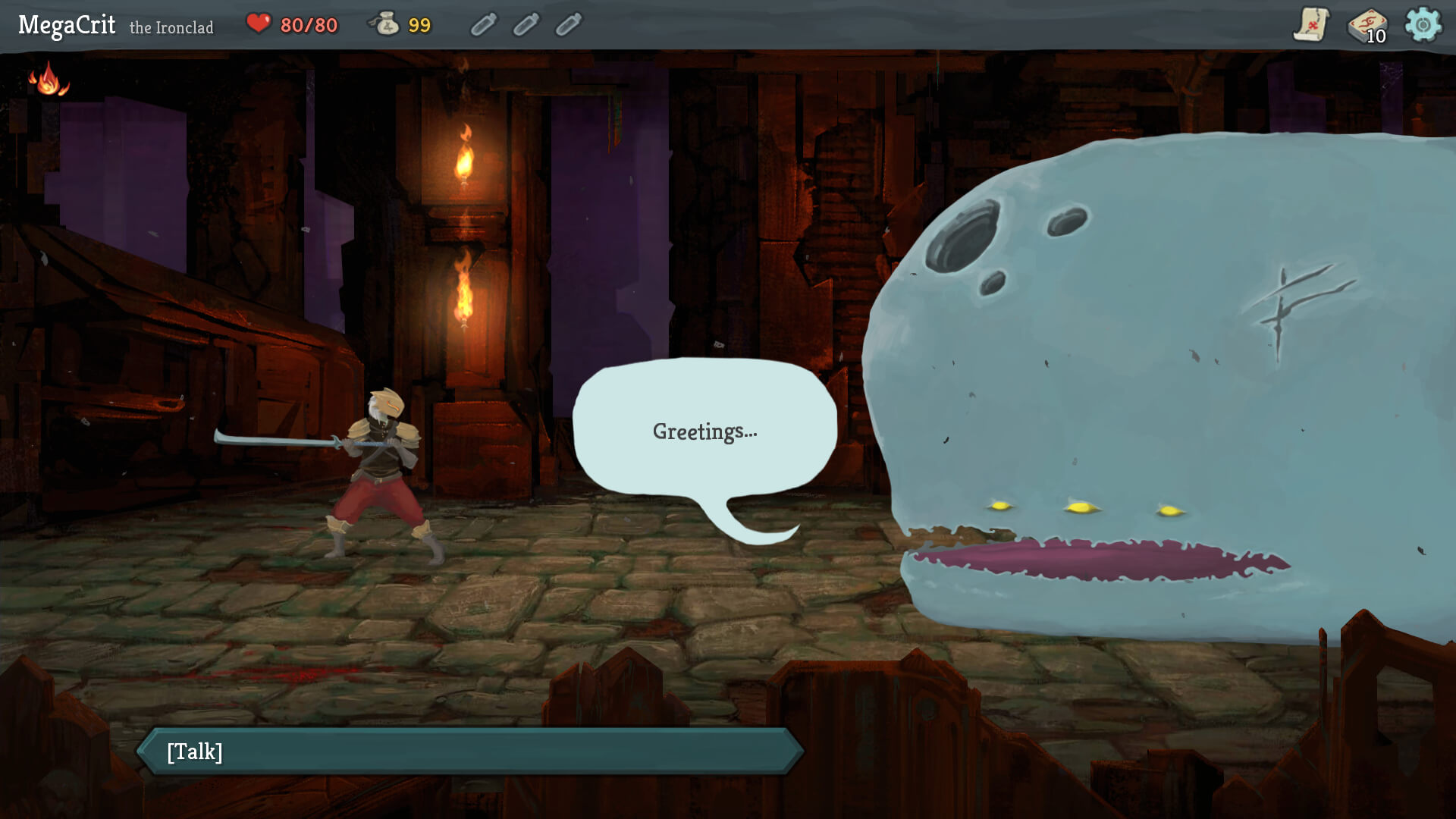 An Event encounter ("Greetings..."): these are hand-authored narrative beats with branching choices, scattered procedurally across the map. Source: Steam. | (crown) | Boss | Choice of 3 rare cards + 3 boss relics |
Why the map is the load-bearing mechanic
The map is the meta-decision layer that wraps the combat layer. Every node-choice is a small risk/reward call:
- Take an Elite for the relic, but burn HP/cards.
- Skip a Rest to hit a Shop, but you can't smith that key card.
- Cross over to a Treasure, but lose a Monster fight you needed for gold.
Critically: paths are partially-visible from the start of the act, so the player plans the shape of the run before the first fight. This is what makes Spire feel strategic across runs of similar enemies. The map turns "random encounters" into "chosen sequences of risks."
See branching-dag-map.
Procedural generation rules
(Paraphrased from wiki + the arxiv analysis paper.)
- 15 floors per act, plus the boss.
- 6 starting nodes, 1 boss at the top.
- Edges generated to form a DAG with branching/merging.
- Distribution of node types is partly fixed, partly randomized within constraints.
- Floor 6 in Act 1 is always a Treasure.
- Floor 9 in Act 1 is always a Rest Site.
- First 4 floors never have an Elite.
This is a clean handcrafted-PCG hybrid: the positions of certain key node types are fixed; the layout connecting them is procedural. Same trick Sparklite uses for biome layout, same trick Warframe uses for tile-set assembly. See handcrafted-pcg-hybrid.
Anti-streak RNG
The "?" Unknown nodes have a dynamic resolution table: the longer it's been since you saw an Event, the higher the chance the next "?" is an Event. When it resolves as Event, the counter resets.
That's a great example of anti-streak RNG. Pure randomness would produce stretches of "all events" or "no events ever." Spire biases against feel-bad runs without lying to the player. Same pattern shows up in card-reward rarity (see deckbuilding).
See pity-system-anti-streak.
Patterns this exemplifies
branching-dag-mappity-system-anti-streakhandcrafted-pcg-hybrid