Through the ludonarrative resonance lens
A reading of Path of Exile's loop through the ludonarrative resonance lens, does what the player does affirm what the game says it's about?
Mechanic read: the loot / skill-gem / passive tree / Atlas of Worlds loop.
Verdict: Orthogonal, and that's the right call. The fiction doesn't tell the story the loop is telling; the loop tells a different story (optimisation, market, mastery), and PoE is honest about that.
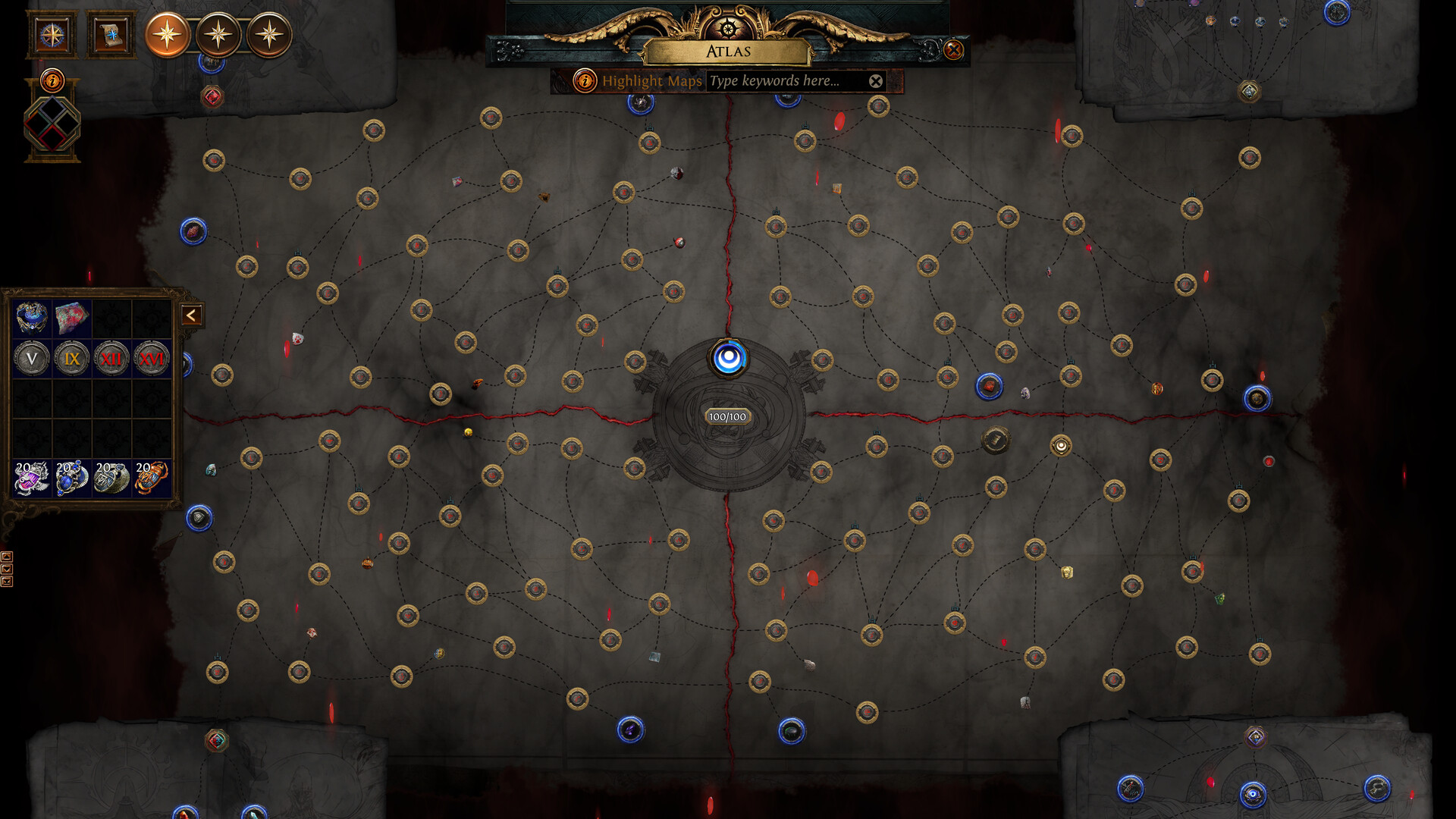 The Atlas: a meta-progression surface of ~700 map nodes layered on top of the ~1500-node character passive tree. Beautiful. Almost entirely silent on Wraeclast. Source: Steam.
What the fiction is
Wraeclast has setting: a continent of exiles, a buried Vaal civilisation, gods that may or may not be back, named ten-act villains. There is voice-acting. There are story acts. None of it is what makes Path of Exile work, and none of it is what players come back for after their thousandth hour.
What players come back for is the optimisation surface: 1500 passive nodes; multi-axis affix rolls; currency-as-crafting where every "currency" item is a verb on item state; the Atlas tree as a meta-progression on map drops; league mechanics stacking each three months.
Why orthogonality is honest, not lazy
The lens is descriptive, not prescriptive. Saying PoE's loop is orthogonal to its fiction isn't a complaint, it's a correct read of what the game is for.
Three signs of honest orthogonality:
- Story acts are skippable. Players have been able to ignore plot beats since the first ten acts shipped. GGG knows the loop is the product; story is service.
- Lore is opt-in cipher. Forsaken Masters dialogue, hidden lore tablets, cryptic environmental detail. Players who want the lore can dig for it; players who don't never have to.
- The optimisation surface is the marketing. League launches are pitched on what math is new. New skill gems, new map mods, new currency. Trailers show numbers go bigger. Compare to a game that ships a thirty-minute opening cutscene about themes its loop will never touch.
Why forcing resonance here would weaken the game
Imagine a redesign that tried to fix the "dissonance" between exile narrative and loot loop. Two paths:
- Bend the math toward narrative. Drop the trade economy because exiles wouldn't have a currency market. Cap the passive tree because wandering exiles wouldn't have time to optimise. Result: a worse loot game.
- Bend the fiction toward the math. Rewrite Wraeclast as an explicit optimisation arena, no exile pretext. Result: lose what little flavour the world has, gain nothing the players were asking for.
Either move trades a strength for nothing. The orthogonality is doing real work, it lets the loop be ruthless about its own logic without owing the fiction concessions.
What the lens diagnoses here
The diagnostic question is describe the loop without the fiction; does it still read as a story about this character?
For PoE: no, and that's by design. "You roll items, optimise a passive tree, run procedurally-generated maps, sell currency in a player market" describes the whole gameplay experience without ever referencing exile, Wraeclast, or any character. The fiction is separable, and that's a feature, not a flaw.
Compare this to the failure mode the lens should condemn: a game whose marketing claims it's about something thematically heavy, whose loop describes a different and lighter thing entirely, but which keeps insisting via cutscene that the loop is the heavy thing. PoE doesn't do that. It tells you in act 1 that you're going to be doing math, and the next 1000 hours are math.
Why this game appears in the lens at all
A lens that only collects "examples of resonance" turns into a hall of fame and stops being a tool. Including a correctly orthogonal entry, and refusing to call it bad design, is what keeps the lens diagnostic instead of moralising.
See also
- Mechanic pages: Passive tree, Atlas of Worlds, Trade & economy
- Lens (overview): Ludonarrative resonance
- Adjacent pattern:
vision-driven-iteration: GGG's design philosophy is explicit that the loop is the product.