Stats: IVs + EVs + Natures + Abilities
Gen 3 is the generation where competitive Pokémon's math was finalised. Every individual Pokémon now has a permanent stat profile assembled from four orthogonal layers:
| Layer | What it does | When set | Visibility |
|---|---|---|---|
| Base stats | The species' baseline in each of 6 stats (HP, Atk, Def, SpA, SpD, Spe) | Fixed at species design time: Charizard is Charizard | Pokédex entry |
| IVs (Individual Values) | Hidden 0–31 per stat: genetic variation within a species | At capture / hatch: random | Hidden until much later in the series |
| EVs (Effort Values) | 0–252 per stat, max 510 total: earned by defeating opponents | Accumulates through play, capped | Hidden: visible only via in-game judges |
| Nature | One of 25; gives +10% to one stat / −10% to another (or neutral) | At capture / hatch: random | Visible on Trainer Memo |
| Ability | Passive effect (Blaze, Levitate, Drought, etc.) | Random between species' 1–2 options at capture | Visible on Pokémon Info screen |
The combination produces a profile that is fixed for that individual Pokémon and very rarely manipulable after the fact. The Pokémon you have is the Pokémon you have.
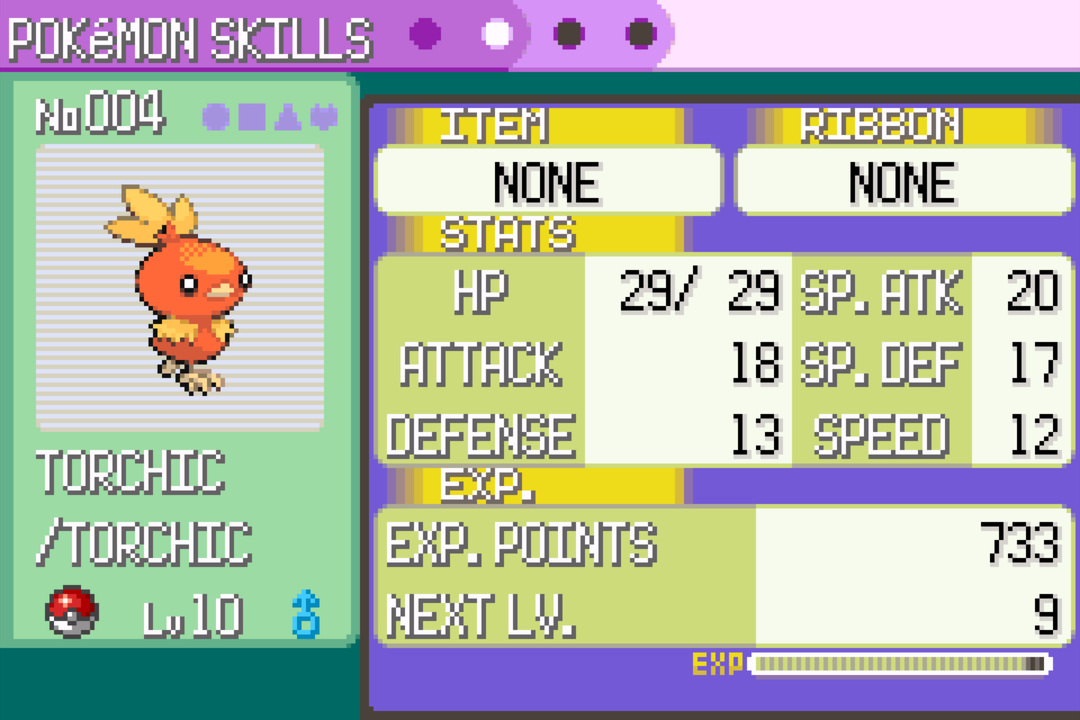 The visible stat panel: six stats, integer values, current/max HP. Behind these numbers, four hidden layers (Base + IV + EV + Nature) determined the result. The player sees the final number; only competitive players go looking for the layers underneath. Source: Game UI Database.
The stat formula
Each stat is computed:
Stat = floor((2 × Base + IV + EV/4) × Level / 100) + Level + 10   (HP)
Stat = floor((2 × Base + IV + EV/4) × Level / 100 + 5) × Nature   (others)
So at Lv 100:
- A 31-IV vs 0-IV difference: up to 31 stat points.
- A maxed 252-EV stat vs 0-EV: up to 63 stat points.
- A +10% Nature: up to ~30 stat points depending on base.
Total: a "perfect IV / max EV / +Nature" Pokémon can have ~125 more in one stat than a "trash IV / 0 EV / −Nature" one. This is the gap that motivates competitive breeding.
Abilities: the species-defining layer
 The Gen 3 signature shot. Type, Ability, and Nature are all introduced here on one screen. Each one is set at capture and effectively unchangeable. Source: Game UI Database.
Abilities are passive effects that fire automatically. Most species have two possible Abilities, and the one a specific Pokémon has is rolled when it's caught. Three categories:
- Stat-modifiers: Huge Power (doubles Attack), Pure Power, Marvel Scale (1.5× Defense when statused), Guts (1.5× Attack when statused).
- Status-immunities: Levitate (Ground immunity), Water Absorb, Volt Absorb, Flash Fire, Lightning Rod.
- Effect-on-event: Intimidate (drops opponent's Attack on switch-in), Sturdy (survives KO from full HP), Rough Skin (returns damage on contact).
The most important Gen 3 abilities are the weather summoners:
- Drought (Groudon): summons permanent sun → Fire moves 1.5×, Water moves 0.5×.
- Drizzle (Kyogre): summons permanent rain → Water 1.5×, Fire 0.5%.
- Sand Stream (Tyranitar): summons permanent sand → Rock SpD +50%, all non-Rock/Ground/Steel take chip damage.
These changed competitive Pokémon overnight. Weather Wars, the multi-year competitive era of teams built around one of these abilities, started in Gen 3 and dominated through Gen 6. See weather-and-battle-modifiers.
Natures: the cute drawback
There are 25 natures in a 5×5 grid:
| Nature | +10% | −10% |
|---|---|---|
| Adamant | Attack | Sp.Atk |
| Modest | Sp.Atk | Attack |
| Jolly | Speed | Sp.Atk |
| Timid | Speed | Attack |
| Bold | Defense | Attack |
| Calm | Sp.Def | Attack |
| Impish | Defense | Sp.Atk |
| Careful | Sp.Def | Sp.Atk |
| Hardy / Docile / Bashful / Quirky / Serious | (neutral) | (neutral) |
Five natures are neutral; the other twenty trade. The trade is small, ~10% in one stat for −10% in another, but on a stat that's already been maximised by IVs and EVs, it's the difference between out-speeding an opponent or being outsped.
Functionally, each Pokémon's nature is bonus-with-drawback baked in at the individual level. A Modest Charizard is a special attacker; an Adamant Charizard is a physical attacker; the same species plays differently depending on which one you caught. And you can only catch one nature at a time.
The player-facing UI shows the nature explicitly ("SASSY nature") on the Trainer Memo. The +/- mapping is not shown in-game. The competitive community had to reverse-engineer the nature chart from leaks and testing, a formative moment in the still-young competitive scene.
EVs: the only accumulated layer
EVs are the only piece of this profile that's not random at capture. They accumulate through play:
- Defeat a Zubat → +1 Speed EV.
- Defeat a Tentacruel → +2 Sp.Def EV.
- Defeat a Geodude → +1 Defense EV.
- (Each species awards specific EVs to specific stats, on a fixed table.)
So where you grind matters. A casual player who levels their Charizard against random encounters ends up with a Charizard with chaotic EVs (some Atk from Mankeys, some HP from Wooper, some Speed from Zubat). A competitive player goes to Route 113 to fight Slugmas (+1 Sp.Atk per kill) for ~250 kills to max out one stat.
The cap is 252 per stat / 510 total, so the optimal allocation is 252 + 252 + 6 across two priority stats. The 6-EV "leftover" is a famous edge case that competitive players spend on a third stat for tiny benchmarks.
This is loadout-as-budget operating on the individual level: 510 EVs is the budget, six stats are the slots, the player decides where to spend.
The 4-move slot: the visible loadout
At any time, a Pokémon knows at most 4 moves. Pokémon have a learnset (~30+ moves over their lifetime), but only 4 are equipped. Adding a 5th means forgetting an existing move, permanently.
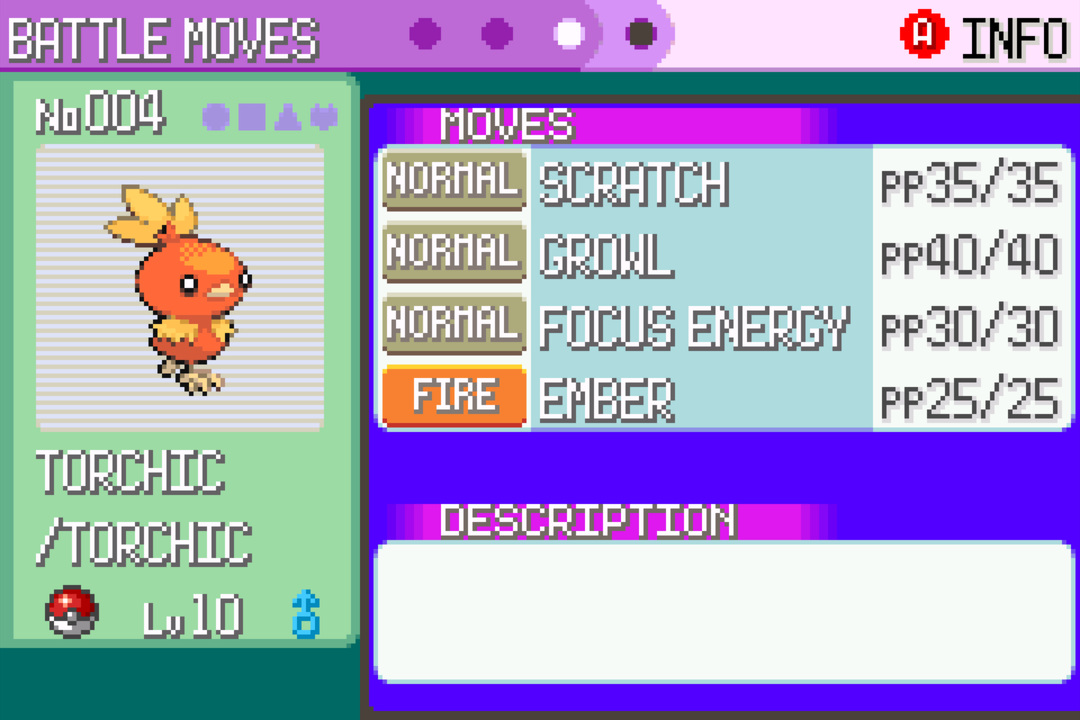 The 4-slot moveset is the most visible loadout-as-budget in the franchise. PP (Power Points) is a per-move use limit: strong moves have low PP. Source: Game UI Database.
The 4-slot constraint is the most-felt ongoing decision. Every level-up that offers a new move forces a real trade: drop coverage, drop status, drop a finisher, or skip the new move. This is why moveset advice is a core competitive activity, every Pokémon's "set" is a 4-move recipe.
It is also one of the cleanest examples of loadout-as-budget at the smallest possible grain: 4 slots, hundreds of moves, type-tagged. The constraint is the design.
What this teaches
- A permanent profile per individual is a 25-year-old design that still works. Every modern monster-collector copies this template. The trick is the unalterability: re-rolling means starting over with that creature, which is a cost players will absorb when the upside is a build that beats theirs.
- Hidden layers reward the curious without punishing the casual. A child can finish Emerald with no awareness of IVs or EVs. A competitive player obsesses. The game scales smoothly between modes because the depth is invisible unless sought.
- A 4-slot loadout is enough. Pokémon's 4-move limit has not been raised in 27 years. The constraint is what makes coverage interesting.
- Natures are a clean version of
bonus-with-drawback. +10% / −10% is small enough to feel like personality and big enough to matter at the top end. The bilingual phrasing as a personality trait ("Sassy nature") softens what is, mechanically, a stat tradeoff.
Patterns this exemplifies
permanent-stat-profile: the four immutable layers per individual. Uncurated; canonical case in this knowledge base.bonus-with-drawback: Natures (+10%/−10%) and Choice items (boost one stat, lock to one move) are explicit. Most Abilities are pure upside; some are tradeoffs (Slow Start, Truant).loadout-as-budget: at two grains: the 4-move moveset (per Pokémon) and the 510 EVs across 6 stats (per Pokémon). Both produce real opportunity cost.