Series evolution: Hades 1 to Hades 2
Hades II is not a sequel that walks the prior game's formula back. It iterates. The core run-loop, dialogue trigger system, and god-boon draft all transfer directly. What Hades II adds: a Magick resource, two run paths, the Arcana grid, and a new cast.
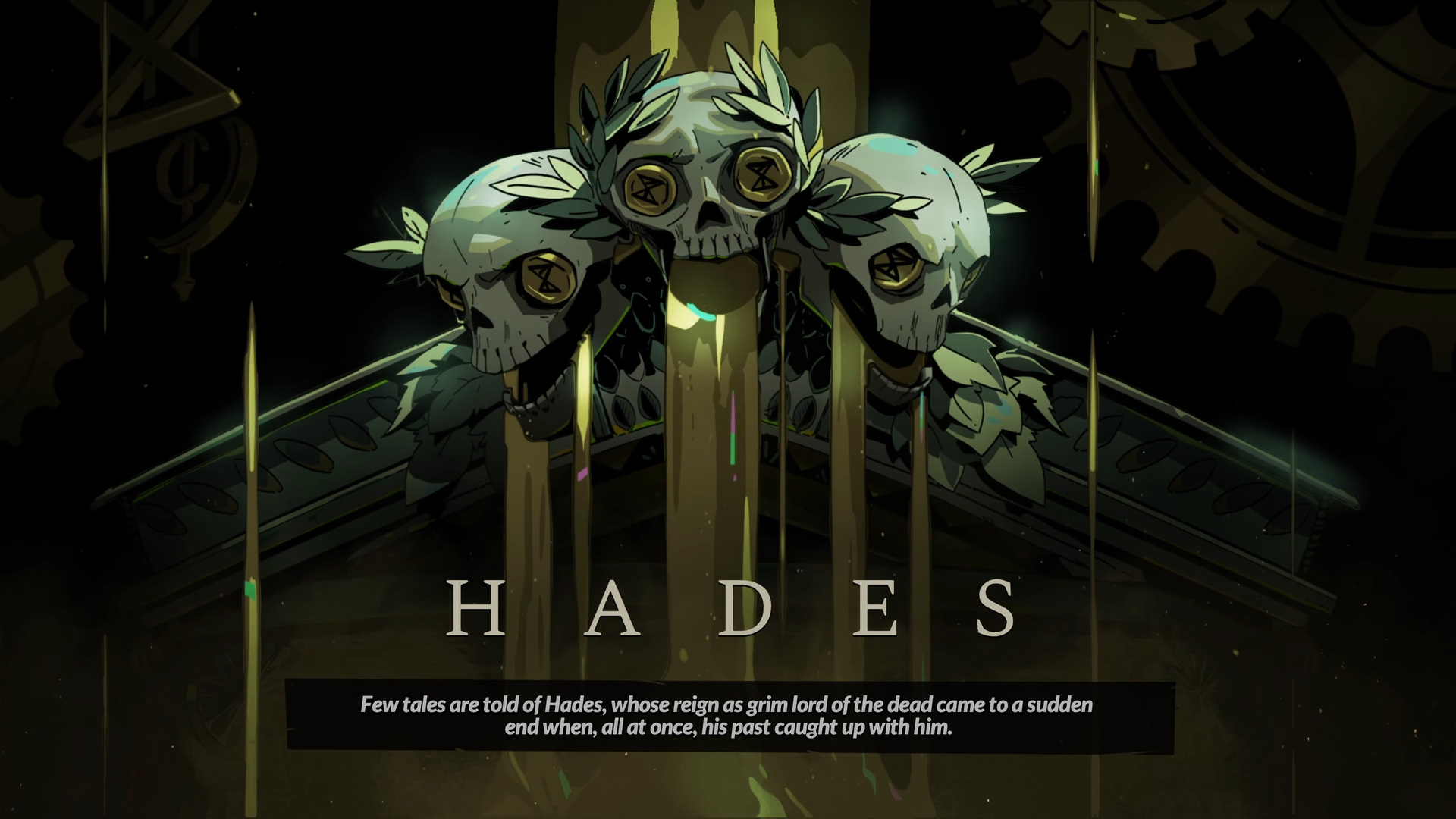 Hades 1's title cinematic. The framing (Greek myth retold via the family of the Underworld) is the series's house tone. Hades II picks up narratively after these events. Source: Game UI Database.
What carries over
| System | Same shape in H1 and H2 |
|---|---|
| Pick-1-of-3 boon draft | ✓ Same, with revised god roster |
| Hammer of Daedalus | ✓ Renamed but same role |
| Door icon foreshadowing | ✓ Same |
| Hub-as-dialogue-source | ✓ Crossroads instead of House of Hades |
| Death triggers dialogue | ✓ Same, more granular triggers |
| Pact / Heat (opt-in difficulty) | ✓ Same, renamed Vows of the Crossroads in H2 |
| Weapon Aspects | ✓ Same |
| Resource Cards / Charon shop | ✓ Same |
| Boss arc tracking | ✓ Same |
The combat feel is also broadly the same: isometric action, dash-based mobility, attack/special/cast/dash kit, isometric arenas with throwing and AoE telegraphs. The hand-painted-portrait-over-pixel-painted-environment art style is identical.
What Hades II adds
Magick resource
Hades 1 had no mana; Cast was on a cooldown / pickup-recovery system. Hades II adds Magick as a regenerating-with-conditions resource that fuels Cast and Hex.
This means a third bar is now part of every fight: HP (red), Magick (cyan), and the various meta-currencies on top. Combat decision-making gets more multi-axis. Boons now also offer "Magick generation" or "Magick-on-X" hooks, giving the boon design space a new dimension.
Hex: the third spell slot
Each weapon has access to a Hex, a high-cost spell that's slotted at hub-time and fires once per run condition. Hex options are meta-progressed and chosen outside of run; they're effectively a meta-loadout pick on top of Cast (which is in-run boon-driven).
So H2 has 4 ability slots (Attack, Special, Cast, Hex) where H1 had 3 (Attack, Special, Cast).
Two paths
Hades 1 had one direction: descend through 4 biomes, fight Hades, escape to surface, repeat. Hades II splits the player's options:
- Descent: Tartarus → Erebus → Oceanus → Chronos's chamber. Underworld biomes.
- Ascent: Surface → Mount Olympus. Surface biomes the original game never showed.
The player picks which direction each run. This doubles the dialogue requirement: surface NPCs (Apollo, Eros, etc.) versus underworld NPCs (Hecate, Odysseus, Moros). It also doubles the boon roster: Olympian gods on the surface path, Underworld characters on the descent.
This is late-introduced-mechanics at the per-run timescale: at hour 5 the player has only seen one direction; at hour 30 they're balancing arcs in both.
Arcana grid replaces Mirror of Night
See meta-progression.md. Hades II's meta-talent system is grid-and-Grasp-budget shaped, not slot-shaped. More combinatorial; less linear power growth.
New cast
Hades 2 swaps protagonists (Melinoë instead of Zagreus) and the supporting cast. Some characters carry over (Nyx, Hypnos, Achilles in adjusted form, Hecate); most are new (Odysseus, Nemesis, Schelemeus, Eris, Moros, Dora, Echo). The narrative arc is fresh (Melinoë's quest to defeat Chronos, who has imprisoned the family), rather than a continuation of Zagreus's escape.
What Hades II doesn't change
- Death-as-narrative is preserved. The granular dialogue trigger system from H1 is the load-bearing engine; H2 builds on it without restructuring.
- The boon draft language is preserved. Players coming from H1 immediately read H2's boon offers.
- The hub-then-run rhythm is preserved. The session loop is identical.
- The bounded-roguelite framing is preserved. Hades 2 will eventually have a "true ending" the same way H1 did.
What this teaches
- Sequels can iterate without re-architecting. Hades 2 added two systems (Magick, two paths) and one structural twist (Arcana grid replaces Mirror), without touching the load-bearing dialogue/boon/hub/death systems. The result is recognizably "more Hades" instead of "different game with the same name."
- Adding a resource axis is a content-multiplier. Magick alone unlocks an entire new boon design space (Magick-generation, Magick-on-X) and a new ability slot (Hex), without invalidating any existing systems.
- The narrative budget compounds across entries. Hades 1 ships ~21,000 lines; Hades 2 builds on a writing system that already proved itself, so the writing team can ship more coverage (two paths, broader cast) without re-validating the engine.
Patterns this exemplifies
iterative-yearly-refinement: same shape as Mega Man Battle Network and Xenoblade. Combat / hub / dialogue core preserved; meta layers iterate.late-introduced-mechanics: H2's two paths drip the surface path's content over the player's first 20–40 hours.