Through the ludonarrative resonance lens
A reading of Hollow Knight's mechanics through the ludonarrative resonance lens, does what the player does affirm what the game says it's about?
Mechanic read: Earned cartography (Cornifer + benches + Iselda's shop) + silent protagonist + shade-on-death.
Verdict: Affirms. The Knight is a creature without voice exploring a kingdom whose original inhabitants are mostly dead, infected, or hidden. The player's vocabulary mirrors the character's: same verbs, same posture, same loneliness.
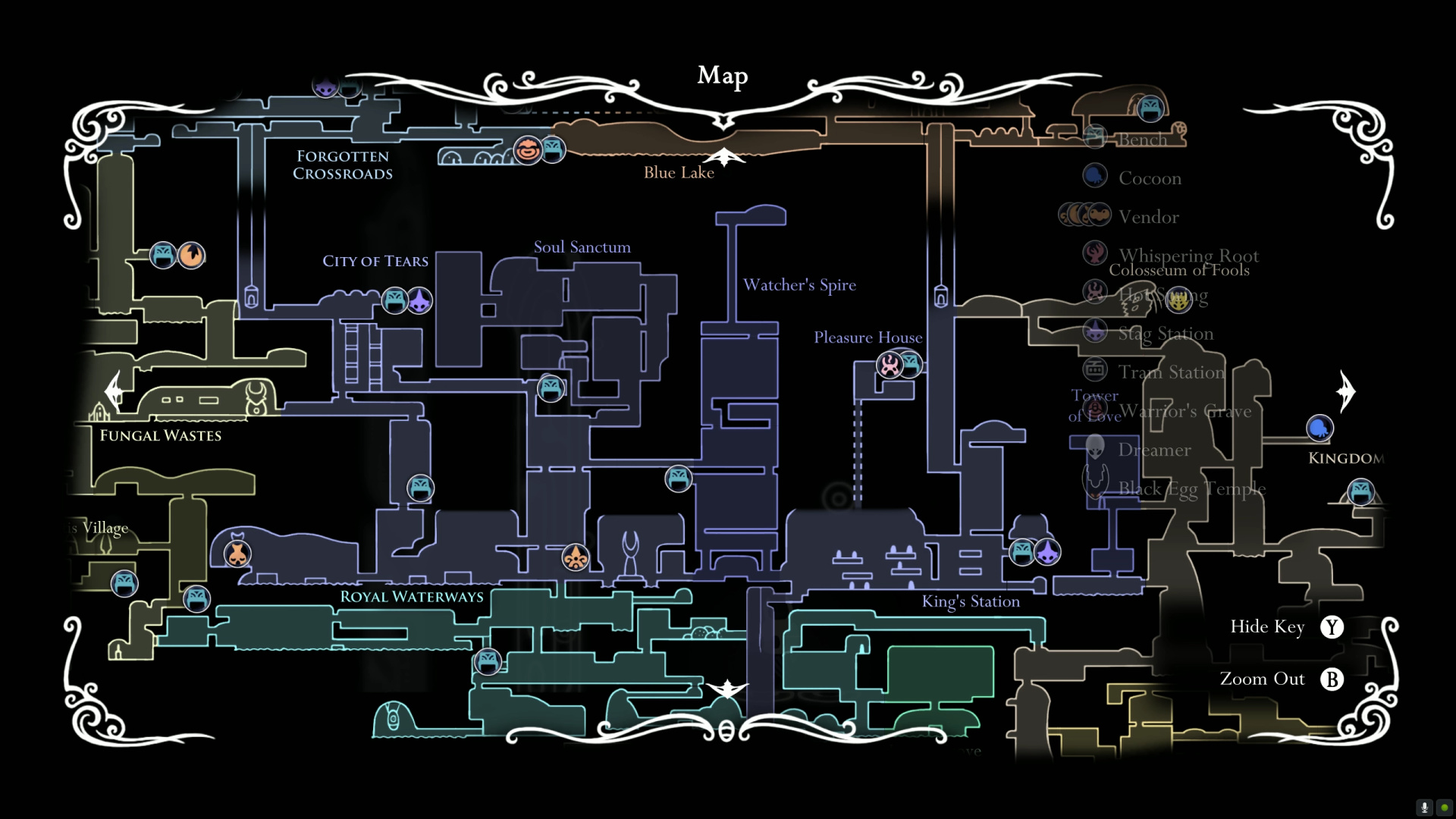 The map is only this clean because the player has visited each region, found Cornifer there, drawn it up, and bought every upgrade from Iselda. A new player's map is mostly empty for the first 20 hours. Source: Game UI Database.
Why it lands
Hollow Knight's fiction is "a small, voiceless wanderer in a vast, dying kingdom that does not orient itself for outsiders." Almost every mechanical decision affirms that posture, and refusing to do so would have produced a different, lesser game.
- No voiced protagonist. The Knight nods, sits at benches, swings a Nail. That's the verb-set. The player's interaction surface is exactly as wordless as the character's.
- No quest log, no objective marker. No NPC tells you where to go next. The world communicates through environment, music, enemy design, and the few NPCs who themselves only half-understand what's happening.
- No map until you find Cornifer. Each region begins blank. You hear his humming theme before you see him. You buy a regional map. You can't read it until you reach a bench and rest. Even then, it only fills in for rooms you've walked. Cartography is something the Knight is doing, not something the UI hands you.
- Compass costs a charm notch. The most basic spatial awareness: where am I on the map?, is opt-in and costs build budget. The world doesn't owe you orientation; you pay for it.
What makes the resonance dense, not nominal
The lens distinguishes between fiction-shaped-by-mechanics (cheap reskin) and mechanics-shaped-by-fiction (expensive co-design). Hollow Knight is the latter. The map system isn't "a map that happens to be earned", it's an entire economic surface (Geo to Cornifer, Geo to Iselda, charm slot to Wayward Compass, separate purchase for pin types, separate purchase for marker types). Each separately reinforces the same fictional posture: you are alone, you are unwelcome, the world will not interpret itself for you.
Two more cases:
- Iselda's shop. Pin types are sold à la carte. Marking a Cocoon vs. a Bench vs. a Whispering Root is a separate purchase. Even annotating your understanding of the world is an economic action: a tax on your mental model.
- Shade-on-death. Your literal previous self is left where you fell, hostile, wielding your kit against you. Recovering Geo means fighting yourself. The mechanic is structurally the Dark Souls bloodstain: and the fiction (a vessel that splits when its shell breaks) is built so that the bloodstain is a character, not a UI conceit.
What the loop says
I am small and quiet. The world is old, large, and indifferent. To know it I must walk it. To survive it I must spend on it. Even my own death is something I will have to come back and fight.
That describes both the gameplay and the protagonist's narrative position. That is affirmation.
Where it could have failed
The same game with a voice-acted protagonist quipping in the City of Tears would feel different. The same game with quest markers on a shared map would feel different. The same game with a free and complete Compass charm would feel different. Each addition is "small" individually; collectively they out-vote the silent-vessel fiction. The lens diagnoses why "small" UI improvements often dissolve a game's atmosphere, they're not UI improvements, they're rewriting what the loop says.
See also
- Mechanic pages: Map & discovery, Shade on death
- Lens (overview): Ludonarrative resonance
- Adjacent pattern:
bonus-with-drawback: the Compass-charm-cost / Wayward-Compass-vs-real-charm tradeoff.