Combat
Top-down action. Less novel than the patch board, but worth a quick page because the patch board's choices only matter if you understand the combat shape they're tuning.
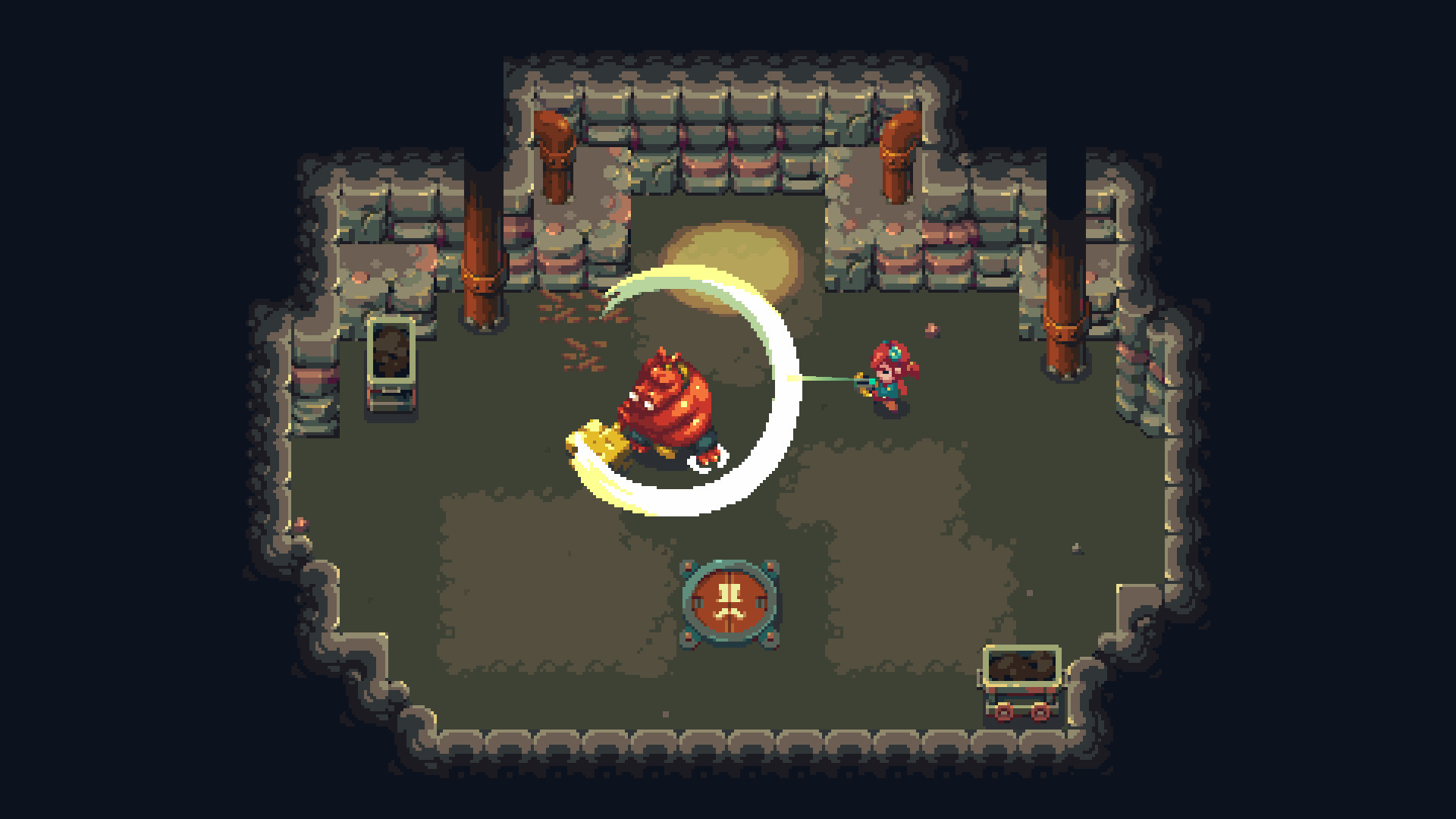 The wrench's swing arc against a Furnace boss. Combat is pattern-recognition first, reflex second. Source: Steam.
Melee
- Wrench: main weapon. Tap = quick slash, hold = heavy. Successive taps chain a 2-hit combo, upgradable to 3-hit via the damage patch.
- Hammer: secondary, doubles as a puzzle interaction tool.
Sub-weapons / gadgets
Found one per Vault, one Vault per biome. Energy-gated, capacity comes from the patch board.
- Boom Balloon: remote-control kamikaze.
- Spark Slinger: rapid energy bolts.
- Spark Blitzer: charge-shot precision burst.
- Flare Bang: area light + crowd disrupt.
- Rocket Boots: dash / gap-jump (also a traversal unlock).
- Shrink Ray: lets Ada enter pipes (traversal unlock).
The dual-purpose pattern (some gadgets are weapons, others are traversal keys for new biomes) is metroidvania scaffolding under the procedural skin.
Combat shape
Pattern-recognition first, reflex second. Enemies have clearly telegraphed wind-ups; bosses are layered patterns. Starter HP is deliberately tight, about 3 hearts, and most enemies hit for a full heart, so first runs are punishing. The patch board is the lever that opens that bottleneck.
The wind-ups are the genre default, flash, hitch, swing. They're worth flagging because the patch board's tightness depends on combat being readable: if attacks were unannounced, no patch loadout would feel survivable. See enemy-intent-telegraph.
Why this matters for the patch-board design
Combat being survivable is gated on a successful patch loadout, but combat being fun isn't gated on the loadout. That distinction is what lets the patch board force archetype commits without making bad commits feel like a death sentence, you can play around a bad loadout if your reflex / pattern-reading is good enough.