Driver–Blade pairing (XC2)
XC2's signature system. Every party member is a Driver who fights with a Blade, a weapon-and-companion that also acts as a second character on screen. Drivers can swap between Blades mid-combat to change their entire moveset, weapon class, and elemental affinity.
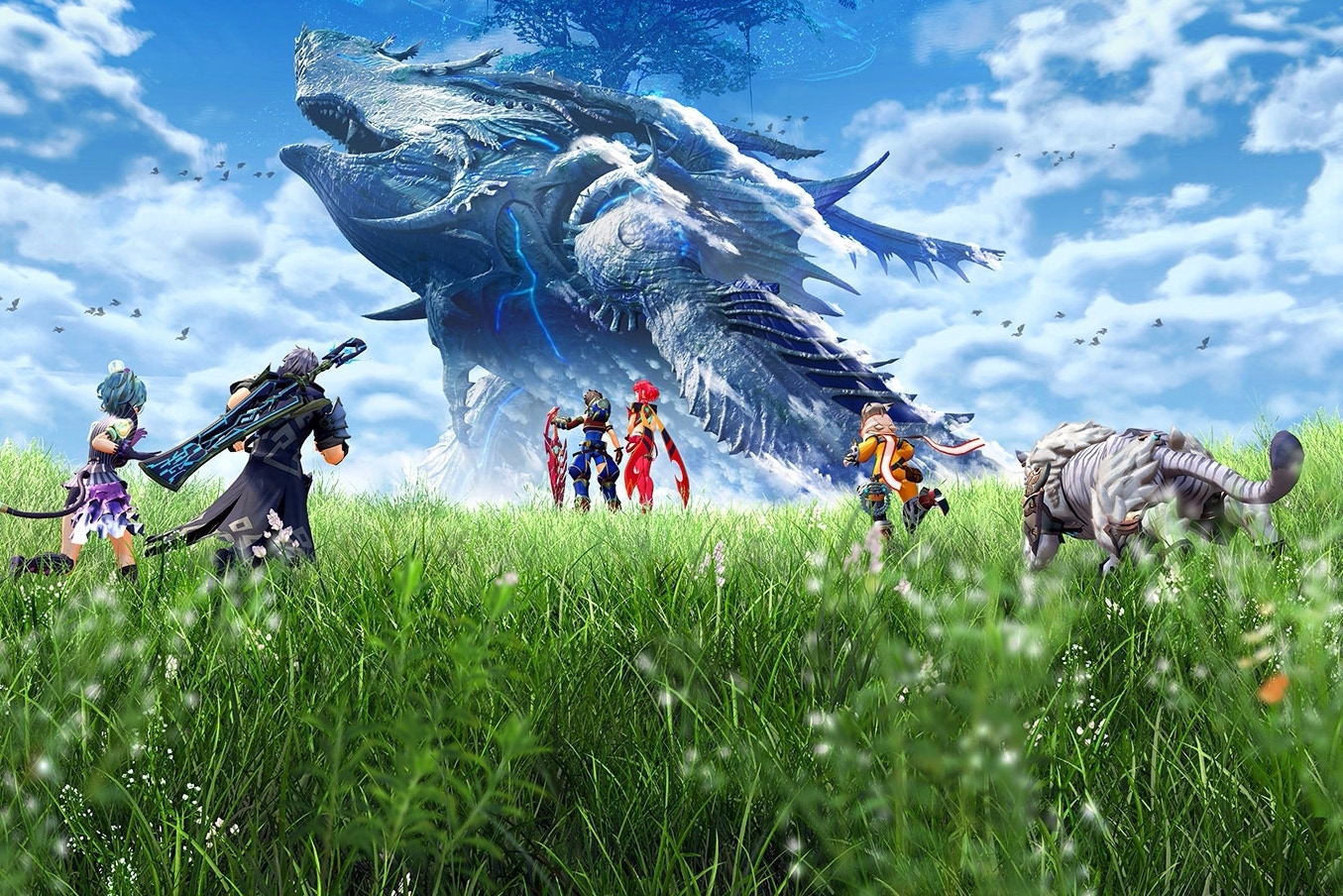 The XC2 cast in their world: Rex (Driver, foreground left) and Pyra (Blade, red), with the rest of the party scattered across the field of a Titan: the gigantic living creatures that make up the world. The Driver–Blade relationship is the game's load-bearing mechanical and narrative thread. Source: Eurogamer.
The pairing
A Driver is the controllable character (Rex, Mòrag, Nia, Tora, etc.). A Blade is bonded to a Driver and provides:
- The weapon. Greatsword, twin rings, knuckle claws, etc.: there are ~12 weapon classes.
- An element. Fire, water, wind, earth, electric, ice, light, dark.
- A role. Attacker / Tank / Healer.
- A skill tree the Driver levels by using this Blade.
- Field skills. Out-of-combat traversal abilities (Fire Mastery, Salvaging, Botany, etc.) used to clear blocked paths and chests.
A Driver carries up to 3 Blades at once and can switch the active one freely in combat (with a swap cooldown). Switching mid-fight is core to combo execution.
Combo system: three nested layers
This is where XC2 combat earns its complexity reputation. There are three combo systems stacked on each other:
1. Driver Combos (the XC1-shaped one)
The Break → Topple → Launch → Smash chain, executed by Driver arts:
Break    →    Topple    →    Launch    →    Smash
(1 art)       (1 art)        (1 art)        (1 art, big damage)
This is the Xenoblade-classic state chain.
2. Blade Combos (the XC2-original one)
Drivers fire Specials (Blade ultimates) that have an element. Chaining Specials of compatible elements creates a Blade Combo:
Fire Special (Lv1)  →  Wind Special (Lv2)  →  Earth Special (Lv3)
              "Burn"                "Sandstorm"             "Smokestack"
Each step requires a higher-level Special, and Specials level up by using arts before firing them. So even setting up a Blade Combo requires sequencing 3+ regular arts to charge.
When a Blade Combo completes, an elemental orb locks onto the enemy. Up to 8 orbs can be on a single enemy at once.
3. Fusion Combos (the meta one)
Driver Combos and Blade Combos run simultaneously. Fusion Combos apply when both fire on the same target at the same time, multiplying damage and locking in elemental orbs. Then, in a Chain Attack, the player bursts all the orbs, dealing exponential multiplied damage.
The meta-strategy: build up orbs through 3-stage Blade Combos for an entire fight, then chain-attack to detonate them all. A maxed Chain Attack on a fully-orbed enemy can do millions of damage in a few seconds.
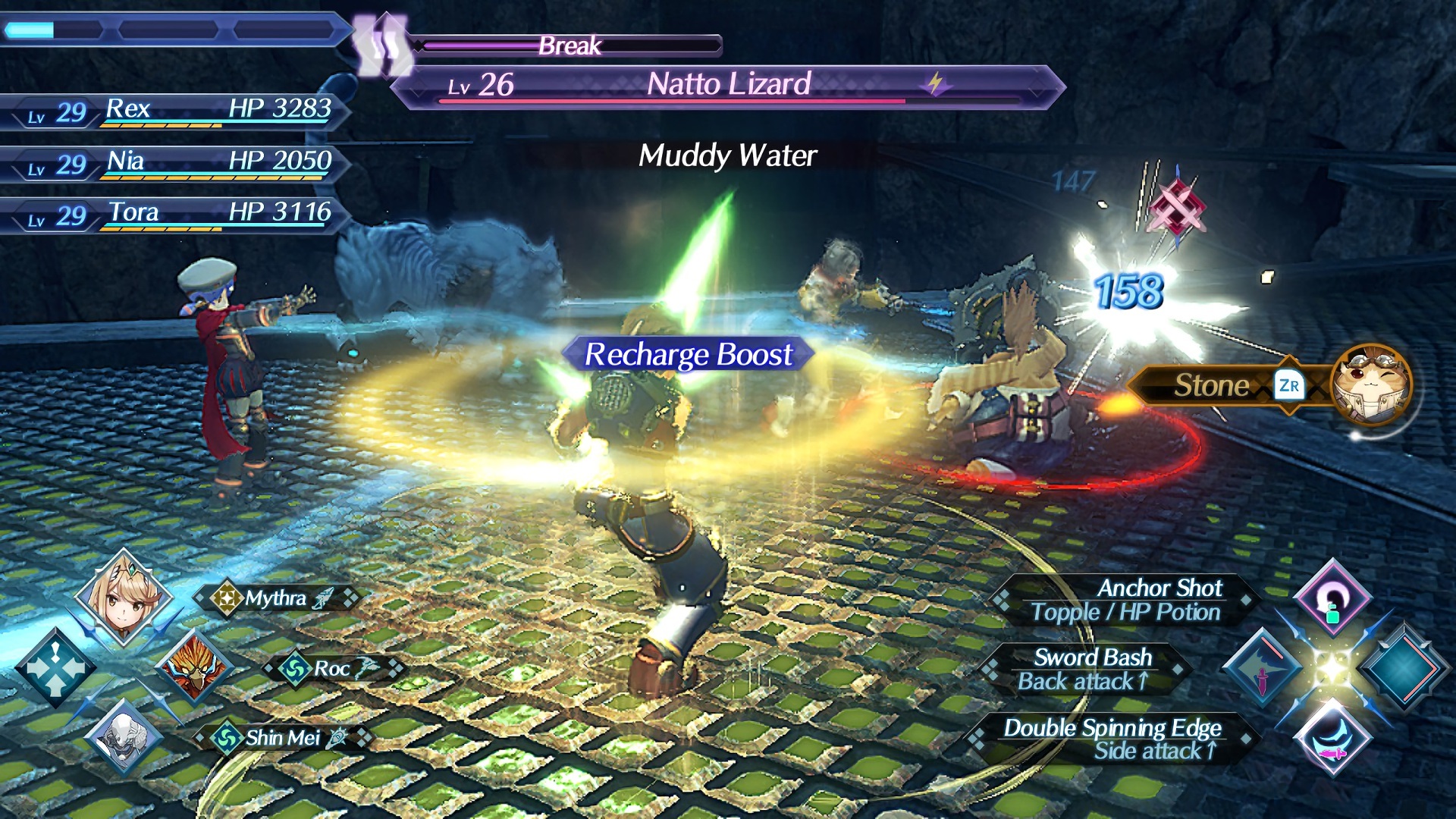 XC2 combat in mid-fight. Top-left: party HP panels (Rex, Nia, Tora). Top-centre: enemy with Break status applied. Centre: a Driver Combo step landing ("Recharge Boost"). Bottom-left: the Blade row: Mythra / Roc / Shin Mei, showing which Blade each Driver has equipped, swappable mid-combat. Bottom-right: the arts palette (Anchor Shot, Sword Bash, Double Spinning Edge) and the element orb sphere that builds up through Blade Combos. Three combo systems running at once. Source: Game UI Database.
This is the most-mechanically-complex combat system in any major JRPG. Reception fairly criticized it for opacity, the game does not teach the three layers cleanly, and the relevant tutorials drop in over the first ~25 hours.
The Affinity Chart per Blade
Each Blade carries its own Affinity Chart, a bowed-arc graph of nodes the Driver fills by using the Blade. Each filled node grants stats, art evolutions, party-level utility, or new field skills. There are ~70 Rare Blades; that's ~70 Affinity Charts.
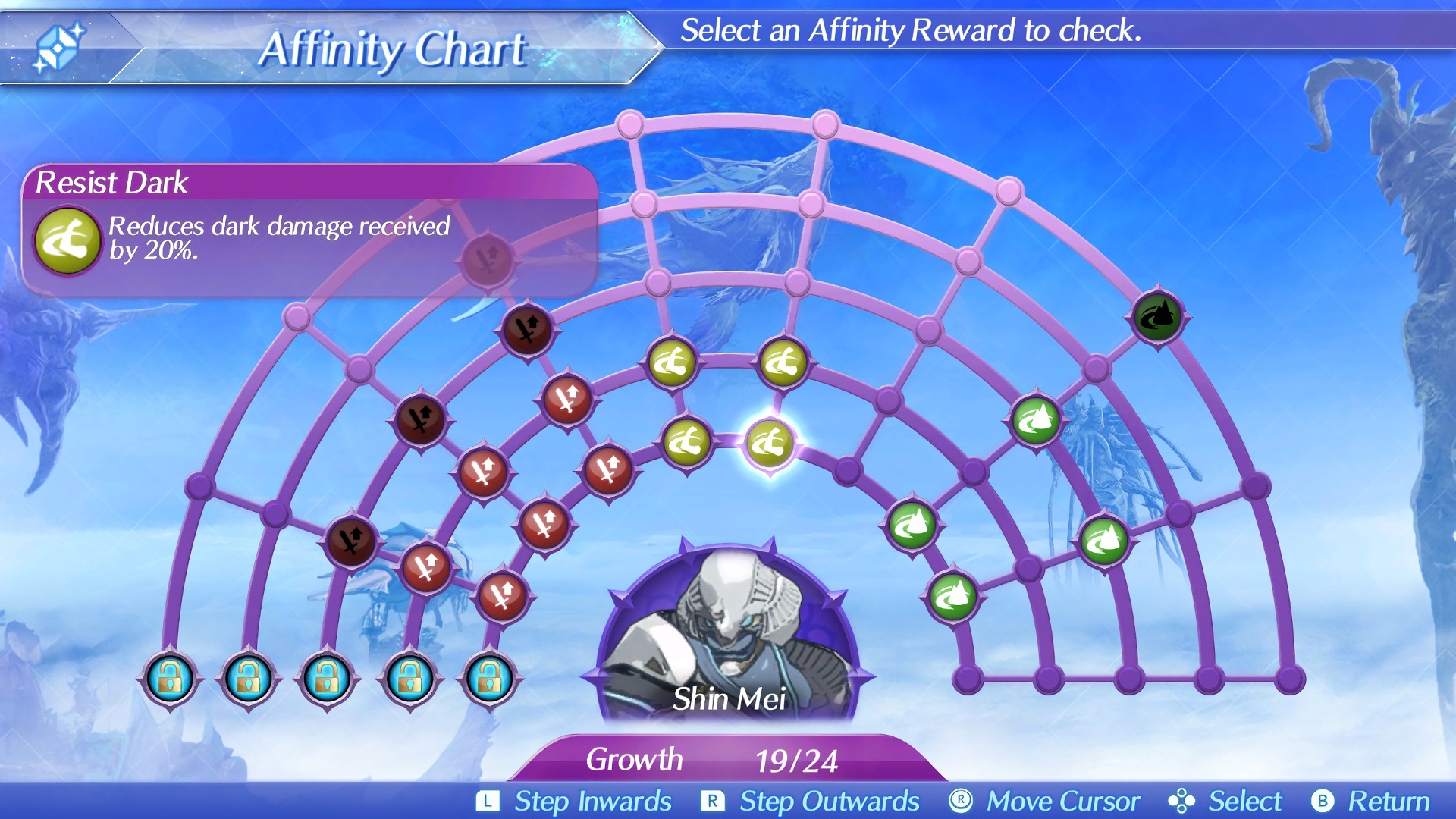 Shin Mei's Affinity Chart. Each ring of nodes unlocks at a Blade-specific milestone (use the Blade in a certain element of combat, win a certain number of fights with this Blade slotted, complete the Blade's personal side-quest). The graph shape is recurring; the content of each Blade's nodes is unique. Filling out one Rare Blade is dozens of hours of focused use. Source: Game UI Database.
The Affinity Chart is one of XC2's clearest late-introduced-mechanics instances, players who unlock a Rare Blade at hour 30 then face the chart and realize "oh, I have to use this Blade for another 20 hours to fill it." The 80-hour campaign is a consequence of the per-Blade growth requirement.
Rare Blades: the gacha
Most Blades are summoned from Core Crystals, random pulls from items dropped in the world or bought from shops. There are ~50+ Rare Blades; pulling one is a gacha event with weighted RNG.
| Element | Pull source | Rate |
|---|---|---|
| Common Blades | Standard Core Crystals | High |
| Rare Blades (~70 total, named) | Rare Core Crystals (random drop) | ~5% per pull |
| Specific Rare Blade target | Boost field skills + idea stat of Driver | Slightly increased |
Pulling a specific Rare Blade you want can take hours of farming. Pulling Praxis or Theory or KOS-MOS or T-elos (Xenosaga collab Blades) is a hours-long farm session.
This was contentious. Reception split:
- Fans: the gacha's a content drip; pulling a new Blade is exciting; Blade rolls are part of the long progression.
- Critics: it's a Switch first-party Nintendo game with gacha mechanics; you can't "pay" but you grind. It feels like F2P design dropped into a $60 premium product.
GGG / DE / Spire-style metrics-driven studios would have nerfed this. Monolith Soft kept it. Same vibe as vision-driven-iteration, the gacha is intentional, not a mistake.
Field Skills: the open-world gating
Every Blade has 1–3 field skills: out-of-combat traversal abilities. World traversal is gated by these:
- A wall might require Fire Mastery 4 to burn through.
- A chest might require Salvaging 3 + Engineering 2 to open.
- A side quest might require a specific Blade class with Botany 5.
You combine field skills from your party's active Blades. So world traversal is a packing puzzle: which 9 Blades (3 per Driver × 3 Drivers) maximize coverage of field-skill prerequisites?
This is one of the most-criticized parts of XC2. Walls can be impassable until you pull a specific Rare Blade with the right skill, which means the gacha gates open-world content.
Late-introduced systems in XC2 (the recurring pattern)
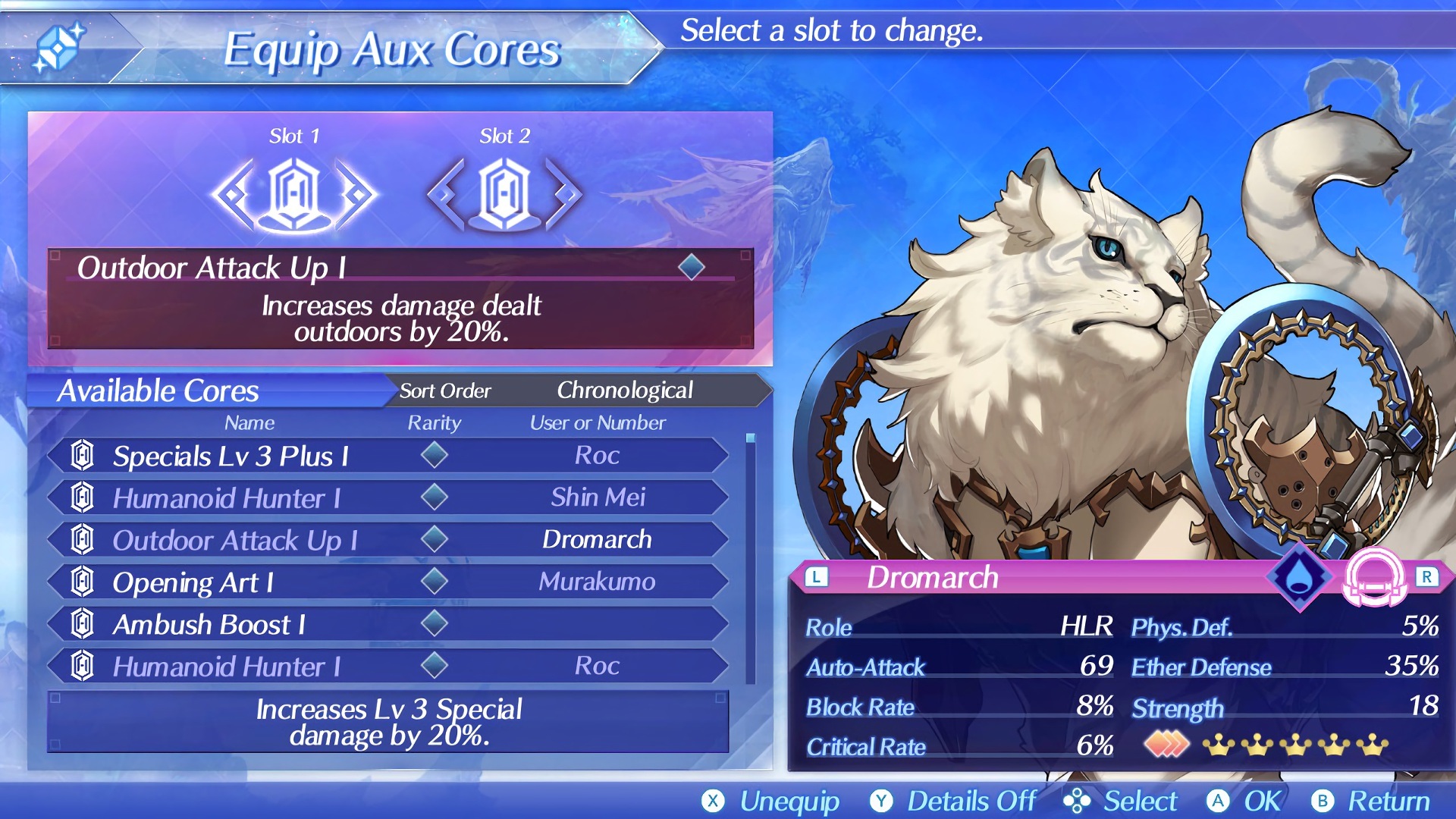 Aux Cores: XC2's mid-game power-tuning system, unlocked ~15 hours in. Each Blade has 1–2 Aux Core slots; cores are dropped or crafted, and the player tunes which two cores fit each of nine slots (3 Drivers × 3 Blades). Yet another loadout layer on top of Blade choice and arts palette. The system isn't tutorialised cleanly, players often discover they've been playing without it. Source: Game UI Database.
XC2 specifically is the poster child for late-system reveal:
| Hours played | System unlocking |
|---|---|
| 0–5 | Basic combat, one Blade per Driver |
| ~10 | Blade swap, Specials |
| ~15 | Blade Combos, third Blade slot |
| ~20 | Field skills, world gates |
| ~25 | Mercenary Missions (assign Blades to gathering/combat off-screen) |
| ~30 | Tiger! Tiger! mini-game (Poppi customization via a separate side mini-game) |
| ~50 | Affinity Chart maxing as long-term loop |
| Post-credits | NG+ Blade trading, optional super-bosses, Torna prequel DLC as a standalone game with its own systems |
Players who quit XC2 at hour 20 saw maybe 40% of the system. Players who quit at hour 50 still hadn't seen NG+ trading or some endgame mechanics.
This is a defining instance of late-introduced-mechanics.
What this teaches
- Combat depth scales with system layering. XC1 has Break → Topple → Daze. XC2 has all three of Driver Combos, Blade Combos, Fusion Combos. The lattice of states grows; the player has more dimensions to optimize. Whether that's good depends on whether the tutorial scaffolding holds up.
- Gacha can land in single-player. It's controversial and high-friction. But for a player who plays 100+ hours, the gacha is a content drip: not a monetization vehicle but an attention-pacing tool. The trade-off is tonal mismatch (premium product, F2P feel).
- Field-skill open-world gating produces real load-bearing decisions. Spending currency on a specific Rare Blade pull because you need Salvaging 5 to unlock a quest line is the kind of decision that connects loadout to world traversal. Few RPGs do this.
Patterns this exemplifies
loadout-as-budget: three Blades per Driver × three Drivers = nine slots. A combinatorial loadout puzzle for both combat and field-skill coverage.bonus-with-drawback: every Blade choice forecloses two others; element-locked Blades can't fight an enemy of the same element.random-perfect-roll-economy: Rare Blade gacha is the closest a Nintendo first-party JRPG has come to a perfect-roll economy. Specific Blades have meta-defining stats; Common/Rare drift is the lottery.late-introduced-mechanics: XC2 is the canonical case in the series.