Two-version exclusivity + trade-as-content
Pokémon ships in paired versions. Buy Ruby; some Pokémon will not appear in your game. The same is true if you buy Sapphire, different Pokémon are missing. To complete the Hoenn Pokédex, you have to trade with someone who owns the other version.
This pattern was set in Gen 1 (Red / Blue, 1996) and has continued through every mainline generation up to the present (Scarlet / Violet, 2022). Gen 3 is where the full expression of this pattern landed: two starter versions + one third-version canonical revision (Emerald) + remakes (FR/LG) + GameCube spinoffs (Colosseum / XD) all interconnected via the Game Boy Advance Link Cable.
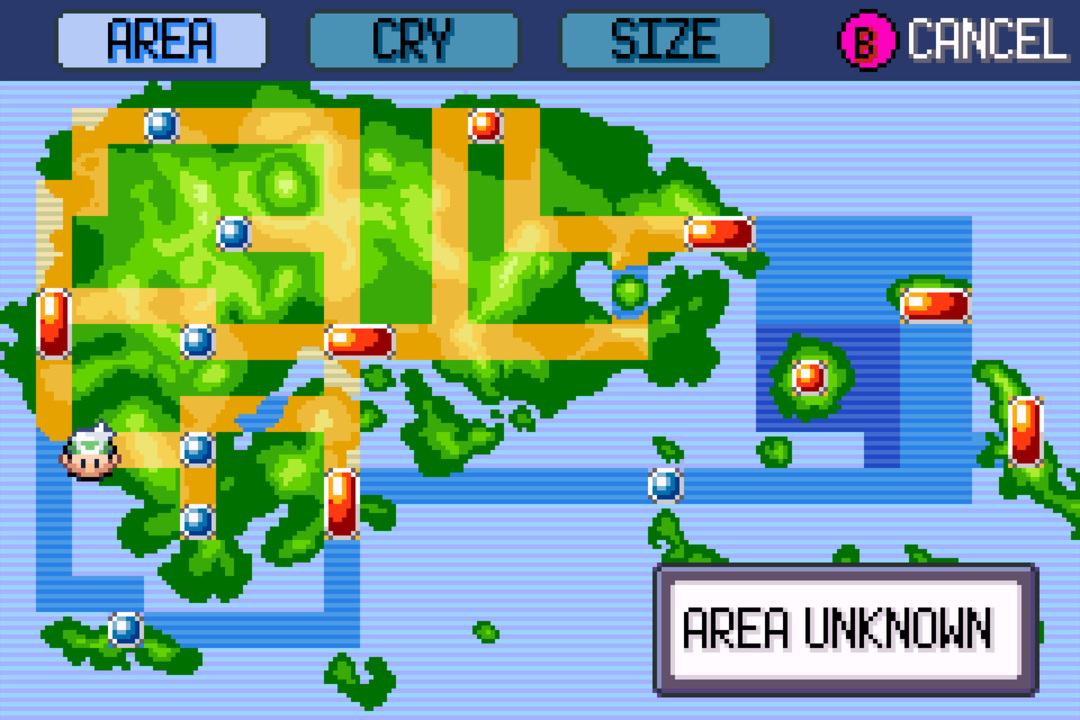 Hoenn. Each red/blue marker is a location with version-exclusive encounters. Some species are only found in one version's tall-grass tiles. Source: Game UI Database.
What's exclusive
In Ruby/Sapphire, the exclusivity is mostly:
- Wild encounter pools: Seedot/Lotad and their evolution lines split between versions. Ruby gets Seviper; Sapphire gets Zangoose.
- Mascot legendaries: Groudon (Ruby) vs Kyogre (Sapphire). The third legendary, Rayquaza, is only catchable in Emerald, an explicit incentive to upgrade.
- Antagonist team: Team Magma (Ruby) vs Team Aqua (Sapphire). The opposite team is the minor faction in your version. The story is symmetric but partial in each cartridge.
- Trade-only evolutions: many Pokémon evolve only when traded (Kadabra → Alakazam, Machoke → Machamp, Graveler → Golem). You cannot complete these evolutions without a trade partner, and you have to trade them back if you want to keep playing with them.
Why this works as design
Three things become true simultaneously:
- Completion requires social play. Catching every Pokémon in a single cartridge is impossible. The Pokédex is a single-player goal that requires a multi-player network.
- Cartridges have asymmetric story content. Two friends with different versions can't just compare notes: they've literally played different games, with different antagonists prominent.
- Resale supports the network. Used Ruby and Sapphire cartridges are interchangeable currency on schoolyards. Owning one doesn't substitute for owning the other.
This is sometimes critiqued as exploitative, "they're selling me half a game!", but the design requires the asymmetry. If both versions had the same Pokédex, there'd be no incentive to trade with friends. The trade is the social loop. The exclusivity creates the trade.
Trade as the player's most enduring verb
Trade was the iconic Pokémon mechanic before competitive battling existed. It is also the one mechanic that reaches across hardware generations:
- Game Link Cable (Gen 1/2): physical cable between two Game Boys.
- Wireless Adapter (Gen 3: FR/LG and Emerald only), the rare "purple wireless adapter" that came with FR/LG was a Pokémon-only peripheral.
- Pokémon Box / Bonus Disc: GameCube-side storage that allows Box-to-cartridge transfer and Pokémon Colosseum / XD integration.
- Wi-Fi GTS (Gen 4+, 2006): first-ever globally-networked trade.
- Pokémon Bank / Home (Gen 6+): cross-generational save service.
So Pokémon's "trade your Pokémon" architecture has been incrementally reinforced for ~30 years. The Pokédex completion goal is load-bearing across the franchise's entire commercial life.
The Gen 3 transfer break
A subtle but important Gen 3 fact: you cannot trade Pokémon from Gen 1/2 (Red/Blue/Yellow/Gold/Silver/Crystal) into Gen 3. The save format was rebuilt; the link cable protocol changed. Any Pokémon caught in the original games stayed there.
This was painful for players who had spent years curating Gen 1/2 collections. Gen 3 is the only point in the franchise where the chain breaks. Every gen since has supported forward-only transfer (you can move Gen 4 Pokémon to Gen 5, Gen 5 to Gen 6, etc., though never backwards).
The pragmatic explanation: Game Freak rewrote the engine for GBA and the data structures didn't translate. The community-cultural cost was enormous; the design choice was apparently necessary.
Third-version: Emerald merges the universe
Pokémon's "third version" releases (Yellow, Crystal, Emerald, Platinum, BW2, USUM) follow a consistent pattern: a single revised cartridge that merges the two paired versions' content and adds new endgame. Specifically for Emerald:
- Story merged. Both Team Magma AND Team Aqua are antagonists. The plot wraps both versions' arcs into one continuous narrative.
- Mascot legendary is the third. Rayquaza, who in R/S only appears in the post-game Sky Pillar, becomes the cover legendary and final boss.
- Pokédex unified. Most version-exclusives still exclusive (you trade for the other version's encounters), but a few Emerald-only additions arrive.
- Battle Tower → Battle Frontier. The post-game challenge is seven facilities now (Tower, Dome, Palace, Arena, Factory, Pike, Pyramid), each with a Frontier Brain.
- Animated sprites. All in-battle Pokémon now have a brief animation when they enter the field. Cosmetic but iconic.
- Gym leader rosters revised. Some leaders use different teams; some routes have re-tuned encounter pools.
Emerald sells as a canonical edition to people who already own R/S. It's not a directors-cut DLC, it's a separate $30 cartridge. The trick works because: (a) it's the third version's content that becomes the Pokémon canon, Emerald's plot is what fans treat as "what really happened in Hoenn"; (b) the Battle Frontier is the post-game R/S buyers wanted; (c) the third version arrives ~2 years after the originals, when R/S fatigue has set in.
This pattern, third-version-canonical-merge, was used for every Pokémon generation through Gen 7. Gen 8+ shifted to dual-flagship-only releases (Sword/Shield without a third version), arguably losing something in the process.
What this teaches
- Asymmetric content across paired SKUs creates social demand. This is one of the oldest tricks in collectible-product design (sports cards, Magic: The Gathering's set rotations, etc.): Pokémon's contribution is making it the spine of a single-player RPG's completion arc.
- Trade as a verb has 30 years of architectural reinforcement. Pokémon's franchise-level architecture has every generation cooperate with the next via trade. The trade-storage ecosystem is one of the franchise's deepest competitive moats.
- A "canonical edition" is a real product, not a patch. Emerald, Crystal, Platinum, BW2, USUM all sold as $30 cartridges to people who'd already paid $30 for the original. The lesson: if you have a "definitive cut" of a game, ship it as a real product on a real timeline, not a free update.
- Hardware breaks are sometimes necessary. The Gen 2→Gen 3 trade break is the franchise's only such break, and it was forced by the GBA architecture. Game Freak has avoided it ever since by maintaining forward compatibility: at a cost in code complexity that they've apparently decided is worth it.
Patterns this exemplifies
version-exclusive-trade-gate: paired SKUs with asymmetric encounter pools, trade required for completion. Uncurated; Pokémon is the canonical case in commercial games.third-version-canonical-merge: a third release of a paired duology that merges story + adds endgame, sold at full price. Uncurated.late-introduced-mechanics: the Battle Frontier is post-credits content (Emerald) that reshapes the back-half of the game's life.