Dungeon map
Moonlighter 2's biggest single departure from the original: the dungeon is now a Hades/Spire-style map rather than a procedural maze.
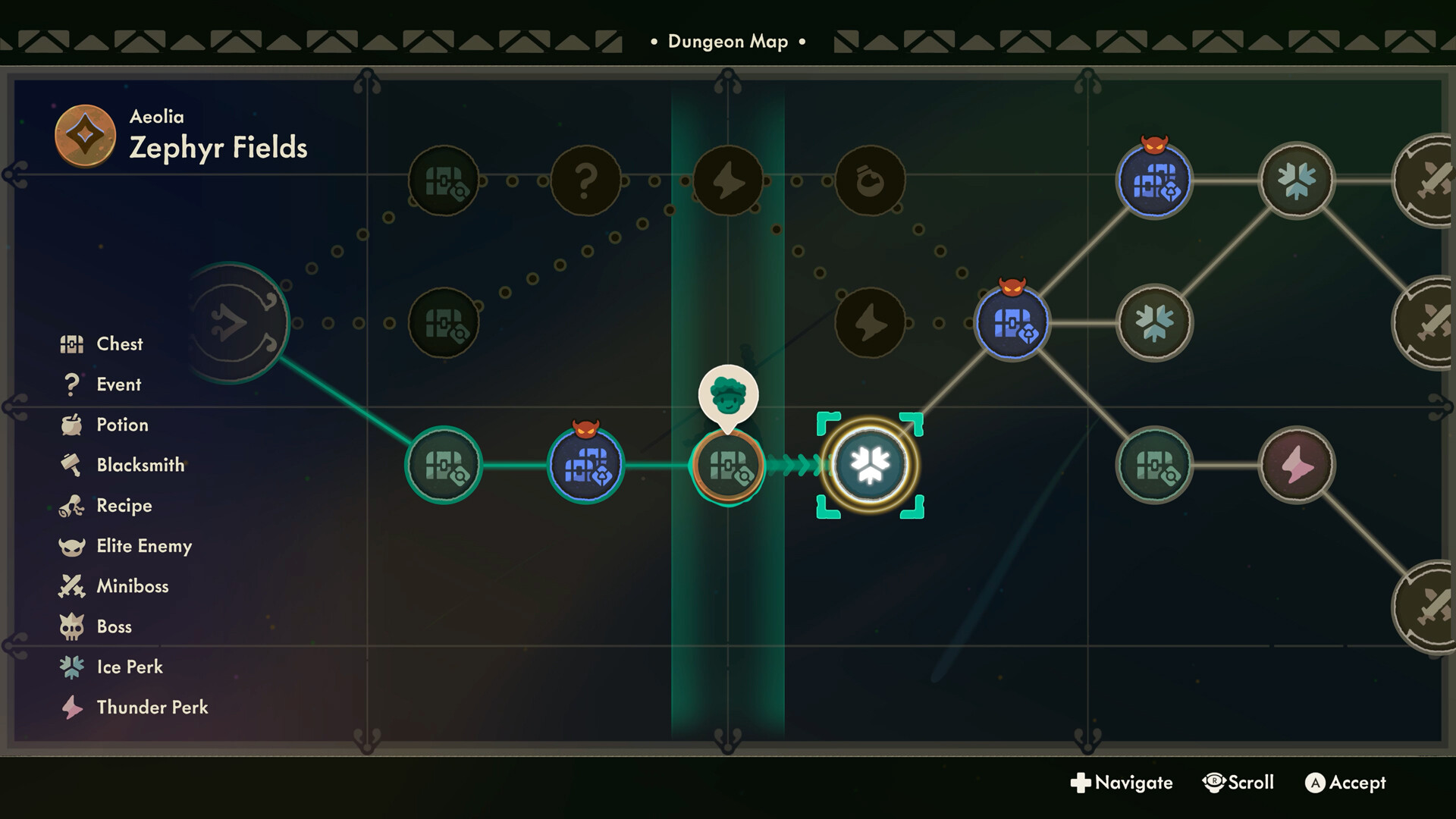 "Zephyr Fields": the Aeolia biome's dungeon map. Pick your path through the DAG; the legend (left) shows node types: Chest, Event, Potion, Blacksmith, Recipe, Elite Enemy, Miniboss, Boss, Ice Perk, Thunder Perk. Source: Steam.
Node types
Read off the in-game legend:
- Chest: fight an encounter, claim a relic.
- Event: narrative + decision (often costs/benefits).
- Potion: consumable refill.
- Blacksmith: mid-run gear adjustment.
- Recipe: unlock a new craftable / shop item.
- Elite Enemy: harder fight, better reward.
- Miniboss: sub-boss.
- Boss: biome's final encounter.
- Ice Perk / Thunder Perk: branch your damage profile.
Why the map is the design fulcrum
The same logic as Slay the Spire: the map is the meta-decision layer that wraps the combat layer. Every node-choice is a small risk/reward call:
- Chase the boss path for completion.
- Detour for a perk to make the boss easier.
- Take the Elite for a better relic but burn HP.
- Visit a Blacksmith to fix a broken build.
Critically, paths are visible from the start of the run, so you plan the shape of the run before the first encounter.
This is a deliberate Hades-inspiration. Devs cite it explicitly:
"The progression is clearly inspired by Hades in terms of choosing your path, choosing which upgrade you want."
Perk choices on the map
Two of the node types (Ice Perk and Thunder Perk) are explicit damage-profile choices. Picking one closes off the other for that run. This is a bonus-with-drawback in disguise: the bonus is more damage in one element, the drawback is opportunity cost (no synergy with the other element this run).
In Hades terms, these are equivalent to the gods you accept boons from.
Procedural arrangement, hand-authored encounters
Same trick as Sparklite, Warframe, and Spire: author content at the unit level, randomize the layout. Each Chest / Event / Boss is hand-tuned; which of them appears at which floor of the map is procedural.
What this teaches
The Moonlighter 2 map is a strong endorsement of the DAG-map pattern even outside roguelike-deckbuilders. The original Moonlighter had hand-authored dungeons, and one of the most-cited improvements in the sequel is "you now feel like you're choosing a run shape, not just walking through one."
For any game with sequential encounters, the cost of adding a node-map is small (one extra UI screen) and the perceived-agency upgrade is huge.
Patterns this exemplifies
branching-dag-maphandcrafted-pcg-hybridbonus-with-drawback: perk node choices.