Weapon stories
Every weapon in Nier: Automata has a four-paragraph Weapon Story, flavor text that's gradually unlocked as the weapon is upgraded. The four levels of upgrade reveal four sequential paragraphs. Together, the paragraphs typically form one short story with a beginning, middle, end, and grim final twist.
This is the game's most consistent narrative voice. There is more total prose in the weapon stories than in the cutscenes.
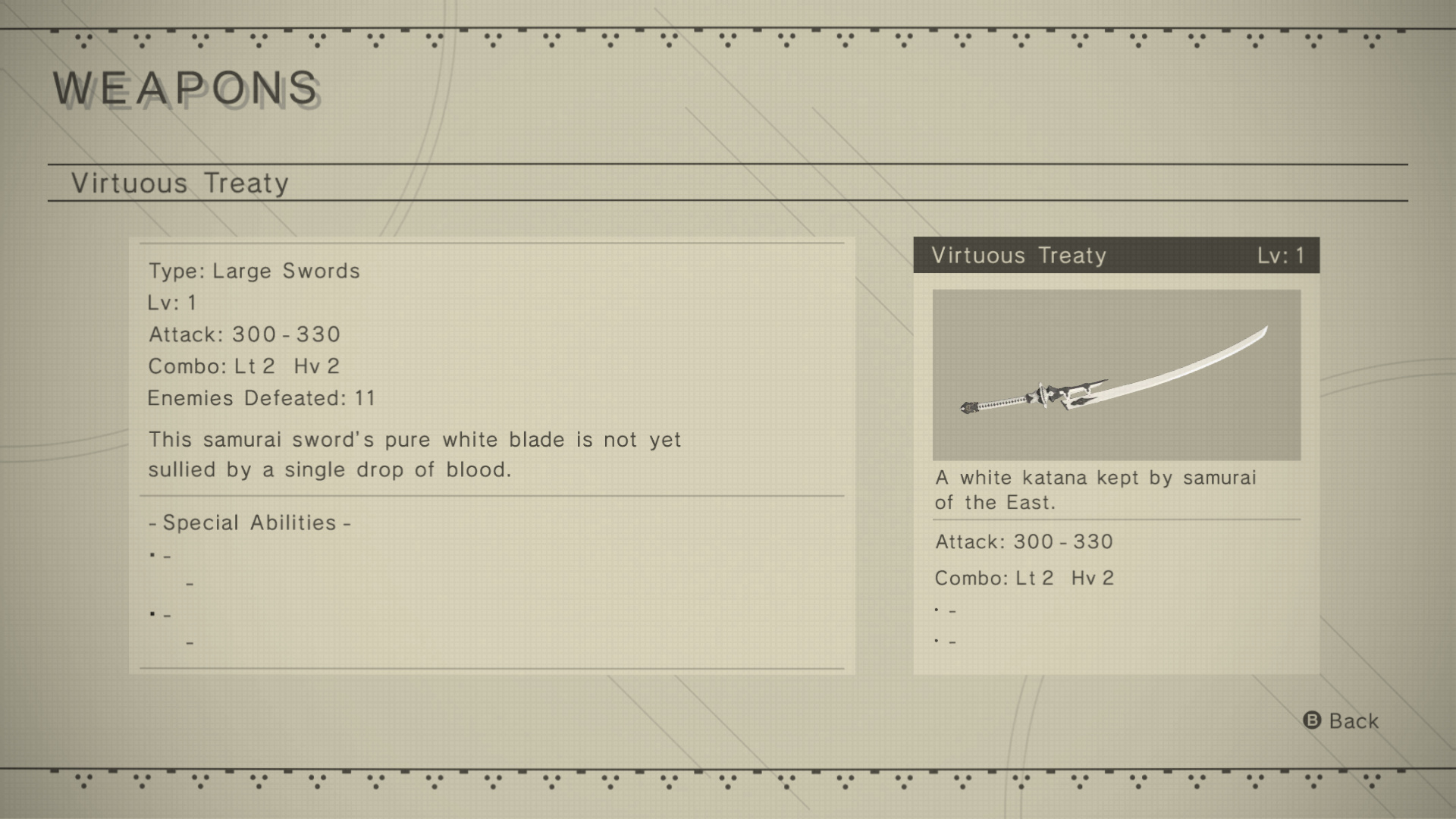 Virtuous Treaty at Lv 1: the first paragraph of its weapon story is shown: "This samurai sword's pure white blade is not yet sullied by a single drop of blood." Each subsequent upgrade level (Lv 2, 3, 4) reveals the next paragraph. Source: Game UI Database.
The structural mechanic
Each weapon has 4 levels of upgrade (Lv 1 → 4). Upgrading costs Funds (G) + crafting materials at a Maintenance Shop. With each level:
- Attack damage increases.
- Combo attack count increases (Lt 2 Hv 2 → Lt 3 Hv 3 etc).
- One new paragraph of weapon story unlocks.
So to read the full story of a weapon, the player has to invest in the weapon, gather materials, return to the shop, spend Funds. The narrative is gated behind player commitment to the item.
This couples flavor text to gameplay engagement in an uncommon way. Most RPG flavor text is read-once at acquisition. Automata's weapon stories are read in installments over a 5–25 hour arc.
The narrative voice
The weapon stories are the most consistently dark and inventive prose in the game. A representative selection (paraphrased structurally, the actual prose is on the wiki):
| Weapon | Story shape |
|---|---|
| Virtuous Treaty (white katana) | A samurai's pure blade. Each level: a fight, a betrayal, the death of innocence, the blade no longer pure. |
| Iron Will (massive cleaver) | A girl who lost her family. Each level: vengeance kindled, sword carried, vengeance achieved, "the red rust was the weapon's tears." |
| YoRHa-issue Blade | A radio idol broadcasting to the dead, learning her audience is corpses. |
| Phoenix family (sword/spear/dagger) | A martial-arts master and his three students. Each weapon tells the same story from a different student's POV. |
| Beastbane (gauntlet-blade) | A boy who befriends a wolf. The weapon is what becomes of the wolf. |
The tonal range: fairy-tale, war-correspondent, surreal, philosophical. Most end grimly. Many feature child protagonists whose stories slowly reveal the weapon was made of them or for killing them.
This pattern is consistent enough to be a deliberate authorial signature: every weapon a tomb.
How the player encounters it
Weapon stories are opt-in. The Weapons menu has Equip / Details / Story as a popup; selecting Story opens the four-paragraph reveal at the current upgrade level.
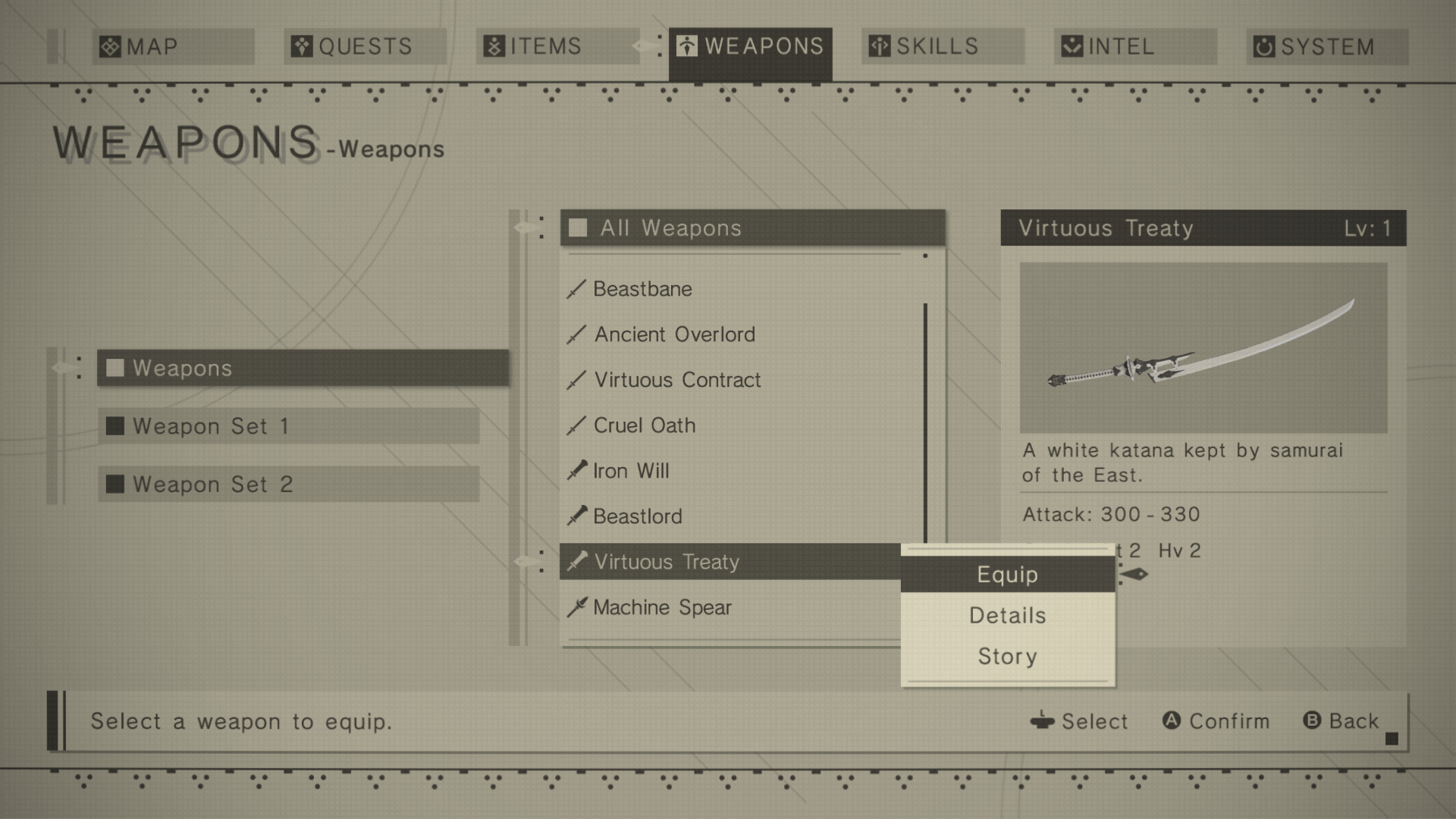 The "Story" option in the weapon context menu: the canonical entry point. The game does not auto-show stories; the player has to seek them. Source: Game UI Database.
A player who never opens this menu will go through Nier: Automata without seeing a single weapon story. The game does not warn them. Maintaining your weapons for combat efficiency reveals the prose as a side effect, you find out the katana has a story when you tap upgrade one too many times and a paragraph appears.
This is flavor-as-meta-narrative in the sharpest form: the world's deepest prose layer is discoverable, not narrated. Players who don't engage stay shallow. Players who do find the game's actual themes, repetition of violence, generational trauma, the persistence of suffering across forms, articulated nowhere else.
Why "meta-narrative" is the right framing
The weapon stories are not lore (background world-building) and not plot (events of the main story). They are a third layer of narrative that operates as commentary on both:
- The main plot is YoRHa fighting machine lifeforms.
- The weapon stories make a structural argument that every weapon has a victim, every fight has a survivor's story, and the cycle is older than the conflict.
By the time the player understands what the YoRHa androids actually are (a Route C/D reveal), the weapon stories have already told them, in dozens of small parallel forms, across 5–25h of upgrade choices.
So the weapon stories are not decorative. They are the thematic spine the player has been reading the whole time without realising.
What this teaches
- Flavor text is content. Most games treat item descriptions as a 30-character one-liner. Automata writes them as 200–400 words across four installments. If your game has equippable items, you have a budget here you may not be using.
- Gating prose behind upgrade levels couples narrative to engagement. The player who uses the weapon gets the story; the player who hoards it doesn't. This is a form of
late-introduced-mechanicsoperating at the prose layer. - The discoverable surface should reward seekers without punishing skippers. A player who never opens the Story menu still finishes the game. A player who reads every weapon's story has read a 100-page short-story collection. Same game; different texture.
- Authorial consistency in optional content earns trust. Because every weapon story leans into the same tonal palette (fairy-tale grim), players who find one are motivated to read another. Inconsistent flavor text trains players to skip.
Patterns this exemplifies
flavor-as-meta-narrative: the most committed instantiation in the knowledge base. Uncurated. Adjacent tolore-as-itemised-text(Souls games) but Yoko Taro's weapon stories are narratively continuous across upgrade tiers in a way Souls item text typically isn't.