Power forms
The series' iconic transformation mechanic, evolved across BN3 → BN6. One iteration per year, swinging between two design poles, permanent identity vs. per-battle commitment, until BN6 found the synthesis.
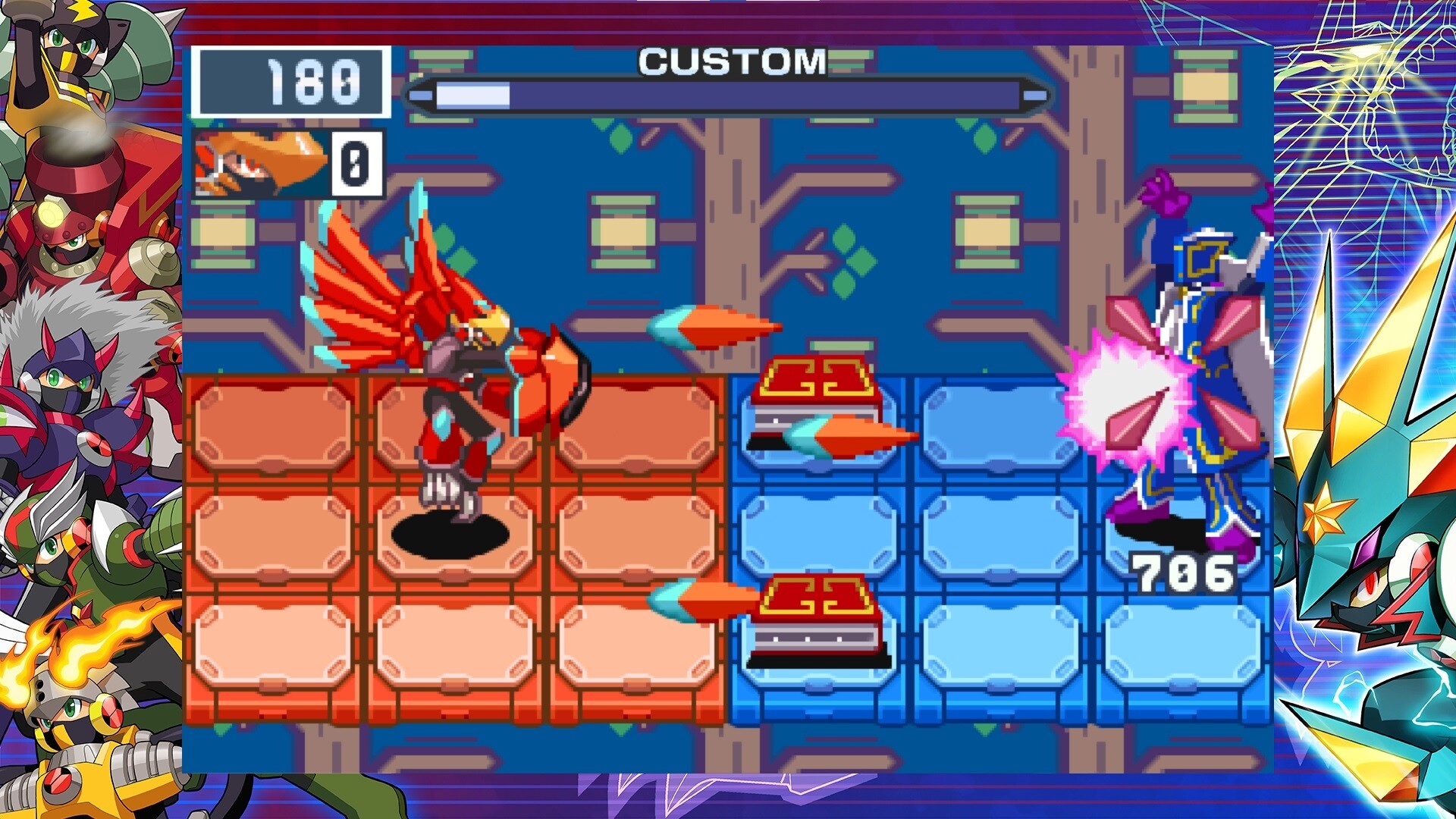 Beast Out (BN6, Falzar version). The series-final super-form: temporary, timed, with a forced fallback debuff (Bug Out) when the timer runs out. The synthesis of every transformation idea Capcom tried in BN3–BN5. Source: Steam.
Side-by-side evolution
| BN3: Style Change | BN4: Soul Unison | BN5: Soul + Chaos Unison | BN6: Cross + Beast Out | |
|---|---|---|---|---|
| Acquisition | Earned by play patterns (use Buster a lot → Guts; full chip folder → Custom; 4 chips of same element → elemental) | Defeat NPC Navi in story; fuse via chip code | Same as BN4, larger roster; Chaos Unison via DarkChips | Cross: defeat 5 NPCs (version-locked, Falzar/Gregar). Beast: absorbed mid-story |
| Form pool | 4 elements × 5 types = 20 nominal | ~6 Souls (Roll, GutsMan, ProtoMan, …) | ~10 Souls + Chaos variants | 5 Crosses (per version) + 1 Beast (per version) + Cross Beast hybrids |
| Trigger cost | None; auto-applies when earned | Sacrifice 1 chip of matching element/code at chip-draw screen | Sacrifice element chip (Soul) or DarkChip (Chaos) | Cross: free, switchable any time pre-battle. Beast: per-battle, consumes Emotion Counter |
| Duration | Permanent (until you earn another!) | 3 turns | 3 turns Soul; 1 turn Chaos | Cross: full battle (until hit by elemental weakness for 2× damage + drop). Beast: 3 turns max → Bug Out / Beast Over = Tired emotion locks Full Synchro for 1+ turns |
| Reward shape | Buster mods + NaviCust color affinity + passive | Element + signature chip ability + charge shot | Same as BN4 + DarkChip combos | Cross: element + passive (e.g., super armor, panel control). Beast: massive ATK/SPD + auto-counter, but timer pressure |
| Problem it solved | Replaced linear stat grind with playstyle-expressive identity | Style was random, non-deterministic: players couldn't choose their build. Soul made forms a deck-building decision | Expanded Soul roster + risk/reward via Chaos | Soul-cost-per-battle felt punishing. Cross gives a free baseline form; Beast is the opt-in super with a real downside |
What each iteration was solving
BN3's Style Change was a leap forward from BN1/2's linear stat upgrades. But the random earn condition felt like grinding, and players who'd earned a Style they liked could lose it by unintentionally triggering the next earn condition.
BN4 fixed earning by making Souls deterministic story unlocks. But the per-battle chip cost was tight: sacrifice one of your better chips to fuse, and you've lost a copy of that chip permanently from your Hand. New problem: Soul use felt punitive at the deckbuilding layer.
BN5's Chaos Unison added a darker risk/reward branch: sacrifice DarkChips for 1-turn ultra-fusions. But the system as a whole stayed inside the per-battle-cost frame.
BN6's Cross + Beast Out is the synthesis:
- Cross System is essentially Style Change reborn: always-available, identity-defining, free to switch. The "what kind of MegaMan are you?" baseline.
- Beast Out is essentially Soul Unison's burst version: a temporary super-form triggered when your Emotion Counter is full, with massive power and a forced debuff fallback (Bug Out / Beast Over).
The Bug Out fallback is the design move. Beast Out can't be spammed, when the timer runs out, you're locked into a Tired emotion state (no Full Synchro, no offensive surge) for at least 1 turn. Burst now, eat the consequence later.
This is one of the cleanest implementations of bonus-with-drawback I've seen in any action game. Compare with Spire's boss relics ("+1 energy, no potions"), PoE's keystones ("Chaos Inoculation: max life = 1"), Moonlighter 2's perk forks ("Ice or Thunder, not both"). Different game, same principle.
What this teaches about iterative live design
Capcom shipped one BN per year for five years on the same engine. The battle system + Folder + chip codes + Custom Gauge core stayed essentially frozen across all six games. What iterated was the meta-progression layer, NaviCust expanded outward, transformations swung between poles.
The lesson: yearly iteration on a single ruleset can converge to a layered solution faster than any single design pass, but only if the team keeps the scaffolding frozen. BN's combat shell was good enough in BN1 that the team never needed to revisit it; all the redesign budget went into the layers above.
This is the opposite of how some live-service games run. PoE2 chose to walk back PoE1's combat after 12 years of drift. BN's Capcom chose not to drift in the first place, keep the core, iterate the meta.
The cost: BN's audience saw similar games every year and some critics dismissed the series as repetitive. The benefit: by BN6 the design felt complete, layered, and self-balancing, and 20 years later it still holds up.
Patterns this exemplifies
bonus-with-drawback: Beast Out's burst-then-Bug-Out cycle is a textbook example.iterative-yearly-refinement: five years of iterating one transformation system on a frozen core, converging on a layered synthesis.