Ludonarrative reading
Reading Pokémon Ruby/Sapphire/Emerald's mechanics through the resonance lens.
Verdict: split. The Hoenn-as-nature framing, the starter-pick scene, and the trade-as-friendship loop all resonate cleanly. The competitive math layer (IVs, EVs, Natures, Abilities, weather) is honestly orthogonal to the "be a Pokémon Trainer" fiction, and that's a strength of the design, not a weakness.
The diagnostic question, applied
Describe the loop without the fiction. Does the description still read as a story about this character?
For the main loop: yes. "Travel between towns, meet wild creatures, befriend or capture some, build a small team, defeat regional gym leaders to prove you belong on the championship circuit, become Champion." That is both the system and the story.
For the competitive math layer: no. "Roll a 31/31/31/31/31/31 IV egg with a +Speed Nature, EV-train it 252/252/6 against fixed mob spawns, breed the right Ability via parent inheritance, slot a Choice Scarf." That is a math game; the story is irrelevant.
The split is the design's interesting feature.
What resonates strongly
The starter-pick scene
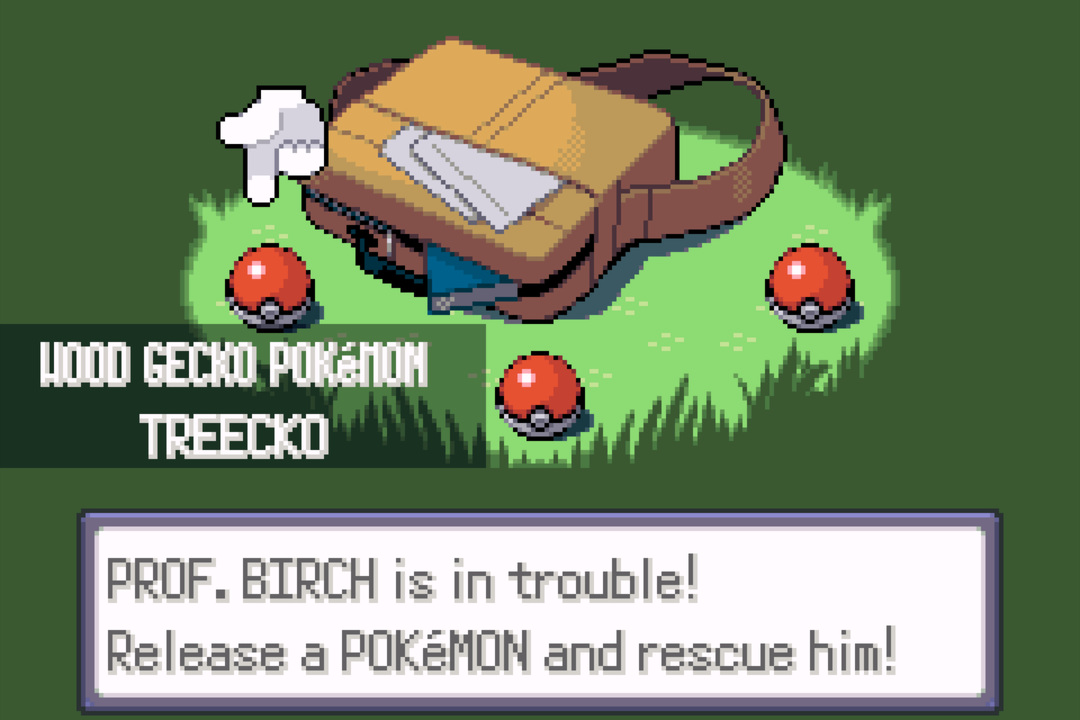
The very first decision the player makes is picking a starter to save Professor Birch from a wild Poochyena. The framing is: a stranger needs help, you are not yet a trainer, you have to commit to a partner under duress. There is no menu lobby, no character select; the choice is in-fiction.
The starter you pick will be your partner for 25 hours. The Fire/Water/Grass triangle is your first systems lesson AND the first meaningful in-fiction commitment. Mechanic and narrative are the same beat.
Resonance level: strong. The Pokémon series has been doing this since Gen 1; it remains one of the cleanest in-fiction onboarding moments in commercial games.
Hoenn as nature, mechanically
Junichi Masuda's design brief was "abundant nature", Hoenn-as-Kyushu, mountains and forests, tropical and seasonal. The mechanics follow:
- Weather routes. Some routes have permanent rain, some have permanent sandstorm, some have heavy fog. The weather-as-ability mechanic is foreshadowed by the world's weather being non-uniform.
- Surf, Dive, Climb. Hoenn is the first region where extensive HM-traversal opens significant water routes. Half the late game is on Surf.
- Berry trees and soil patches are physically present in the routes. Farming is a verb the world supports.
So the world's physical design (lots of nature, real weather, traversable water) and the mechanics' systems (weather-as-ability, water-traversal HMs, agriculture) reinforce each other. Resonance level: strong.
Trade as friendship
The cartridge architecture requires the player to interact with another player to complete the Pokédex. The fiction reinforces this, every Pokémon Center has a Cable Club where two trainers connect their consoles to trade or battle. Trade-only evolutions (Kadabra → Alakazam, etc.) make the social interaction necessary for power growth.
This is meta-altruism-on-completion operating ~15 years before Nier: Automata's Ending E, players trade Kadabra for Alakazam, then trade back, a small ritual that requires trust and reciprocity from the other party.
Resonance level: strong. The fiction is "you can't be a Pokémon Trainer alone." The mechanic enforces it.
What's orthogonal
IVs / EVs / Natures / Abilities
The four-axis competitive stat system is not doing thematic work. There is no in-fiction reason a Pokémon's "Sassy nature" should reduce its Speed by 10% and increase its Sp.Def by 10%. The mapping is arbitrary; the math is arbitrary; the trade-off is arbitrary.
This is fine. Pokémon's competitive math is a separate game with its own elegance. The fiction provides flavour (your Pokémon has a personality, makes you happy when fed Pokéblocks) but doesn't try to justify the math. Most casual players never read the math; most competitive players don't think about the fiction.
This is closest to Slay the Spire's verdict: light fiction, heavy math, honest framing. Resonance level: orthogonal.
Battle Frontier
Battle Frontier is a 7-facility post-game challenge sequence. Each facility has its own ruleset (rental Pokémon, fixed levels, single-elimination tournament, etc.), none of which are narratively motivated. The fiction is "you challenge the seven Frontier Brains because they're strong." The systems are "here are seven mini-games."
Resonance level: orthogonal, by design. The Battle Frontier is meant to be a math playground, not a story.
Weather Wars (the meta)
Weather-as-ability creates a competitive metagame in which Drizzle teams (rain) battle Drought teams (sun) battle Sand Stream teams (sand) for years. The fiction has nothing to say about this. Tyranitar isn't narratively a sand-summoning legendary; it just has the ability for systems-balance reasons.
Resonance level: orthogonal.
What's mildly dissonant
Magma vs Aqua: the version-split antagonists
Ruby's antagonist is Team Magma (wants to expand land, awakens Groudon). Sapphire's is Team Aqua (wants to expand sea, awakens Kyogre). Each version frames their team as the primary threat. The opposite team is the minor faction in your version.
The fiction can support this, both teams have a complete arc, but the narrative shape is partial in either cartridge. A player who only owns Sapphire experiences Magma as fringe villains; a player who only owns Ruby has the inverse experience.
Emerald fixes this by merging the plots. R/S's split is mildly dissonant, the story wants to be about both teams, and the cartridge architecture forced an asymmetry. Resonance level: mildly dissonant in R/S, repaired in Emerald.
This is interesting evidence that ludonarrative dissonance can be introduced by hardware/business constraints, not just by design intention. Game Freak's eventual fix (Emerald) is the canonical narrative; R/S's split version is an artifact of the cartridge-pair model.
"Be a Pokémon Trainer" but the EVs are gained from grinding
The most jarring meta-narrative break: a Pokémon Trainer in the fiction trains their Pokémon. The mechanic of "training" is to defeat 250 Slugmas in a row in Route 113 to max out one Pokémon's Sp.Atk EVs.
The fiction is "you're forming a bond with your friends." The mechanic is "grind the right mob in the right route." A competitive player will spend hours doing this.
This is the franchise's most enduring tension and Game Freak has slowly addressed it across generations, Hyper Training (Gen 7), Vitamins (uncapped in Gen 8), and Mints (alter Nature without re-rolling) all chip away at the dissonance. But in Gen 3, the math layer is the math layer, and the fiction is the fiction, and they don't pretend to be the same thing.
Resonance level: mildly dissonant.
Why this game matters for the lens
Pokémon RSE is interesting because it's the case where the same game can be played fully resonant OR fully orthogonal depending on the player.
A casual player reads the surface and never breaks resonance. A competitive player ignores the fiction and works the math. Both are correct uses of the design.
This is unusually permissive. Most games that are resonant are resonant for everyone (Hades, Hollow Knight, Nier: Automata); most games that are orthogonal are orthogonal for everyone (Slay the Spire, Path of Exile). Pokémon's split between the surface and the math is the rare middle case where the same product offers both readings.
Where it sits in the table
In the main resonance table, Pokémon RSE sits between Warframe and Path of Exile 2, both of which are "split" verdicts. The shape of the split is different (Warframe's narrative peaks resonate while the daily loop is orthogonal; Pokémon's main story resonates while the competitive layer is orthogonal) but the structural framing is the same.