Atlas: one-death maps
PoE2's endgame is structured similarly to PoE1's Atlas, a graph of map nodes the player traverses, with passive-tree investment shaping which mechanics spawn, but with one fundamental change: you get one attempt per map.
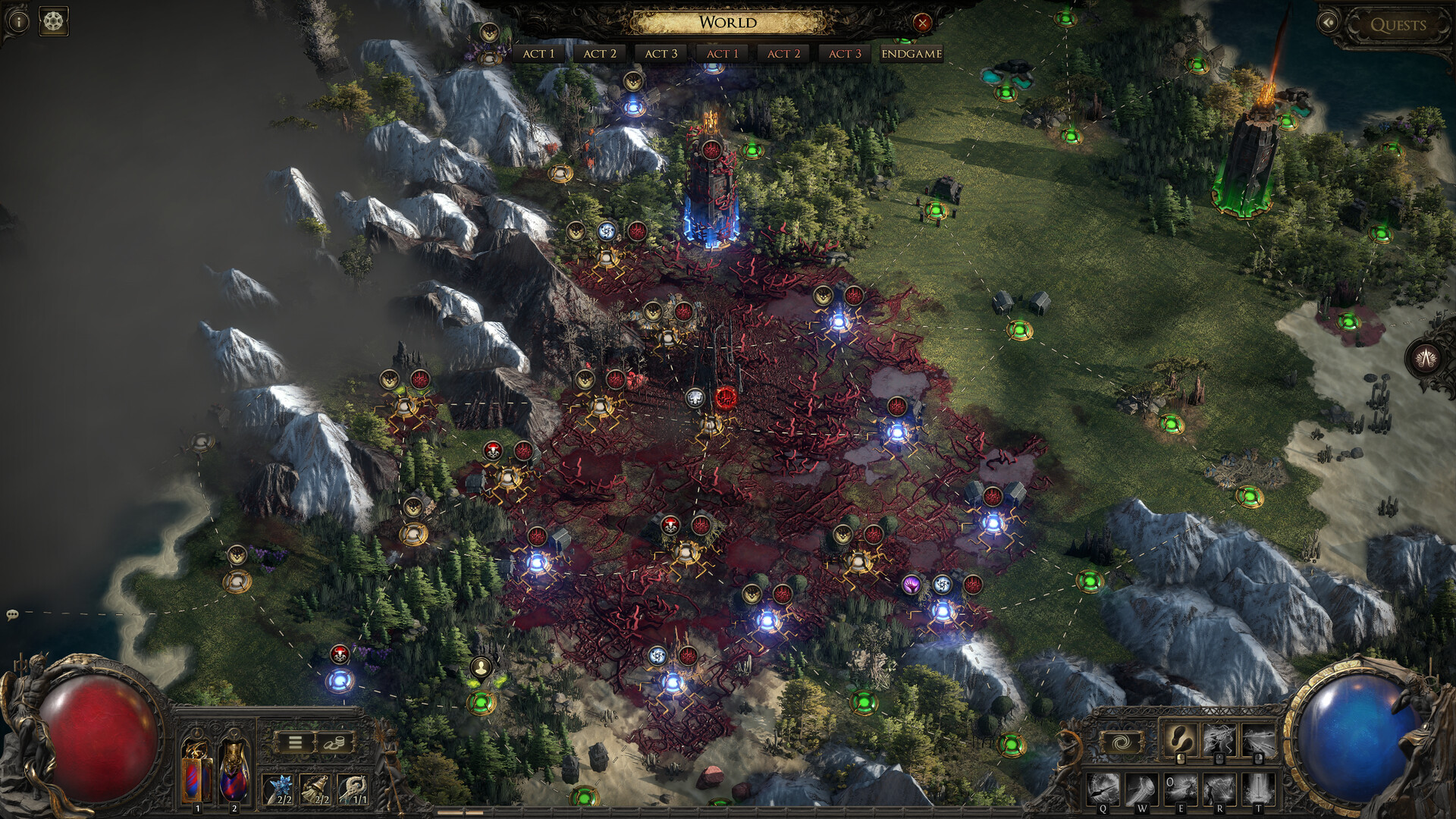 PoE2's endgame World Map. Map nodes are spread across an overworld; corruption visibly spreads through completed nodes. Source: Steam.
The one-death rule
In PoE1, dying in a map costs you 10% XP (above level 67) and the map ends, but you can re-enter the same map type by using another map. Maps drop frequently enough that "lose one, run another" is fine.
In PoE2:
- Each map is a node on the world map graph that you click to enter.
- Dying in the map ends the run. You cannot re-enter that node. The node is consumed.
- Loot you hadn't picked up is gone.
- Atlas progression contribution from that node is lost.
- Pinnacle bosses may have multi-attempt fragments, but otherwise: one death, map gone.
This is the single biggest and most-debated PoE2 design choice.
The stated rationale
Paraphrased from Jonathan Rogers (EA-launch livestream, December 2024):
If a map matters, dying in it should matter. One portal. One attempt. That's the deal.
The logic: PoE1's "die, try again, die, try again" loop made deaths feel free. Players didn't fear death because death cost only XP. PoE2's stake-restoration design says death should cost the run.
This is downstream of the combat philosophy decision, slowing combat means each fight matters; one-death maps mean each map matters.
Where it works
For players who want deliberate combat with real consequence, one-death maps deliver:
- Engagement during the map is heightened: every elite pack is a real check.
- Build resilience matters: pure-glass-cannon builds die in maps frequently and progress slowly.
- Clearing a hard map feels like an achievement, not a routine.
- Loot has weight: you're going to want every drop in this map because you can't come back.
The audience that wanted soulslike consequence in an ARPG broadly loves this.
Where it doesn't work
For players who want flow-state speed-clearing, one-death is hostile:
- One unlucky on-death effect ends the run. RIP-on-death chains in PoE1 are notorious; in PoE2 they're game-ending.
- Lag, disconnects, or rubber-banding can kill maps that should have been cleared. Online-game realities meet a permadeath rule.
- Casual players who can't reliably out-skill the difficulty stall on Atlas progression.
- Boss attempts are particularly punishing: testing a build vs. a pinnacle boss costs you the map.
The discourse split between purists ("this is what ARPG endgame should be") and the speed-clear audience ("this isn't fun, it's tedious") has been continuous from EA launch through April 2026.
Compared to PoE1's Atlas
| Element | PoE1 Atlas | PoE2 Atlas |
|---|---|---|
| Structure | Per-map node graph (each map is a separate instance) | Single contiguous overworld map graph |
| Death | XP loss + map ends, can re-enter via another map | XP loss + map node consumed, no re-entry |
| Voidstones | Yes | Different progression |
| Atlas tree | ~700 nodes, league-mechanic specialisation | New tree, similar shape |
| Pinnacle bosses | Multiple, gated by Conqueror/Maven progression | Different boss roster, similar role |
| Sustain | Maps drop maps; you sustain your pool | Map nodes are the world; sustain is graph traversal |
What this teaches
- One-death maps are a high-conviction design choice. They force the rest of the game to be balanced around survivability over speed. A casual cannot opt out.
- Stake restoration after a long-running drift is hard. PoE1 spent 12 years drifting toward "death is free"; PoE2 went the other direction in one swing. The pendulum is wide.
- There's no soft middle. If you adopt one-death, you commit. Half-measures (one death per multi-map session, etc.) probably don't deliver the intended feel.
Patterns this exemplifies
one-death-map: the design pattern. One attempt per content unit; failure ends the run.nested-progression-graph: like PoE1, the Atlas is a separate progression axis from the character. The shape is different (continuous overworld vs. per-map graph) but the role is the same.