Nested progression graph
Lemma: Long-running games stack multiple orthogonal progression axes instead of one big track. Each axis is its own graph (tree, chart, currency rank); the player picks an edge each session. Adding a new system layers in rather than replacing, old axes keep their meaning.
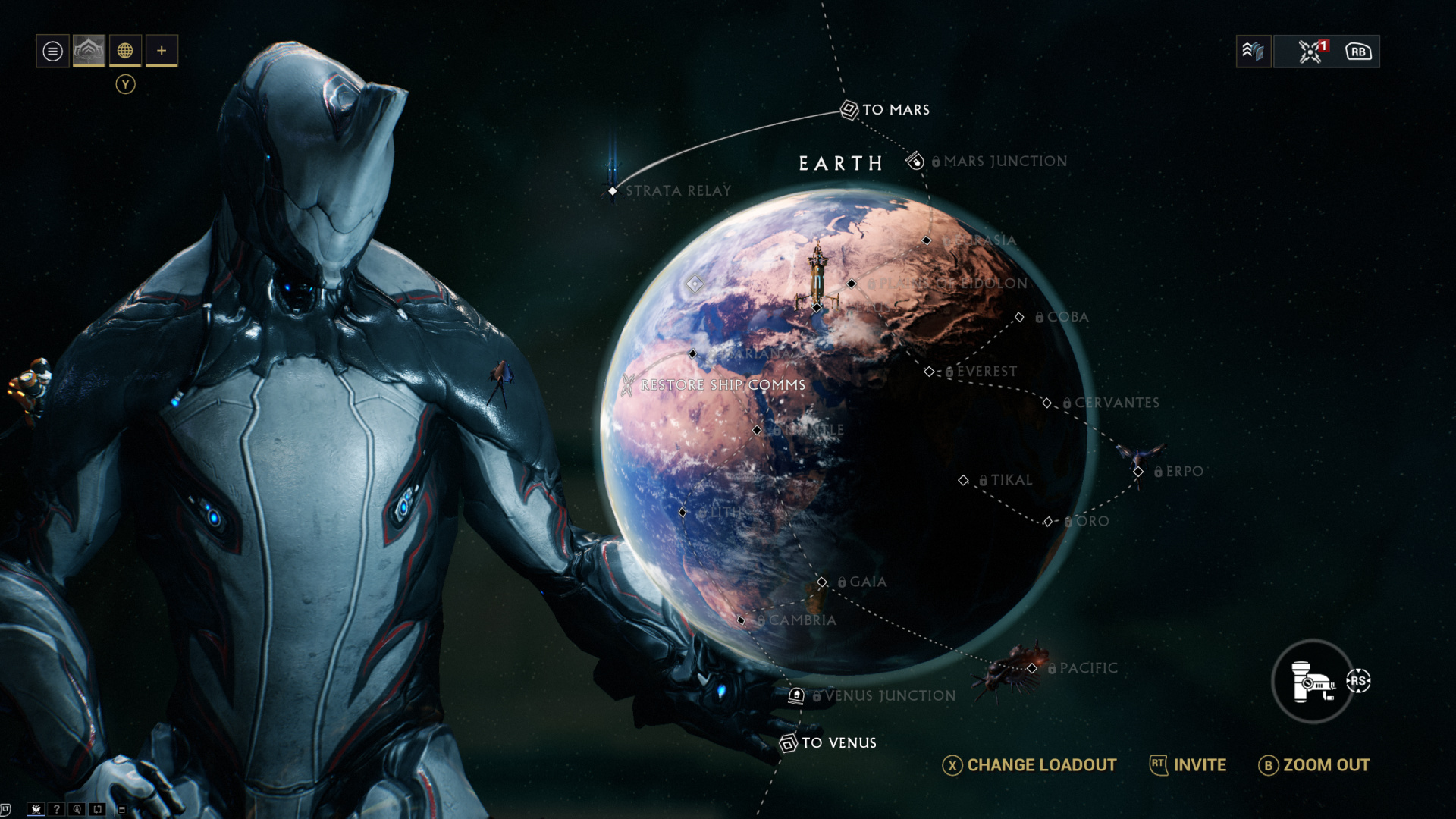 Warframe's Star Chart: one of nine progression axes. Beating Junctions unlocks new planets and new sub-systems (Archwing, Operator, Railjack), each of which is its own separate graph layered alongside this one. Source: Game UI Database.
What it solves
Linear XP is a thin treadmill. Once a player hits the cap, the game has nothing left to give except harder content. Live-service games solve this by exploding "progression" into a graph of progressions, character XP is one axis among many, and the others stay productive long after the level cap is hit.
The discipline is orthogonality. New systems must do something the old systems can't already do, otherwise they just compete with the old ones and force deprecation. When done right, a 12-year-old game can ship a new system that genuinely opens new ground without invalidating existing builds.
Variants across games
| Game | Axes | How they layer | Headline orthogonality |
|---|---|---|---|
| Path of Exile | Character passive tree (~1500 nodes) · Ascendancy (~8 dense nodes) · Atlas tree (~700 nodes) · gear / sockets / links · skill gem levels | Each is a separate respec / earn / spend loop. Atlas points come from completing maps, not character XP. | Atlas-as-build: the meta-game has its own tree, not just a difficulty slider. |
| Path of Exile 2 | Same shape as PoE1 but tightened: passive tree · ascendancy · atlas overworld · gear · weapon-set passives | Each weapon set carries its own subset of the passive tree, swapped mid-combat: a fifth axis layered on top | Weapon-set swap as an in-combat progression axis |
| Warframe | Star Chart · Mastery Rank · Quest progression · Focus (5 trees) · Syndicates (6 factions) · Helminth (subsume) · Steel Path · Incarnon · Arcanes | Each layer was added in a different year (2013–2024). Every new system added a parallel axis, never deprecated an old one. | Mastery Rank rewards breadth (rank everything to 30), making time-played proportional to content-experienced rather than to power. |
| Xenoblade Chronicles X | Character XP · Class mastery (17 branching classes) · BLADE division rank · FrontierNav probe placement · Skell licensing → Flight Module · Heart-to-Heart affinity | All six axes operate independently; FrontierNav probes generate resources in real-time even when offline | Single-player JRPG running an MMO-shape progression graph; the idle-game layer (FrontierNav) underneath the action layer is unusual outside of live-service. |
| Hollow Knight | Charms (notch budget) · Mask Shards (max HP) · Vessel Fragments (Soul cap) · Pale Ore (Nail damage) · Spells (3 base + upgrades) · Dream Nail (charges + lore-reading) | Each axis is a separate collectible scattered in the world; each has different commitment timescales (resettable charms vs. permanent HP) | Six axes from a 30-hour metroidvania: proves the pattern works at small scope, not just live-service. |
| Cult of the Lamb | Divine Inspiration tree (~6 building branches gated by Cult Level rows) · Doctrine tree (4+ permanent policy branches) · Sermon tree (per-Crusade modifiers) · Tarot codex · Weapon/Curse/Fleece/Relic pools · Follower-form collection | Each axis spends a different currency: Divine Inspiration (Devotion → points) for buildings, Faith for Doctrines, Sermons for skill nodes, dungeon Talisman fragments for Crown perks. Adding Sins of the Flesh in 2024 layered a 7th axis (Sin / procreation) without invalidating the prior six | Two-axis gating in the tech tree (category × Cult-Level row) plus six other parallel meta-graphs: unusually nested for a 20-hour indie scope |
The cleanest test of the pattern: what does a player do once they hit the level cap? Single-axis games have nothing. Nested-graph games have a dozen edges to follow.
Visual contrast: three games, three meta-graphs
| Warframe: Star Chart | Path of Exile: Atlas of Worlds | Path of Exile 2: Endgame World Map |
|---|---|---|
| 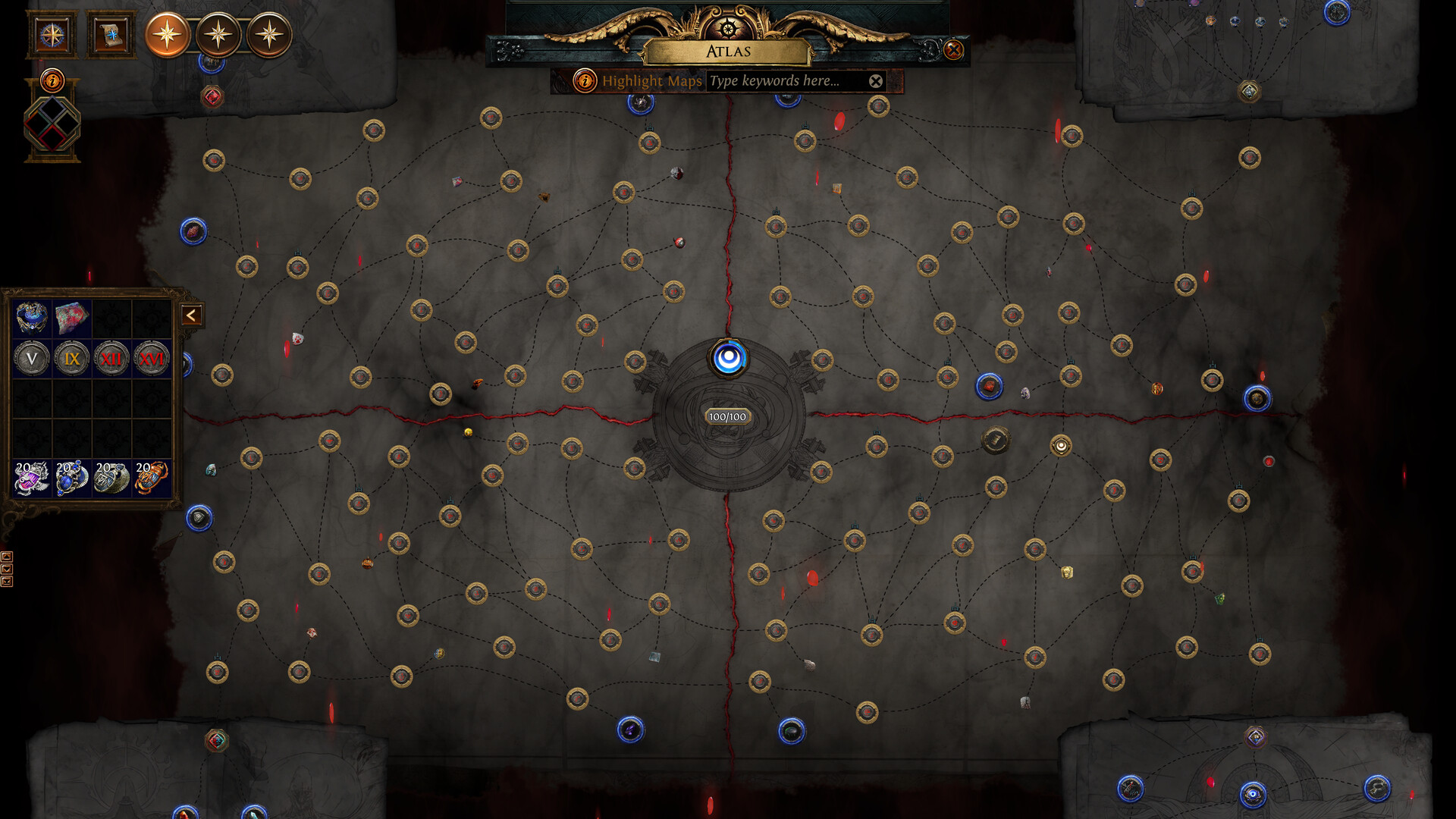 | 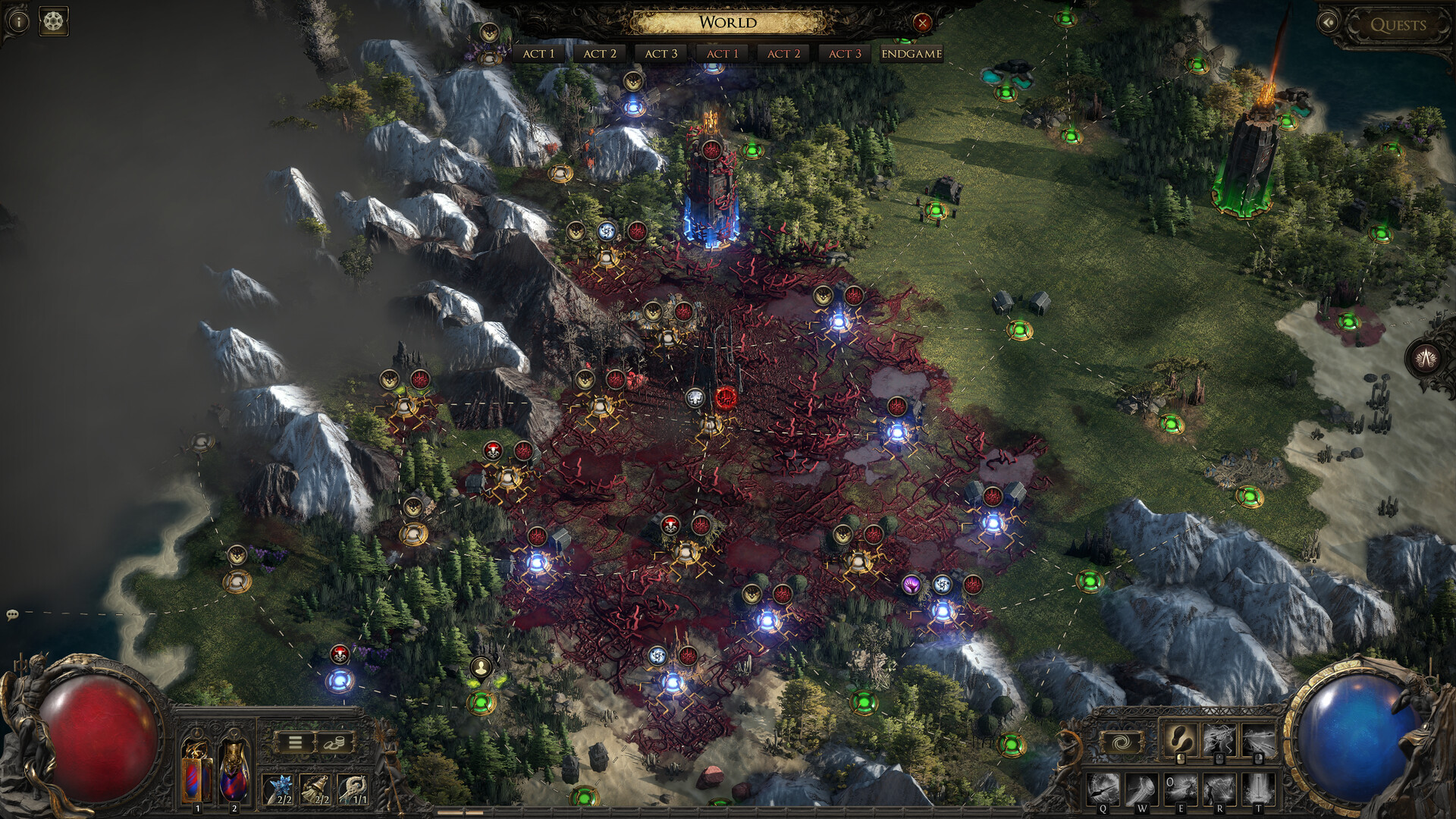 |
| Solar system overview: planets gated by Junctions. Each planet hosts mission types and entire sub-systems (Operator, Railjack). | ~115 map nodes connected in a web. Each map has its own affixes; the Atlas tree is a separate ~700-node passive tree on top. | Continuous overworld where corruption visibly spreads through completed nodes. Same role as PoE1's Atlas, different topology. |
These are three different shapes (radial chart, web, contiguous overworld), but each is a meta-progression axis the player builds out alongside the character. None of them are character XP; all three are productive long after the level cap.
When to use this pattern
- Live-service games that need to keep producing meaningful work for thousand-hour players.
- ARPGs / looters / MMOs where the post-campaign is the actual game.
- Sequels and expansions that want to add depth without invalidating existing builds.
Avoid when:
- The game is a closed-form 20–40 hour campaign. A nested graph is overhead with no payoff if the player will never see the third axis.
- Onboarding budget is tight. Each axis adds a UI surface, a vocabulary, and a tutorial moment. Nested graphs are brutal on new players (PoE's reputation).
Pitfalls
- Lack of orthogonality. If the new system is just "another way to get +damage," it competes with the old systems and forces deprecation. Helminth in Warframe works because slot-overwrite is a different decision from mod-fitting; if it had been "+10% damage per subsume," it would've replaced modding.
- Surface-area bloat. Each axis costs a UI, a tutorial, and a community wiki page. PoE1 currently has Atlas tree + scarabs + sextants + influence + altars + …; the EA reception of PoE2 partly reflects players wanting fewer axes, not more.
- Veteran walls. Returning players bounce off the cumulative complexity. Each axis added is also each axis a player who left in 2019 has to relearn.
- Cross-axis dead ends. Designing axes in isolation can produce combinations that are mechanically degenerate. PoE's Atlas mods × map mods × scarabs occasionally compose into "free loot" loopholes that get patched out post-hoc.
Adjacent patterns
meta-progression-tree: when a meta-axis (Atlas, Forma, etc.) is itself a tree, not just a counter. The Atlas tree is the canonical example.atlas-as-build: a specific case where the content axis (which maps spawn what) gets its own build space.mastery-as-meta-currency: Warframe's specific implementation of a breadth-rewarding meta axis.loadout-as-budget: usually orthogonal to the progression graph: each axis has its own budget. The character passive tree is one budget; the Atlas tree is a different one.
Why this matters as a design lesson
The pattern's discipline is harder than it looks. Saying "we'll add a new system" is easy; saying "we'll add a new system that's orthogonal to everything we've already shipped" is a real design constraint. Warframe has held the line for over a decade, every major expansion added an axis, none deprecated an old one. PoE shipped 12 years of league mechanics and only a handful (Synthesis, original Bestiary) were actually retired.
For a game intended to run for 5+ years, picking orthogonality as a constraint upfront is cheaper than mass-deprecating systems later.