Late-introduced mechanics
Lemma: Major systems unlock 5, 15, 30, even 60 hours into the game, not at the start. The campaign keeps revealing new mechanics long after the player thinks they've seen everything. Engagement at hour 50 comes from learning a new system that just unlocked, not from "more content with the same system."
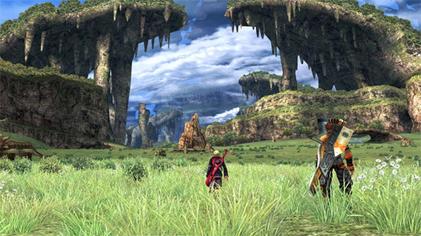 Xenoblade Chronicles is the canonical case. The first 5 hours teach combat. Hours 5–30 add affinity charts, gem crafting, skill links. Hours 30–60 add Colony 6 reconstruction and the entire post-Mechonis arc with Monado evolutions. The game keeps growing under the player's feet. Source: Wikipedia.
What it solves
The conventional wisdom, particularly from F2P / mobile design, is front-load: dump the loadout system, the gacha, the meta-progression, the class system on the player in the first 60 minutes, because most players bounce in hour one.
That works for 1–10 hour engagement curves. It fails for 30–80 hour ones. After 30 hours of the same systems with bigger numbers, players ask "what's the point of hour 31?" and quit.
Late-introduced mechanics solves this by dripping new systems across the campaign. The player at hour 30 doesn't get more content; they get a new system, Skells, classes, Ouroboros, Operator powers, Helminth subsume, that changes how the existing world plays. The world they already learned becomes new again.
The trade-offs:
- Higher dropout in the first 5 hours. Players who don't connect to the early systems bounce before seeing the deep ones.
- Tutorial moments at strange times. A tutorial pop-up at hour 35 interrupts flow.
- Returning-player walls. A 6-month break and the player has forgotten how layer 4 of the combo system works.
The pay-off:
- Engagement-at-hour-50 is strong. The hour-50 player isn't bored: they're learning.
- Replay value. Players who saw 60% of the systems the first time replay specifically to see the rest.
- Mechanic-narrative alignment. Each new system can drop alongside a story beat, so unlocking is a moment, not a UI pop-up.
Variants across games
| Game | Hour-1 systems | Hour-10 reveals | Hour-30 reveals | Hour-50+ reveals |
|---|---|---|---|---|
| Xenoblade Chronicles 2 | Basic combat, one Blade per Driver | Blade swap, Specials, Blade combos | Field Skills (gating zones), Mercenary Missions, Tiger! Tiger! mini-game | Aux Cores, NG+ Blade trading, Torna prequel DLC |
| Xenoblade Chronicles X | On-foot combat, basic FrontierNav | Class branching, BLADE divisions | Skells (mech mode + new combat shape), Flight Module | G-Buster cannon, online Squad missions, post-credits superbosses |
| Xenoblade Chronicles 3 | Basic combat, fixed character classes | First Ouroboros pair, Heroes start joining | Open class swap, advanced chain-attack rules, fusion arts | Future Redeemed DLC arc, ascension classes, optional Heroes |
| Warframe | Frame combat, basic Modding | Forma, Polarities, Junctions to new planets | Operator (Second Dream), War Within, Helminth subsume | Steel Path, Incarnon Genesis, Arcanes, Railjack |
| Path of Exile | Skill gems, passive tree, basic crafting | Ascendancy at mid-campaign (Labyrinth) | Atlas of Worlds endgame opens after credits | Atlas tree, Influence systems, eldritch implicits, pinnacle bosses |
| Mega Man Battle Network | Folder, basic chip codes | NaviCust opens (program packing) | Beast Out / Cross / Soul transformations | Program Advance recipes (community-discovered, in-game cryptic) |
| Slay the Spire | Combat, deck, map | Act 4 unlocks after first Heart-key | Ascension unlocks new modifier per win | Ascension 20, Daily Climb, Endless Mode |
| Hades | Run loop, hub dialogue, boon draft | Mirror of Night talents, weapon Aspects, first dialogue arcs | Pact of Punishment / Heat opens after first credits; deeper character arcs land at run #30+ | "True ending" arc requires ~10 specific clears; deepest dialogue lines fire at run #80+; H2 adds the surface path as a hour-30 reveal |
| Hollow Knight | Combat, charms, exploration | Cornifer + Iselda map tooling, first charms, Wayward Compass | Dream Nail (NPC mind-reading layer) ~hour 8–10, late-game biomes, White Palace platforming | Path of Pain (DLC), all Pantheon boss-rush content (DLC), True Ending requirements span 50+ hours |
| Nier: Automata | 2B's combat, basic chips, Pod programs | Side-scroller and shmup transitions; first weapon-story paragraphs | Route B (~hour 12) introduces 9S's hacking minigame as a major systems layer; Route C/D introduces A2's berserk mode | Ending E (~hour 25) introduces bullet-hell credits + asynchronous co-op + the save-deletion prompt: entirely new verbs at the very end |
| Pokémon RSE | 4-move moveset, type chart, party of 6, gym leaders | Contests (~h 5), Berry growing, Secret Bases | Trade-only evolutions, version-exclusive completion, double battles, weather-as-ability | Battle Frontier post-credits (Emerald only, ~h 25): 7 facilities × ~14 Symbols × ~50–100h. National Dex unlocks only after meeting 3 stacked conditions |
| Cult of the Lamb | 4 Bishops, base cult sim, 5 weapons / curses, no NG+ at launch (Aug 2022) | Blood Moon Festival ritual + 3 dark follower forms (Oct 2022) | Relics of the Old Faith (Apr 2023, ~8 months post-launch): post-game story, 37 Relics, heavy attacks on every weapon, all bosses revamped, Purgatory boss-rush, auto-difficulty, Quick Start, Permadeath, photo mode | Sins of the Flesh (Jan 2024, ~17 months): procreation / Mating Tent / Hatchery / Sin meter / Blunderbuss / Leader's Tent / Drinkhouse. Unholy Alliance (Aug 2024, ~24 months): local co-op rebuilt across full campaign. Woolhaven (Jan 2026): first paid expansion, winter-survival mechanics, Ranching, Flail. The drip happens across patches, not within one play-through; the lesson is the same shape |
| BotW | (anti-pattern: front-loaded): all 5 runes + paraglider + climb in the first 90 minutes on the Great Plateau | Camera (~h 5) is the only new utility | Master Sword (requires 13 hearts, ~h 15+), Hyrule Compendium completion (chases across the whole game) | DLC content: Trial of the Sword + Champions' Ballad shrines (post-credits, ~h 50+). The DLC adds contexts for the existing verbs, not new verbs |
The pattern spans wildly different genres, JRPGs, ARPGs, looter-shooters, deckbuilders. The common thread: the studio kept content gated behind hours of play, betting that hour-30 players would be more receptive to new systems than hour-1 players.
A few cases worth contrasting:
- Xenoblade is the canonical case: it does this most aggressively (XCX gates the Skell mech for ~30 hours; XC3 drips classes for 60+ hours).
- Warframe layers years, not hours: the Helminth subsume system was added in 2020, seven years after launch. New systems arrive even for veterans, not just new players.
- PoE's Ascendancy is the milder relative: only one major mid-campaign reveal (the Labyrinth). The endgame Atlas is a hard post-campaign break, not really a late drip.
- Spire is closest to a counter-example: most Spire systems are visible in the first run; Ascension just adds modifiers. The content changes, the systems stay roughly fixed.
When to use this pattern
- Long single-player campaigns (20+ hours). Front-loading wastes the back half; dripping systems funds it.
- Live-service games at year 5+. New systems for veterans are how engagement is sustained when the early-game content is fully solved.
- Trilogies / sequel series. Each entry can drop a new layered system without obsoleting prior systems: the iterative refinement model.
- Games that narratively unlock systems: a boss kill, a story beat, a faction join. Mechanic-as-reward, where the reward is "you can now play a different game."
Avoid when:
- The campaign is short (< 10 hours). Drip pacing assumes the player will reach hour 25; they won't.
- The genre expects player understanding upfront (competitive multiplayer, esports). Hidden systems are hostile to skill-development curves.
- Onboarding budget is tight. Each new mechanic past hour 10 needs its own tutorial moment; mid-flow tutorials are friction.
Pitfalls
- The first-impression review window is hostile. Reviewers play 10–15 hours and write up the game. If your best system unlocks at hour 25, no one in the press will see it. The review-driven discourse for Xenoblade games is explicitly "give it 25 hours" because the press knows. Most games can't afford this.
- Players who quit early miss the load-bearing system. XC2's combat depth is behind the 25-hour wall. Players who bounce at hour 8 think the game is shallower than it is. This is irreversible: those players don't come back.
- Drip too slow and the early game feels thin. XC1's first 5 hours have been called "boring" by veteran fans because the deep systems aren't online. If hour 5 lacks something to chew on, drip pacing is just slow pacing.
- Drip + tutorial overload. A pop-up for a new mechanic at hour 35 interrupts flow. The system reveal should integrate into a story beat or a hub-screen visit, not break out of an action moment.
- Returning-player friction. A player who took a 6-month break needs all the mid-game tutorials replayable. A Tutorial Log menu (Xenoblade does this; many games don't) is not optional for this pattern.
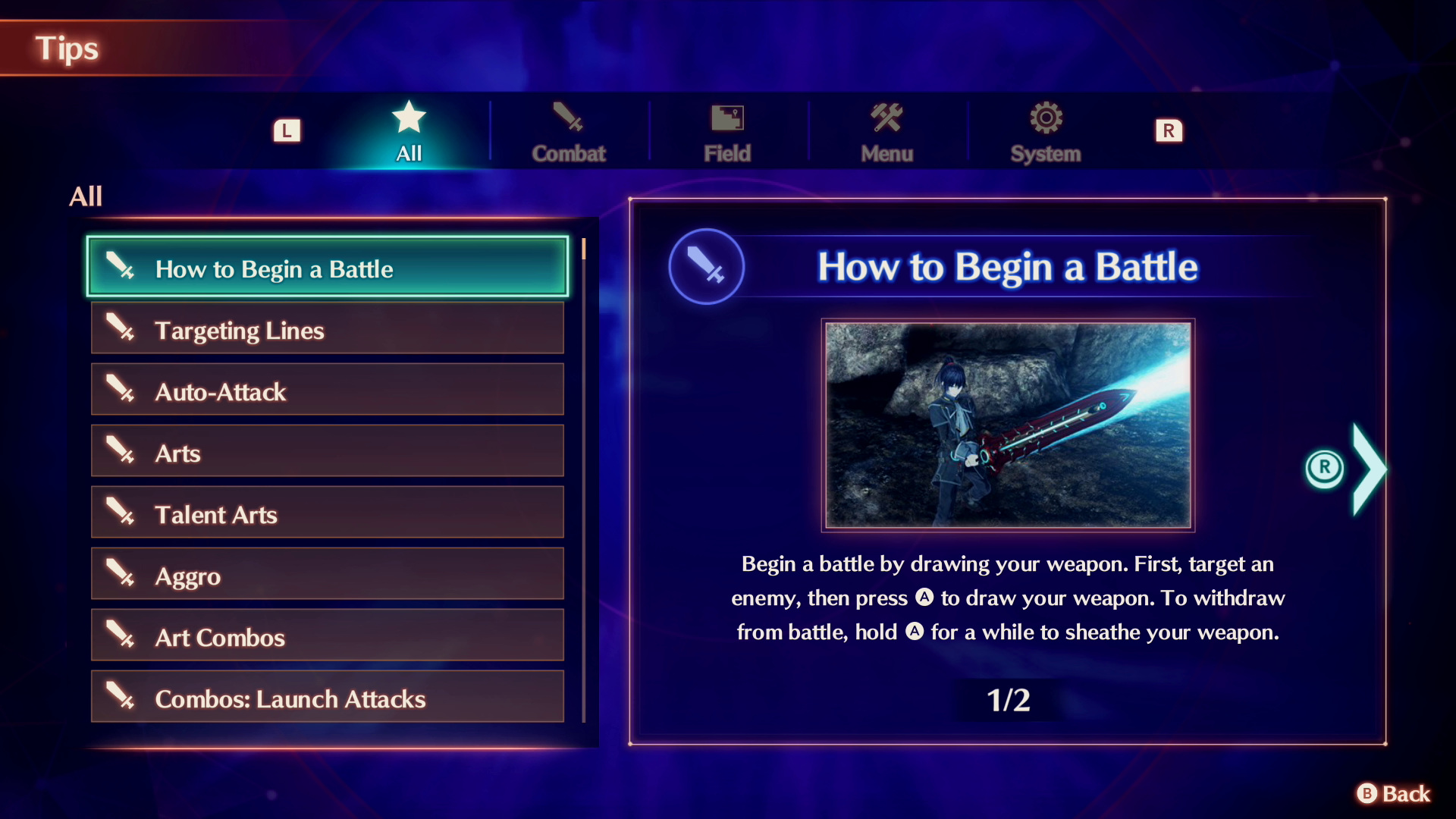 XC3's Tips menu: every tutorial that fired during the campaign is archived and re-readable, sliced by Combat / Field / Menu / System. A player at hour 50 who's forgotten the Aggro rules from hour 8 can pull them up here. This is the shape of "the tutorial log is non-negotiable" rendered as UI: cheap to build, load-bearing for any 60+ hour game that drips systems. Source: Game UI Database.
Adjacent patterns
nested-progression-graph: closely related but distinct. Nested is about how many axes; late-introduced is about when axes appear. Most games that ship one ship the other; the patterns reinforce.earned-identity-gating: sub-pattern. PoE's Ascendancy, XC3's Hero classes, these are identity-defining systems where the unlock is a skill-or-quest gate, not just a level threshold.iterative-yearly-refinement: the sequel-level analog. Mega Man Battle Network and Xenoblade both drip systems across entries the way they drip systems within an entry.
Why this matters as a design lesson
Front-loading is a defensive strategy: keep the player from quitting in hour one. Late-introduced mechanics is an offensive one: keep the player engaged at hour 50 by changing the game out from under them.
Most studios can't fund the second strategy. It requires:
- A long campaign (20+ hours).
- Content authored past every reveal: a system at hour 30 needs at least 30 more hours after it.
- A tutorial/replay system that lets returning players catch up.
- An audience patient enough to invest in the early hours without seeing the depth.
If you have those four, the drip is the most powerful retention mechanism in long-form games. If you don't, front-load.
For your own designs: pick a stance early. Don't drip into a 10-hour game. Don't front-load a 60-hour one. The mismatch shows up in reception.