Death as narrative
The series's signature design innovation. Every death sends the player back to the hub, where every NPC has fresh dialogue tracking what just happened. Cleared a new biome? Fought a specific boss? Used a new weapon? Took 0 damage from Megaera? Each of those run-events triggers a unique line, sometimes a multi-step conversation that advances over the next several deaths.
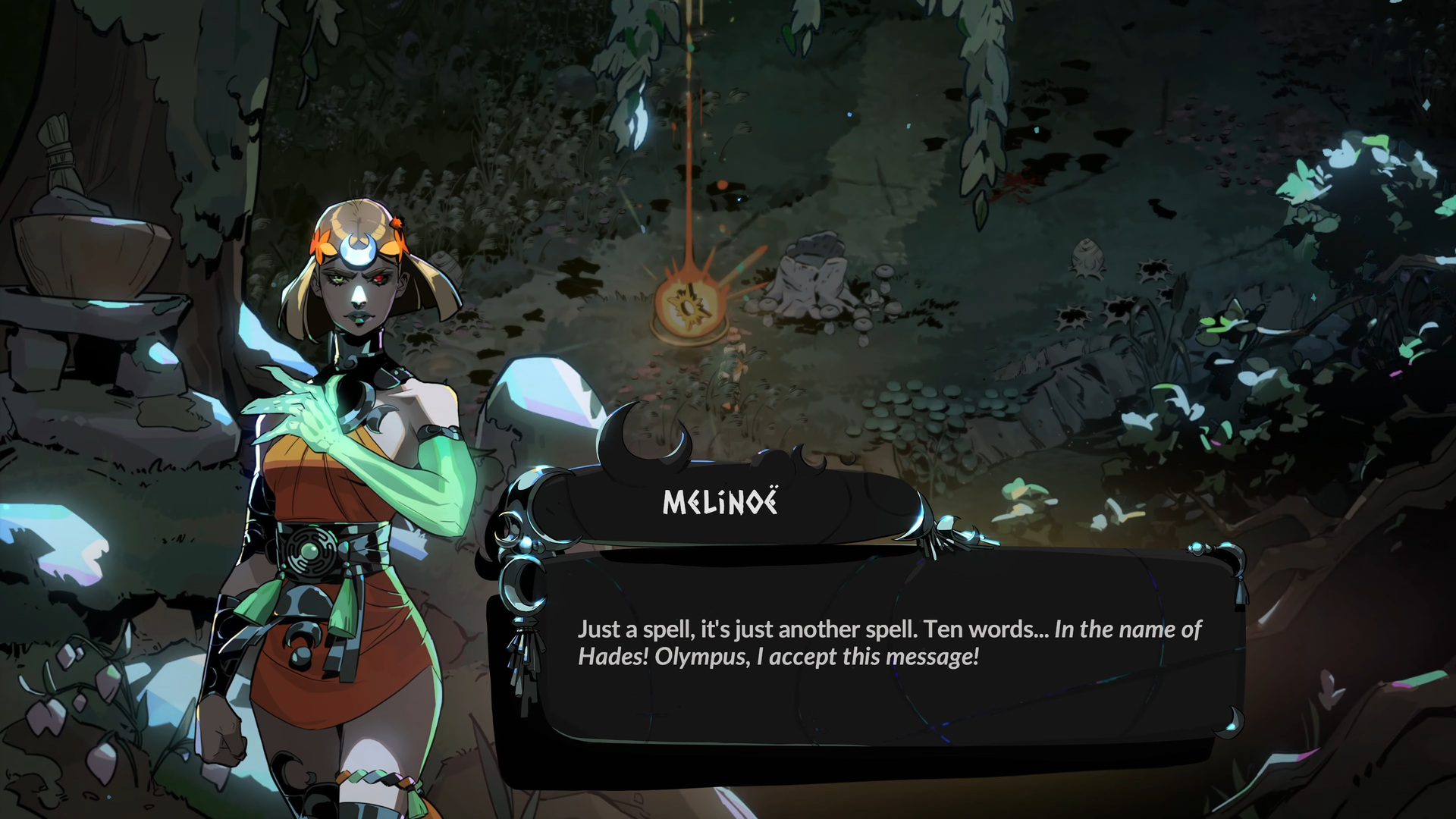 Melinoë soliloquy: written character moments slot directly into the gameplay loop. The text isn't a cutscene; it's a hub interaction that triggers because something specific happened on the last run. Source: Game UI Database.
How the system works
Every NPC in the hub (gods, family, mentors, shopkeeper, etc.) carries a dialogue list, usually 200–600+ unique lines. Lines are tagged with trigger conditions:
- "Player died to Megaera at least 3 times" → unlocks combat-mentor's targeted advice
- "Player carried 4+ Aphrodite boons last run" → Aphrodite teases about commitment
- "Player gifted Achilles Nectar 5 times" → Achilles arc advances
- "Player completed Asphodel for the first time" → Hades reacts coldly the first time, less the second
- "Player won a run with the Bow of Coronacht" → Artemis-arc-advances
Most lines fire once and never again. The same NPC has a background pool of repeating filler lines to fill silence between unique-line triggers, but the unique lines are what carry the narrative arc.
Why this works
Three things had to hold for "death advances story" to work:
- The death has to land in the same place every time (the hub). So the writer has a clean dialogue trigger surface. (Compare to: a roguelite that spawns the player at a new location each death; the writer can't anchor to anyone.)
- The hub has to have characters who care: mentors, family, antagonists who would naturally comment. Hades has the Greek pantheon plus an entire household of named NPCs. Few roguelites have this writing budget.
- The dialogue trigger system has to be granular enough to surface specific events, not just "you died". This requires real engineering on the trigger condition system.
When all three hold, the loop converts:
"I just died, this is annoying, restart"
into
"I just died, what does Achilles say to me about how badly I got owned by Megaera's whip?"
That's a want-to-see state at the moment of failure. It's the rarest emotional achievement in roguelite design.
Recent Remarks: the dialogue tracker
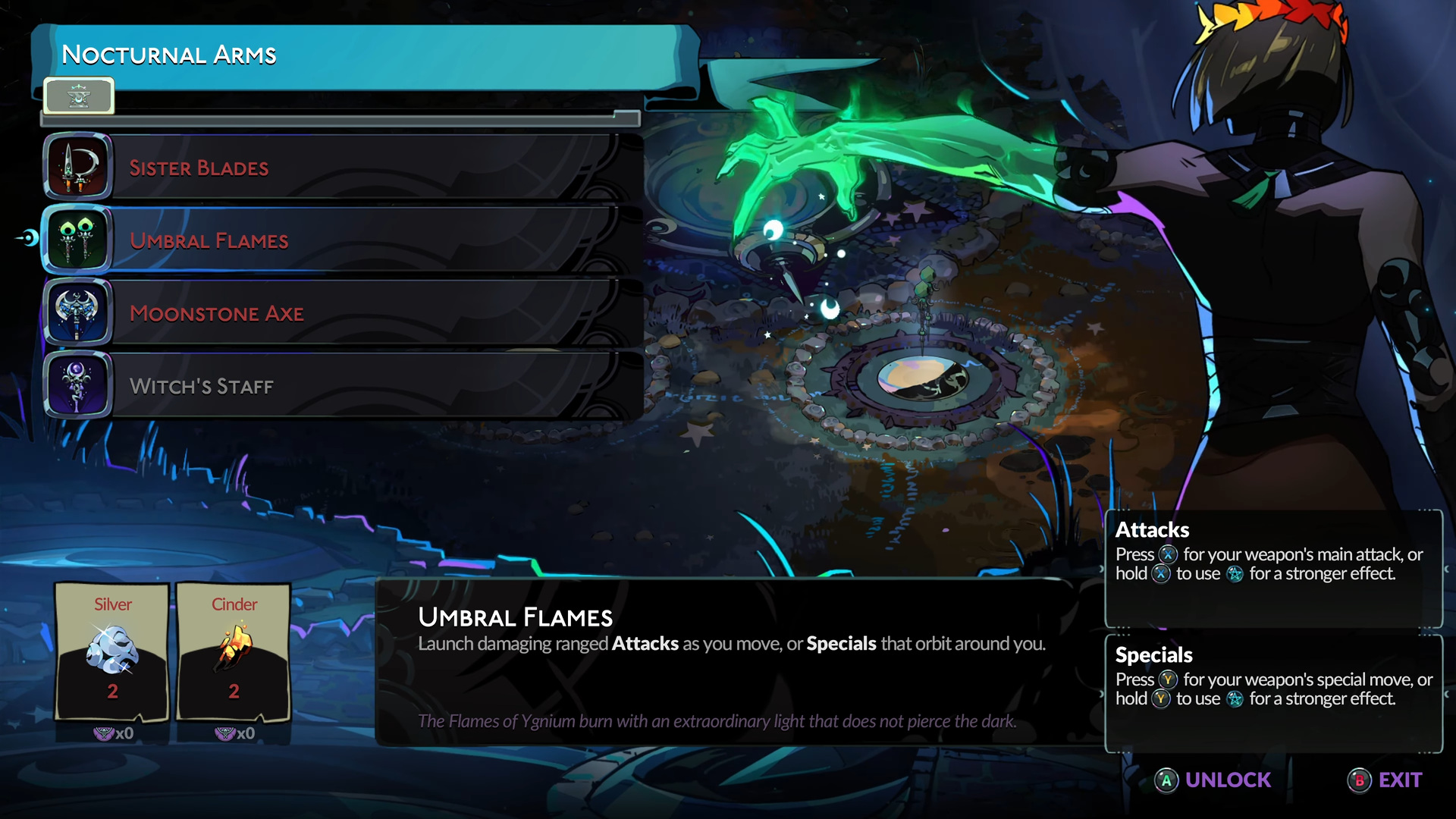 The Recent Remarks log surfaces the writing the player just heard, with character-color-coded paragraphs. Hades 2 added this explicit menu. Hades 1 trusted the player to read live; H2 acknowledges the volume of writing is enough that players want to re-read. Source: Game UI Database.
The Recent Remarks panel is a small UX win that signals how much writing volume the system supports. Players treat the dialogue as content the way Spire players treat new card unlocks.
What makes Hades 2 different
Hades 1 had ~21,000 lines of recorded dialogue. Hades 2 reportedly has more. The structural shape is the same: the hub is the Crossroads instead of the House of Hades, and the cast rotates (Hecate, Odysseus, Nemesis, Moros, Schelemeus, Dora, etc.), but the narrative-as-content mechanism is preserved.
H2 added one structural twist: two paths (descent into the Underworld + ascent to Olympus) means the dialogue triggers fork. NPCs you encounter on the surface path have their own unique-line pool, separate from the underworld's. This doubles the writing requirement; Supergiant accepted the cost.
What this teaches
- The "post-death return location" is a writing surface. Most roguelites waste it. If your game has a hub the player returns to on death, every NPC there is a potential dialogue-progression node.
- Trigger granularity unlocks volume. Vague triggers ("you died") produce 5 lines per character. Specific triggers ("you died to Megaera while carrying 4 Aphrodite boons") produce 500. The granularity determines how much writing the system can absorb.
- Recent Remarks / dialogue logs are not optional. When you're shipping ~20,000 lines of dialogue, players will miss some. A re-read panel converts "I missed that" into "let me look that up," and signals to players that the writing matters enough to track.
- This is a
late-introduced-mechanicssystem: many of the most distinctive narrative beats happen after 30–50 deaths. Players who quit at run 5 see a fraction of the dialogue tree.
Patterns this exemplifies
late-introduced-mechanics: the dialogue tree drips across 30–80 hours; players who quit early don't see the deepest writing.narrative-driven-roguelite: Hades is the canonical case study. Dialogue triggered by run-events makes failure productive rather than punishing.