Monetization model
The cleverness most often praised in design discourse. Worth understanding because it inverts the usual F2P assumptions.
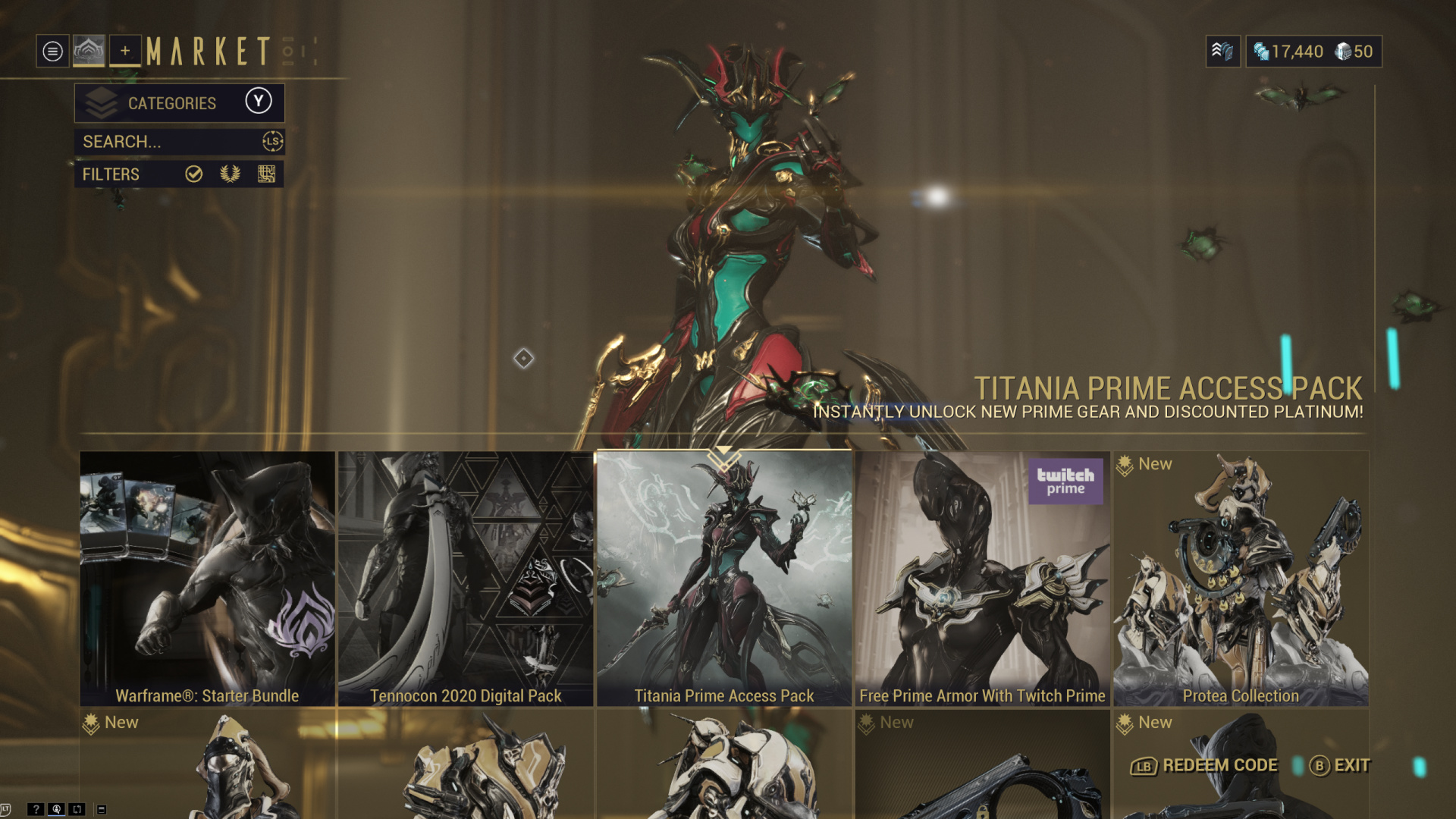 The Platinum store. Real-money purchases mint new Platinum. Player-to-player trades move it without minting. Sinks (cosmetics, instant builds, trade tax) destroy it permanently. Source: Game UI Database.
The triangle
- Platinum: the premium currency. Bought with real money. Spent on cosmetics, slots, instant builds, and trades with other players.
- Prime parts: the strongest equipment. Cannot be bought with Platinum directly from DE. Can only be farmed via the Void Relic system, or traded between players.
- Free players grind Prime parts. Paying players buy Platinum. Players trade Prime parts to free players in exchange for Platinum.
Net effect:
- A free player can grind their way to every premium item without spending a cent.
- A paying player can skip every grind by trading Platinum for parts.
- DE makes money from both populations.
- Free players are content for paying players: their farming generates the supply that paying players' demand consumes.
See dual-currency-with-trade.
Why it doesn't collapse into pay-to-win
You cannot trade Warframes themselves, modded gear, regular blueprints, most cosmetics, Forma/Reactor/Catalyst (mostly). So whales can't simply buy the game: they still have to play it.
What Platinum can buy:
- Cosmetics (skins, color palettes, weapon decorations).
- Inventory slots (frame slots, weapon slots: the real recurring revenue source).
- Instant Foundry skips.
- Player-listed Prime parts and Rivens.
The grind itself is mostly intact for paying players. They pay to skip waits, not to skip play.
Platinum sinks: the inflation cap
Real money mints new Platinum. Some Platinum gets destroyed along the way:
- Market purchases from DE.
- Instant Foundry builds.
- Trade tax (a small Platinum cost per trade).
Player-to-player trades of Platinum don't mint or destroy any, Platinum just moves between players' wallets. So the net Platinum supply only grows when real money is spent and only shrinks when DE-side sinks fire. This caps inflation.
If trades didn't have a tax, the economy would slowly drift. The tax is small enough to not feel onerous, large enough to keep the system bounded.
What this teaches
- Letting players trade premium currency is counter-intuitive but powerful. It removes the zero-sum framing of "F2P vs paying" and replaces it with a marketplace.
- Free players become supply. This is genuinely the design: DE wants free players, because their grind output is what paying players are buying.
- Sinks matter. Every premium currency needs ways to leave the economy that aren't just "transferred to another player."
- Anything that defeats the grind too easily is non-tradable. Forma, Reactors, Catalysts gate the long-term build progression and stay outside the trade economy by design.
Patterns this exemplifies
dual-currency-with-trade