Series evolution
The four Xenoblade games span 15 years (2010–2025) and platforms (Wii → Wii U → Switch → Switch DE remasters). Each entry kept the shared combat grammar (combat foundation) but added one major new system on top, and each entry kept introducing more systems dozens of hours into a single playthrough.
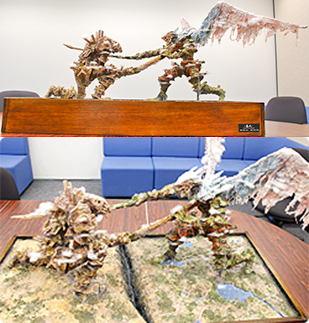 Bionis and Mechonis: the two god-corpses that frame XC1's world. The series's tradition of "the world is the body of a dead god" has continued through every entry: XC2's titans, XC3's Aionios, XCX's Mira. Source: Wikipedia.
Timeline
| Year | Entry | Platform | Hours-to-credits | Defining new system |
|---|---|---|---|---|
| 2010 | Xenoblade Chronicles | Wii | ~60 | Vision system + Affinity charts |
| 2015 | Xenoblade Chronicles X | Wii U | ~60 (main) / 200+ (full) | Skell mechs + planetary FrontierNav |
| 2017 | Xenoblade Chronicles 2 | Switch | ~80 | Driver/Blade pairing + gacha + Field Skills |
| 2020 | Xenoblade Chronicles: Definitive Edition | Switch | ~60 + Future Connected epilogue | Refined original; new epilogue |
| 2022 | Xenoblade Chronicles 3 | Switch | ~80 | Open class system + Ouroboros interlink + Heroes |
| 2023 | XC3: Future Redeemed (DLC) | Switch | ~20 | Standalone narrative bridge with refined combat |
| 2025 | Xenoblade Chronicles X: Definitive Edition | Switch | similar | Re-release with Switch refinements + new content |
What each entry added
XC1 (2010 / DE 2020)
Established the series:
- Auto-attack + arts cooldown + position-aware as the combat language.
- Break → Topple → Daze → Burst as the canonical state chain.
- Affinity Chart: a graph of all NPCs and their relationships; filling it through dialogue and side quests drives side rewards and lore.
- Heart-to-Hearts: discoverable cinematic conversations between any two party members at specific world locations. Story-as-collectibles.
- Vision system: Shulk's precognition. The series' most-celebrated mechanic. (vision-system.md)
Late-introduced systems:
| Hours | What unlocks |
|---|---|
| ~10 | Multi-character control |
| ~15 | Talent arts (the special "named" art each character carries) |
| ~25 | Gem crafting (a separate mini-game for stat-stick creation) |
| ~30 | Affinity Chart fully open |
| ~40 | Colony 6 reconstruction (resource gathering for hub upgrades) |
| ~50 | Skill Links (cross-character ability sharing) |
| Post-credits | Future Connected epilogue (DE only, 10–15 hours additional) |
XCX (2015 / X-DE 2025)
The outlier. Sparser narrative, denser world, bigger map, mech-focused combat. Reception was split, XCX is the most MMO-feeling Xenoblade and the most divisive in the fanbase. The 2025 Switch Definitive Edition added new content and pulled it back into the conversation.
What XCX added:
- Skells as a layered combat-and-traversal mode revealed ~30 hours in. (skells-and-frontiernav.md)
- FrontierNav as an idle-game probe network on top of action combat.
- 17 branching classes vs. fixed character roles in XC1.
- BLADE divisions as a daily-task progression system (closer to MMO weeklies than to single-player JRPG progression).
- Soul Voice as a dialogue-driven chain-attack analog.
- Online Squad Missions: the only Xenoblade with online co-op. Drop-in, time-limited squad runs against pinnacle bosses.
Late-introduced systems are XCX's thing: Skells at ~30h, Flight Module at ~40h, FrontierNav linking at ~25h, online Squad missions at endgame, G-Buster cannon at post-credits.
XC2 (2017)
The most-divisive mechanic-density entry. Three combat layers (Driver / Blade / Fusion combos), Rare Blade gacha, Field Skill open-world gating, Tiger! Tiger! mini-game. (blade-driver-pairing.md)
Reception was bifurcated. Fans: one of the deepest combat systems ever shipped; gacha pulls produce real long-term engagement; the prequel DLC (Torna, The Golden Country, 2018) is one of the best standalone JRPGs in years. Critics: opaque tutorial, anime aesthetic that drove some away, gacha mechanics in a $60 premium product.
Late-introduced systems are XC2's worst-and-best, players who push past the 25-hour learning curve report the second half is exceptional; players who don't never see Mercenary Missions, Tiger! Tiger!, Aux Cores, NG+ Blade trading, or the optional super-bosses.
XC3 (2022)
The synthesis entry. Borrows from XC1, XC2, XCX and combines them:
- 6 party members (vs. 3 in XC1/2): more bodies on screen than any prior entry.
- Open class system: Heroes drop in, you absorb their classes, any character can be any class. (class-and-ouroboros.md)
- Ouroboros: pair-fusion mech form (distantly XCX-Skell-influenced, but mechanically distinct).
- Heaviest chain attacks in the series: full menu game inside combat with multi-stage tactic cards.
- Heroes: 20+ NPC characters who join temporarily, each carrying a personal Hero Quest.
Late-introduced systems: Heroes drip across 60+ hours, each unlocking a new class. Chain-attack rules (Tactic ordering, multi-character chain extension, hero-card interactions) reveal across 30+ hours. The Future Redeemed DLC in 2023 added a standalone arc with new combat refinements.
The recurring pattern
Every Xenoblade game holds back ~40% of its systems past the 20-hour mark. This is unusual. Most JRPGs front-load systems and shift to content in the back half. Xenoblade keeps shifting systems.
The trade-offs Monolith Soft accepts:
- High dropout in the first 20 hours. Players who don't connect early bounce. The series's reputation has always been "give it 25 hours."
- Tutorial overload at strange moments. A new mechanic dropping at hour 35 means the player is mid-flow: interrupting flow with a tutorial pop-up is friction.
- Returning-player walls. Coming back to XC2 after a 6-month break and remembering what Specials vs. Blade Combos vs. Fusion Combos are is genuinely hard.
The pay-off:
- Engagement-at-hour-50 is strong. The hour-50 Xenoblade player isn't bored: they're learning a new system that just unlocked. This is rare in 80-hour games.
- Replayability. Players who saw 60% of XC2 the first time often replay specifically to see the systems they missed. The mechanic drip creates the replay reason.
- Mechanic-narrative alignment. Each new system tends to drop alongside a story beat. The new mechanic isn't just unlocked: it's narratively earned (Hero Quest completes → class unlocks; Skell license earns → mech equips).
This pattern is the cleanest case study in the late-introduced-mechanics concept page.
Cross-entry continuity
Each entry stands alone. But mechanics evolve:
| System | XC1 | XCX | XC2 | XC3 |
|---|---|---|---|---|
| Auto-attack + cooldown arts | ✓ origin | ✓ extended | ✓ + Specials | ✓ + class-driven |
| Break → Topple chain | ✓ origin | ✓ adapted | ✓ + Launch + Smash | ✓ + Burst |
| Telegraph | Vision (XC1 unique) | Wind-ups | Wind-ups + boss markers | Wind-ups + chain previews |
| Chain attack | ✓ origin | Soul Voice variant | Element-orb chain | Multi-stage tactic menu |
| Class system | Fixed roles | 17 branching | Fixed Drivers + Blade-driven | Open (any character / any class) |
| Affinity / relationships | Affinity Chart | Heart-to-Heart + soul voice | Affinity Chart per Blade | Hero affinity + Class mastery |
| Vehicle / mech mode | : | Skells | : | Ouroboros (similar role) |
| Late-system drip | ~5 systems past h25 | ~6 systems past h25 | ~7 systems past h25 | ~6 systems past h25 |
Patterns this exemplifies
late-introduced-mechanics: Xenoblade is the canonical case study. Every entry; every entry doubles down.iterative-yearly-refinement: same shape as Mega Man Battle Network. Combat core stays; meta layers iterate per entry until XC3 synthesis.