The shrine network
The decision that defines BOTW's exploration shape. Classic Zelda games have 8 long dungeons, each ~3 hours, each gating a major item. BOTW has 120 small shrines (~10 minutes each) scattered across Hyrule, plus 4 Divine Beasts as the big-dungeon compromise.
This is one of the most-discussed design changes in modern open-world play. Fujibayashi's framing: the open-world ratio, how often you find a meaningful destination while wandering, drove the count.
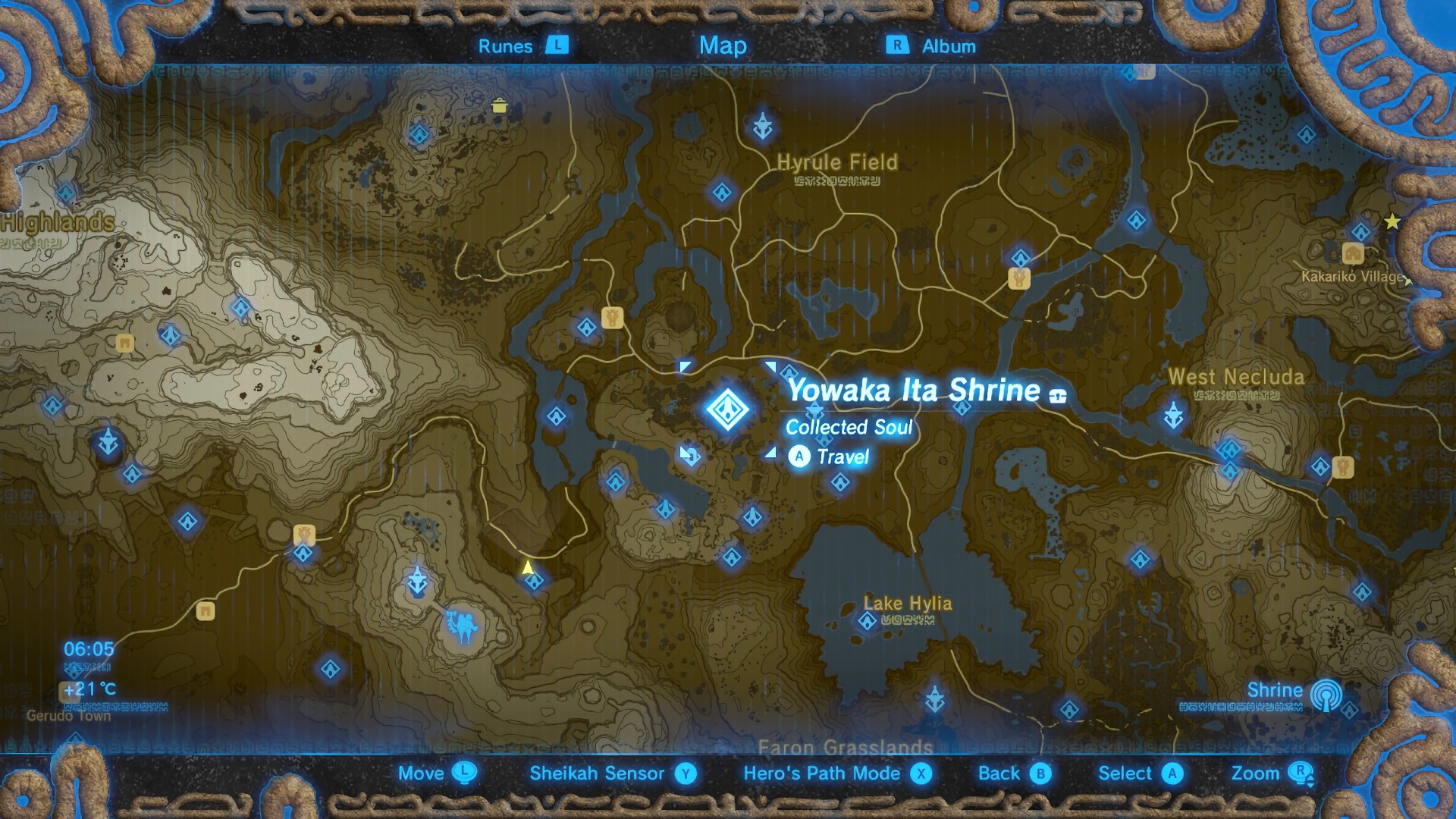 The shrine network on the map. Each blue diamond is a 10-minute puzzle. Shrines that have been cleared show "Collected Soul": the shrine's reward is one Spirit Orb, traded 4-for-1 at Goddess Statues for a Heart Container or Stamina Vessel. Source: Game UI Database.
The numbers
- 120 base shrines + 16 DLC shrines (Trial of the Sword + Champions' Ballad) = 136 total.
- Each base shrine takes ~5–15 minutes for first-time completion (some "blessing shrines" are puzzleless and instant; some "test of strength" shrines are combat-only).
- Reward per shrine: 1 Spirit Orb + a chest with random loot (sometimes a unique item or weapon).
- 4 Spirit Orbs = 1 trade at a Goddess Statue → choose +1 Heart Container OR +1 Stamina Vessel.
- 4 Divine Beasts (the long-dungeon analogue): Vah Ruta, Vah Medoh, Vah Rudania, Vah Naboris, each a single 1-hour puzzle.
So the shrine count is calibrated: 120 ÷ 4 = 30 trades = enough to fill either the heart bar OR the stamina ring almost completely, but not both.
Why this many?
Fujibayashi's stated logic in interviews:
"When we considered the size of the field, about 60 km², and how often a player would want to find something while wandering, we calculated the ratio. … That worked out to about 100 or more shrines."
, Hidemaro Fujibayashi, paraphrased from coverage on Niche Gamer and NintendoSoup
The metric is open-world density. Walking 5 minutes in a random direction should produce a meaningful destination. Working backwards from "5 minutes" and "60 km²" produces ~120 destinations. Shrines were sized to fit the density.
The tradeoff Fujibayashi notes: long dungeons take too much time per node. A 3-hour dungeon prevents the player from re-aligning with the open world for a long stretch. A 10-minute shrine lets them dip into a puzzle and come back out fresh.
"We didn't want a dungeon to take too much player time, so we designed each shrine to take around 10 minutes."
, Hidemaro Fujibayashi
Why also Divine Beasts?
The 4 Divine Beasts are the team's compromise. They acknowledged:
"When we considered each shrine takes around 10 minutes, we realized it might not feel enough for a Zelda title. So we decided to incorporate big dungeons with unique features, a moving dungeon, a gravity dungeon, etc."
, Hidemaro Fujibayashi
Each Divine Beast is itself a whole environment, a giant mechanical creature the player has rotated, climbed, or otherwise reshaped, with 5 terminals (mini-puzzles) plus a boss. Total ~1 hour per beast.
The Beasts are widely critiqued in BOTW reception: many fans feel they are not enough compared to a classic Zelda dungeon. Tears of the Kingdom (2023) responded by adding 4 longer, more-distinct dungeons (Lightning Temple, Wind Temple, Water Temple, Fire Temple), closer to classic-Zelda shape. So the team recognised the shrines-replace-dungeons trade was incomplete.
Shrine design: the consistent verb-set
Every shrine uses the same fixed verb-set: 5 runes (Magnesis, Stasis, Cryonis, Bombs, Camera) + paraglider + climb + bow + sword. No shrine introduces a new verb. Every puzzle is a recombination of existing ones.
This is critical for the system to scale. 120 puzzles built on 8 verbs means each puzzle is teaching a combination, not a new mechanic. The author burden is reasonable.
Categories of shrine:
- Major Tests of Strength (Guardian boss combat shrines: same enemy, scaled difficulty)
- Minor Tests of Strength (puzzles + ambient combat)
- Shrine Quests (the shrine is hidden, the player solves an open-world puzzle to reveal it)
- Blessings (no puzzle: reward for completing the open-world Shrine Quest itself)
Roughly half the shrines have an associated Shrine Quest, a riddle from an NPC, a hidden environmental clue, or a logic-puzzle (e.g. "stand atop the platform when the moon is full"). Solving the quest reveals the shrine.
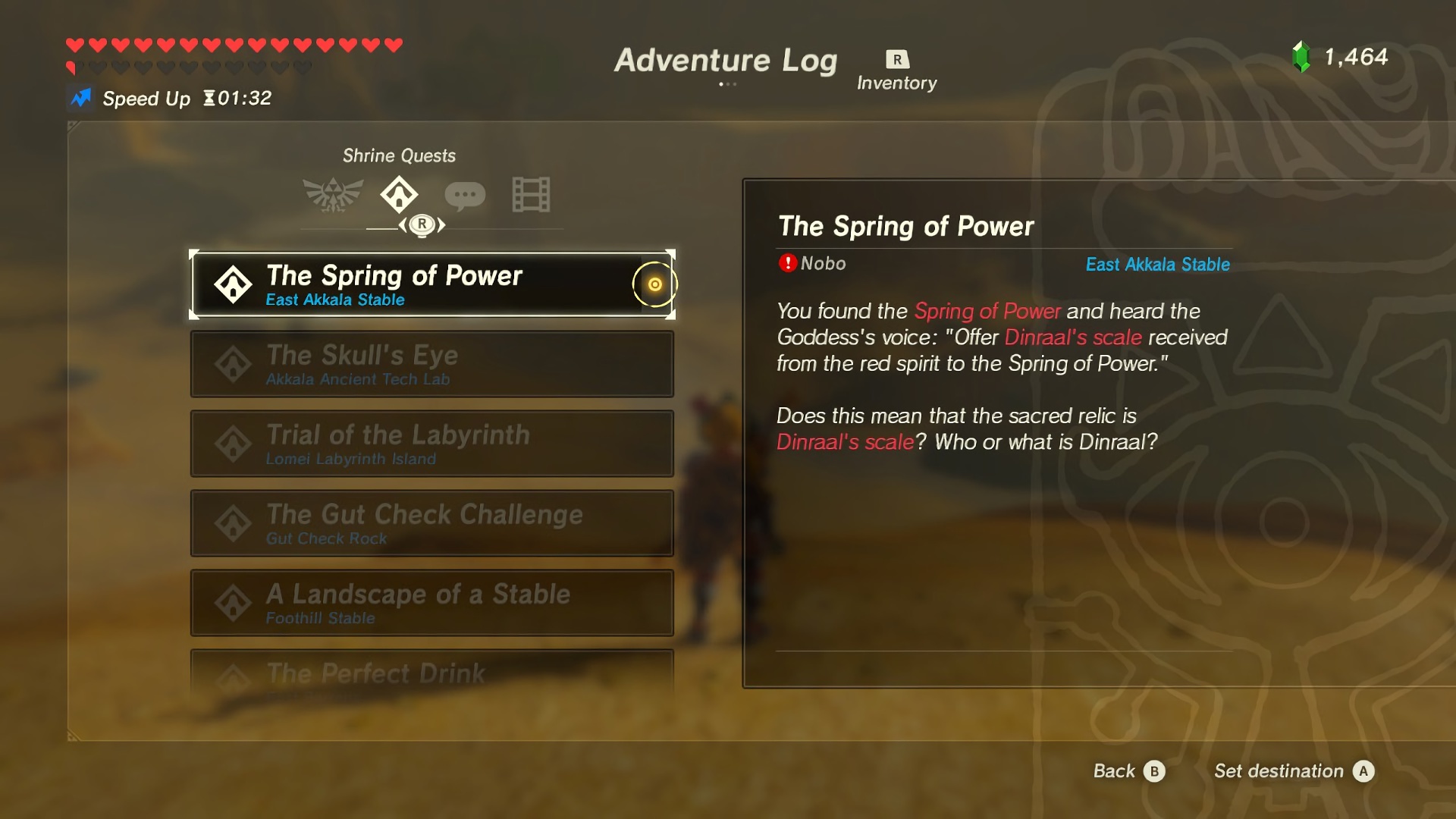 Shrine Quests are tracked in the Adventure Log. Each quest reveals a shrine on completion: sometimes the puzzle is environmental ("stand atop the platform"), sometimes a fetch ("offer Dinraal's scale"), sometimes a logic puzzle. Source: Game UI Database.
The shrine as a save-spawn
Shrines double as fast-travel beacons. Once cleared, a shrine can be warped to from anywhere on the map. The player's own movement-network grows with every shrine they clear.
So clearing a shrine has three mechanical payoffs:
- Spirit Orb (1/4 of a Heart or Stamina trade).
- Loot chest (random; sometimes unique-armor pieces).
- Permanent fast-travel point.
The third is the most valuable in terms of cumulative play time. By 60 hours in, an experienced player has ~80 fast-travel points; movement around Hyrule becomes near-instantaneous in the gaps between shrines.
The shrine count debate
The 120-shrine count is a contested choice. Two sides:
Pro: 120 small puzzles at ~10 minutes each = ~20 hours of puzzle content alone. That's roughly equivalent to the puzzle content in 6 classic Zelda dungeons. The aggregate is comparable; the texture is different.
Con: Many shrines are formulaic. Test of Strength shrines (~20 of them) are the same Guardian fight at different HP scaling. Blessing shrines have no puzzle at all. Fans argue the unique puzzle count is closer to ~80, which is fewer than the count suggests.
Both readings are correct. Fujibayashi has acknowledged the test-of-strength repetition in retrospect; Tears of the Kingdom replaces them with unique-puzzle shrines.
What this teaches
- Open-world density is a designable number. Pick the walking-radius you want between meaningful destinations, work backwards from area to count. BOTW's 60 km² ÷ 5-min-radius = 120 nodes is a clean design exercise.
- Bite-sized puzzles complement open exploration. Long dungeons take the player out of the world. 10-minute shrines let them dip back into the field after a mental break. The pacing logic is sound.
- A fixed verb-set scales. 120 shrines on 8 verbs works because the verbs are deep. Adding a 9th verb at shrine 60 would have invalidated the first 60. Don't introduce new mechanical primitives mid-tail.
- Reward stacking compounds. Shrines give Spirit Orb + loot + fast-travel point. Three independent reward axes per node multiplies player motivation: even a "boring" shrine pays in three currencies.
- The shrine-vs-dungeon trade is incomplete. Tears of the Kingdom's return to long dungeons suggests the team agreed shrines alone weren't enough. The lesson: small puzzles work alongside long dungeons, not in place of them.
Patterns this exemplifies
shrine-network: many small puzzle-nodes scattered across an open-world map, each rewarded with a small currency that aggregates into permanent meta-progression. Uncurated; BOTW is the canonical case.bite-sized-puzzle-loop: 5–15 minute puzzles inside a long-form open-world. Uncurated.
Adjacent patterns
late-introduced-mechanics: Shrine Quests gradually unlock as the player meets the right NPCs. Many shrines aren't accessible in the first 10 hours.loadout-as-budget: the Heart vs Stamina trade at every Goddess Statue is the meta-economy that gives shrines their permanence.