Atlas of Worlds
The post-campaign map system. The campaign exists to onboard you to mechanics; the Atlas is the actual game. Atlas of Worlds was added in expansion 2.4 (August 2016) and has been the load-bearing endgame structure ever since.
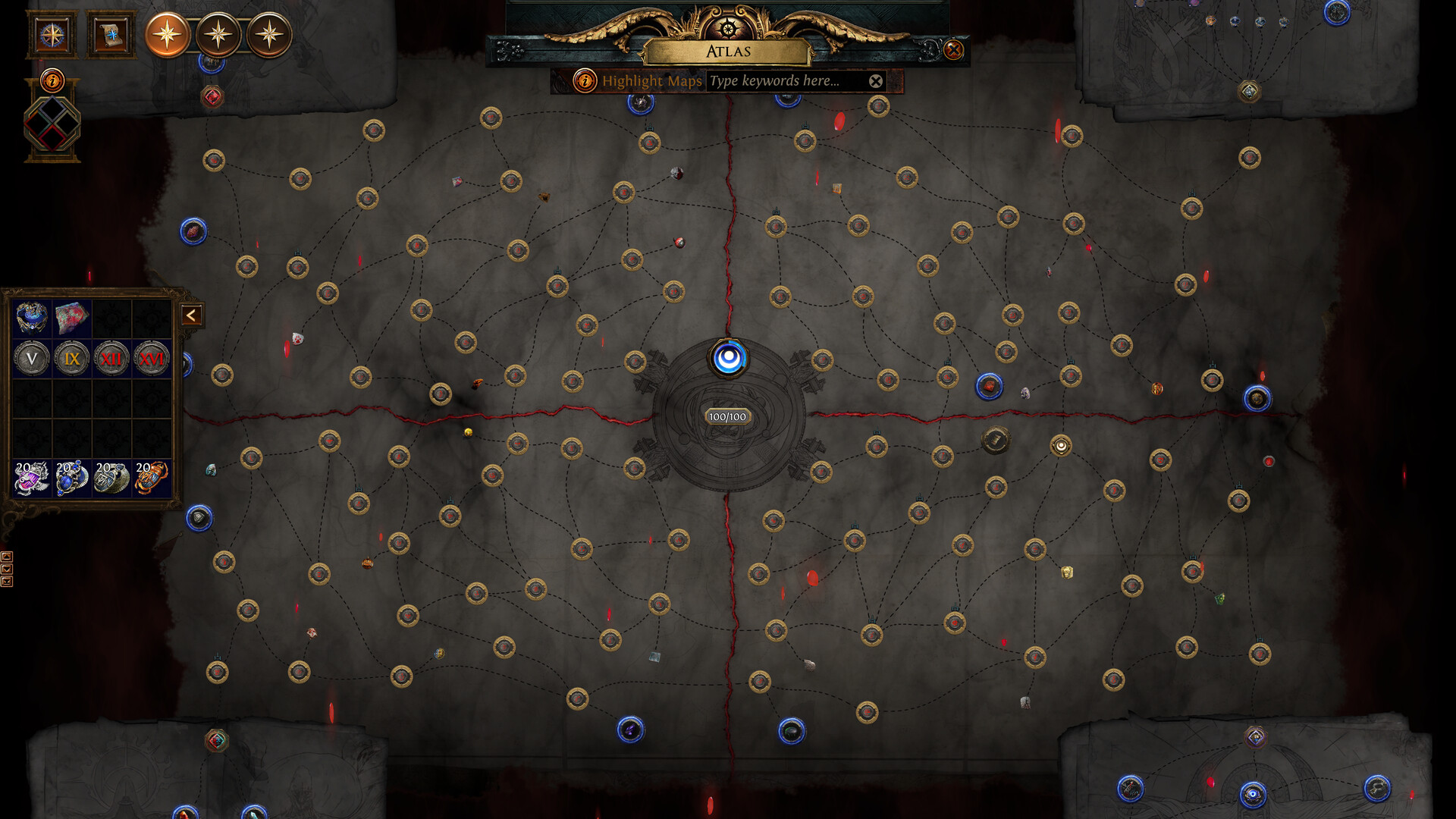 The Atlas: ~115 map zones connected in a web. Each circle is a map; you traverse by completing maps to unlock adjacent ones, and each map has its own Atlas-tree affixes that the player can build into. Source: Steam.
Structure
- Tier 1 → Tier 16 maps. Each map is a self-contained zone (~5–10 minutes). Tier scales monster level and rewards.
- ~115 distinct map archetypes. Each archetype has its own layout, monster mix, and ambience.
- Voidstones (4 in total): earned from pinnacle bosses; each Voidstone raises the effective tier ceiling so all maps scale to T16. Without Voidstones, low-tier maps stay low-tier.
- Atlas Passive Tree: a separate ~700-node passive tree that shapes which league mechanics, map mods, and rewards spawn in your maps. Earned by completing maps with bonus objectives.
Maps as items
Maps are physical drop items. They drop from monsters, get rolled with affixes the same way gear is, and get consumed when used.
- Item Quantity (IIQ): increases the number of items dropped from monsters in this map.
- Item Rarity (IIR): increases the rarity of those items.
- Pack Size: increases the number of monsters in the map.
- Map mods: combat-difficulty modifiers ("monsters deal 100% extra damage as fire", "no life regeneration", etc.). Each mod added increases reward but also increases the chance you die.
The early endgame is therefore a sustain puzzle: you need maps risky enough to drop more maps (and currency), but not so risky that you die in them.
The Atlas Passive Tree: the meta-build
Introduced as per-region trees in 3.13 (Echoes of the Atlas, 2021), unified into a single global tree in 3.17 (Siege of the Atlas, 2022). It's a separate progression axis from the character's own passive tree.
Players "build" their Atlas like they build a character. Specialize into Breach, Legion, Essence, Expedition, etc.: or take generalist mass-density nodes. Each league mechanic (Heist, Delve, Sanctum, Expedition, Ritual, Ultimatum, Beyond, Anarchy, Bloodlines …) is exposed to the player as a knob on the Atlas tree, not as a standalone system.
This is what makes the Atlas feel like a build instead of a checklist. You're not just running maps, you're running maps tuned to drop your preferred currency stream.
Pinnacle bosses
PoE1 has a small constellation of pinnacle bosses gated behind multi-step Atlas progressions:
| Boss | Source | Drop tier |
|---|---|---|
| Sirus, Awakener of Worlds | The Conquerors of the Atlas (Citadels) | Awakened gems, Influence orbs |
| The Maven | Maven's Invitations | Orbs of Conflict, Maven's Orb |
| Searing Exarch | Eldritch Altar progression | Eldritch Embers (implicits) |
| Eater of Worlds | Eldritch Altar progression | Eldritch Ichors (implicits) |
| Uber Elder | Shaper's Realm | Watcher's Eye, top tier uniques |
Each has an Uber version at significantly increased difficulty, sold as a chase fight for endgame characters. Each one's drops feed into specific crafting paths, beating each boss is also unlocking a tier of build materials.
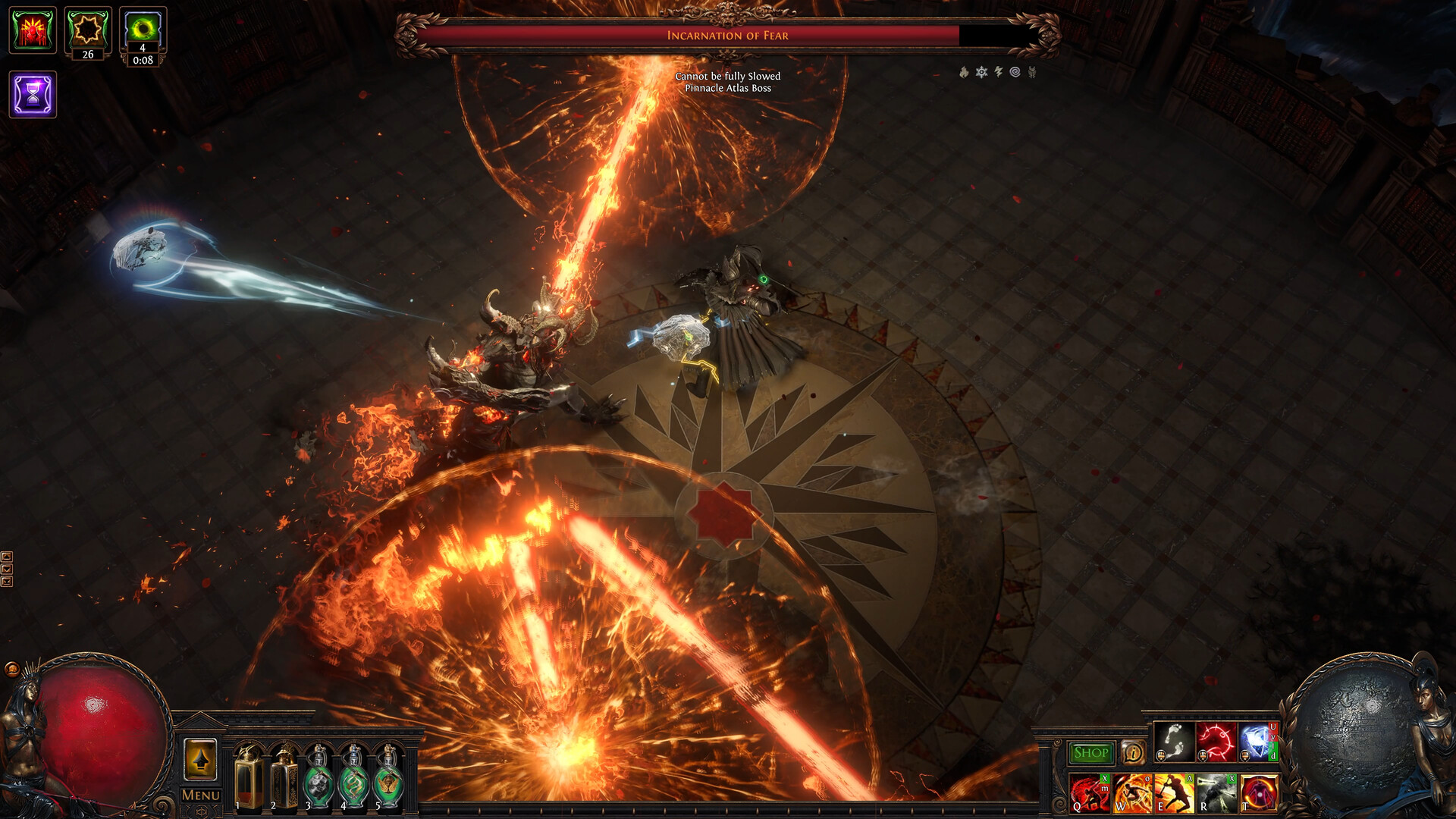 Pinnacle Atlas Boss combat: the design role is build-test plus economy tap. Each pinnacle drops a tier of crafting materials specific to its mechanics. Source: Steam.
The standard endgame progression
Acts 1–10 (campaign, the prologue)
  → unlock Maps (T1–T5, white tier)
  → yellow maps (T6–T10), first real challenge
  → red maps (T11–T16), Atlas tree starts mattering
  → Conquerors (4 mini-bosses) → Sirus → first 2 Voidstones
  → Eldritch Altar progression → Searing Exarch + Eater of Worlds → 2 more Voidstones
  → fully scaled T16 Atlas, every map is now max difficulty
  → 8-mod bosses, Maven invitations, Uber pinnacles
The wall is 8-mod content: invitations rolled with 8 stacked map mods. These require a build that survives gigantic damage spikes plus 5 simultaneous bosses. Casual builds stop here; min-maxed builds clear them efficiently. The cliff between "I beat the campaign" and "I cleared the Feared 8-mod" is roughly the cliff between 50 hours and 500 hours of skilled play.
What works and what doesn't
Works:
- Atlas-as-build is widely loved. Player choice over which league mechanics spawn turns a generic monster-density grind into a personalized loot loop.
- Pinnacle bosses are some of the genre's best fights: multi-phase, mechanically dense, build-testing rather than DPS-checking.
- The Voidstone progression gives endgame an actual finish line (rare in F2P live-service ARPGs).
Doesn't:
- Map sustain is a perennial complaint. Mid-tier players can stall hard if RNG denies maps.
- The 10% XP penalty at level 95+ feels disproportionate when one-shots exist.
- Layout RNG (Crypt, Burial Chambers vs. open maps like Strand) makes league mechanics inconsistent: some maps support certain mechanics, some don't.
- The sheer surface area (Atlas tree + sextants + scarabs + influence + altars + …) is a wall for returning players.
Patterns this exemplifies
nested-progression-graph: the Atlas is one of three orthogonal trees (character passive, ascendancy, atlas). Each is its own progression axis.atlas-as-build: the meta-game gets its own build space, not just a difficulty slider.meta-progression-tree: earning passive points from completing maps (not character XP) decouples meta-progression from per-character progression.