Jokers as multiplicative modifiers
The build. 150 base Jokers, 5 starting slots. Every Joker is a passive trigger: it fires on hands played, on cards scored, on suits hit, on hand types matched, on round end, on shop visited. Some add chips; some add mult; some multiply mult; some scale per-trigger; some interact with other Jokers.
Solving a Balatro run is solving the Joker synergy graph.
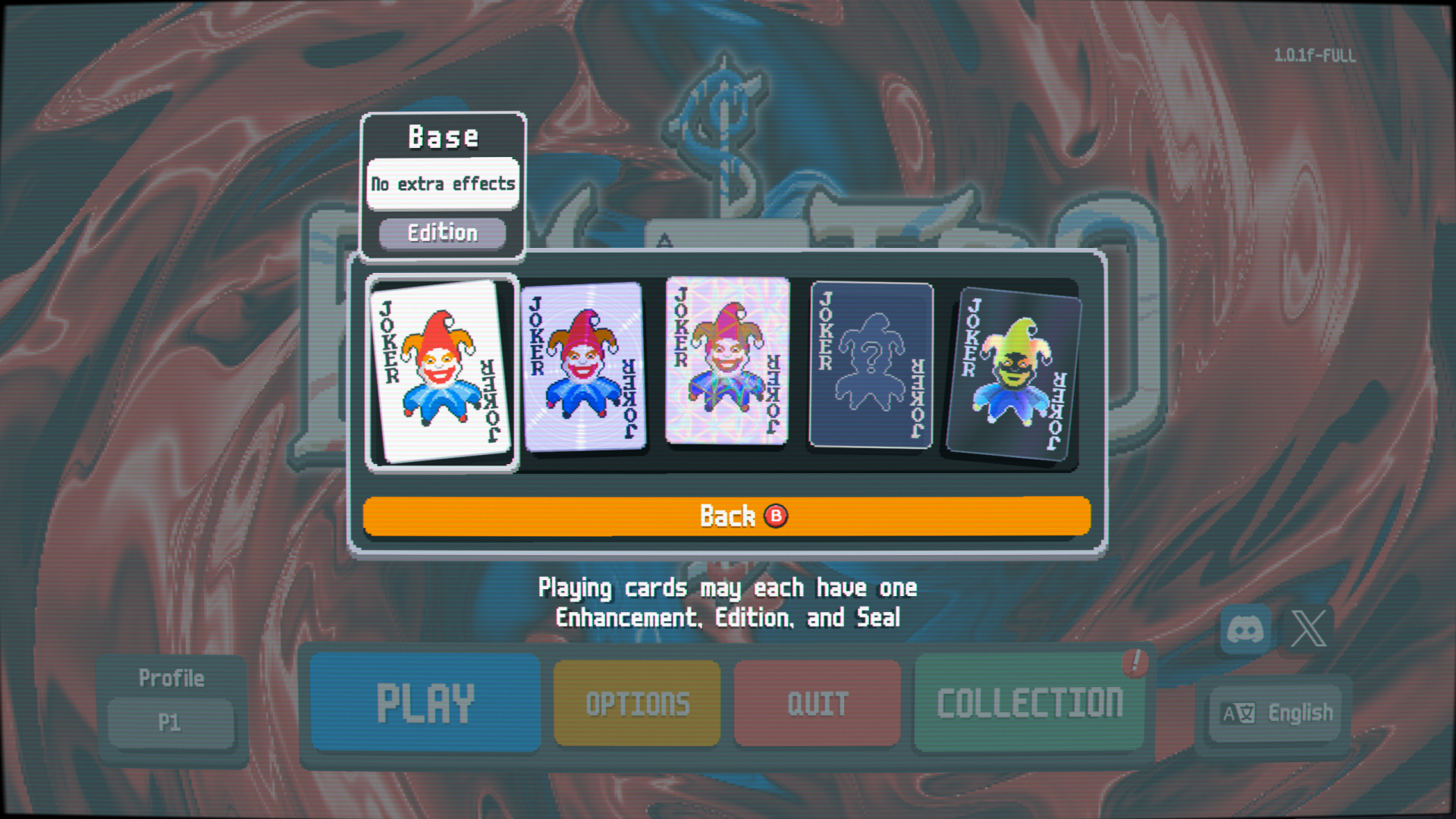 Editions are roll modifiers on Jokers (and on playing cards). Foil = +50 chips, Holographic = +10 mult, Polychrome = ×1.5 mult, Negative = doesn't take a Joker slot. The same Joker becomes much stronger with the right edition. Source: Game UI Database.
Slot budget
The default Joker capacity is 5 slots. Sources of expansion:
| Source | Effect |
|---|---|
| Negative edition (random shop roll) | Joker takes 0 slots: effectively a free slot |
| Antimatter Voucher | +1 slot |
| Hidden / specific Joker effects | Some Jokers (e.g. Blueprint, Brainstorm) reference other Jokers; the game treats them as having a slot but their power scales with neighbours |
So most builds end at 5–7 effective slots. The constraint is real: most jokers seen in the shop will not be picked up.
This is loadout-as-budget at the run-build layer: a 5-slot integer budget over a pool of 150+ candidates.
Joker categories
Jokers fall into roughly six functional buckets:
| Type | Example | What it does |
|---|---|---|
| Flat chip adders | Joker (the base "Joker") | +4 mult on every hand. Cheap, reliable. |
| Suit/rank scaling | Greedy Joker (+3 mult per Diamond), Lusty Joker (+3 mult per Heart) | Scales with deck composition |
| Hand-type scalers | Even Steven (+4 mult per even-rank card scored), Odd Todd (+30 chips per odd-rank) | Tied to specific deck shapes |
| Conditional triggers | Hack (+1 retrigger on 2/3/4/5 played), Photograph (×2 mult on first scoring face card) | Trigger on specific events |
| Persistent scalers | Constellation (+0.1 ×mult per Planet Card used), Lucky Cat (+0.25 ×mult per Lucky Card triggered) | Grow over the run |
| Meta / chain Jokers | Blueprint (copies the Joker to its right), Brainstorm (copies the leftmost Joker), Mime (retriggers held-card effects) | Multipliers of other Jokers |
The deepest builds combine 2–3 chain Jokers with a strong scaler. Example endgame archetype:
Blueprint → Baron (×1.5 mult per King held in hand) → Mime → … → +Polychrome × 1.5 edition on Baron
Each component multiplies the next, producing the famous "Balatro Astronomical Numbers" memes.
The slot-order matters
Jokers fire left to right. Blueprint copies the Joker to its right; if you put Blueprint after Baron, it copies Baron's effect. If Blueprint is at the end of the row with nothing to its right, it does nothing.
So the slot order is a real puzzle. Players physically drag Jokers in the menu to optimize the firing chain.
Compare to Hollow Knight charms, order doesn't matter there, only fit. Balatro's order-mattering is closer to a pipeline / functional-composition design.
Joker rarity tiers
| Rarity | Cost in shop | Drop weight |
|---|---|---|
| Common | $4 | 70% |
| Uncommon | $6 | 25% |
| Rare | $8 | 5% |
| Legendary | (Soul Spectral Card only) | special unlock |
Legendary Jokers (5 of them, Caino, Chicot, Triboulet, Yorick, Perkeo) only appear via the Soul Spectral Card or specific shop interactions. They're build-defining.
Editions stack on top of rarity: a Negative Polychrome Common is rarer than any base Legendary.
The shop randomness layer
Each shop visit shows ~2 Joker slots, drawn from the rarity pool. Players can:
- Buy what's there.
- Reroll for $5 (cost grows: +$1 per reroll within the same shop).
- Skip the shop entirely (no reroll cost, advances to next round).
- Buy Booster Packs (Buffoon Pack contains 2–4 Jokers; Mega Buffoon contains more, with better edition odds).
So the player is not guaranteed any specific Joker on any given run. Two structural consequences:
- Adaptation > optimization. A run that opens with a strong Pair Joker should pivot to a Pair build, not chase the player's "favourite" build.
- Reroll economy is real. Spending $5 on a reroll is $5 you can't bank for interest. The opportunity cost is felt every shop.
What this teaches
- Multiplicative passives produce emergent ceilings. Balatro's ceiling isn't bounded by stat balance: it's bounded by the number of multiplicative Jokers you can chain. Designers who fear "too much power" should look at how Balatro's chained ceiling feels good even at 1e20 scores.
- Slot-order-mattering is a design lever. Most loadout systems are commutative (order doesn't change output). Balatro's left-to-right firing breaks that: and produces more depth for the same nominal slot count.
- Rarity × edition is more space than rarity alone. A common Joker with a Polychrome edition is collectively rarer than a base Legendary. Stacking randomness dimensions cheaply expands the variation surface.
- A 5-slot budget is enough. 150 Jokers / 5 slots = 750+ million possible loadouts. The constraint is what makes individual loadouts feel chosen rather than collected.
- Solo dev coherence. LocalThunk hand-balanced 150 Jokers without committee process. Several Jokers were nerfed post-launch (Triboulet, etc) but the aesthetic of each Joker is consistent because one author held all the threads.
Patterns this exemplifies
loadout-as-budget: 5 Joker slots over 150 candidates. Combinatorial space far exceeds slot count.bonus-with-drawback: many Jokers have strict trade-offs. Mr. Bones (prevents 1 death, then deletes itself), Madness (× 1.5 mult, but destroys 1 random Joker per Blind), Burnt Joker (upgrades a hand, but only the first hand each round counts).