Divine Inspiration: the building tech tree
The hub doesn't grow buildings the way a city-builder does (place foundation → wait for build). It grows them the way an RPG learns abilities, via a tech tree with prerequisite links. The currency is Divine Inspiration.
How Divine Inspiration is earned
Two parallel funnels:
- Devotion accumulation at the Shrine. Followers worship at the central Shrine, ticking up a Devotion meter. When the meter fills, you spend it for one Divine Inspiration point.
- In-world Divine Inspiration drops. Light beams spawn at the hub (often after Crusades or when the cult passes a milestone). Walk over to claim:
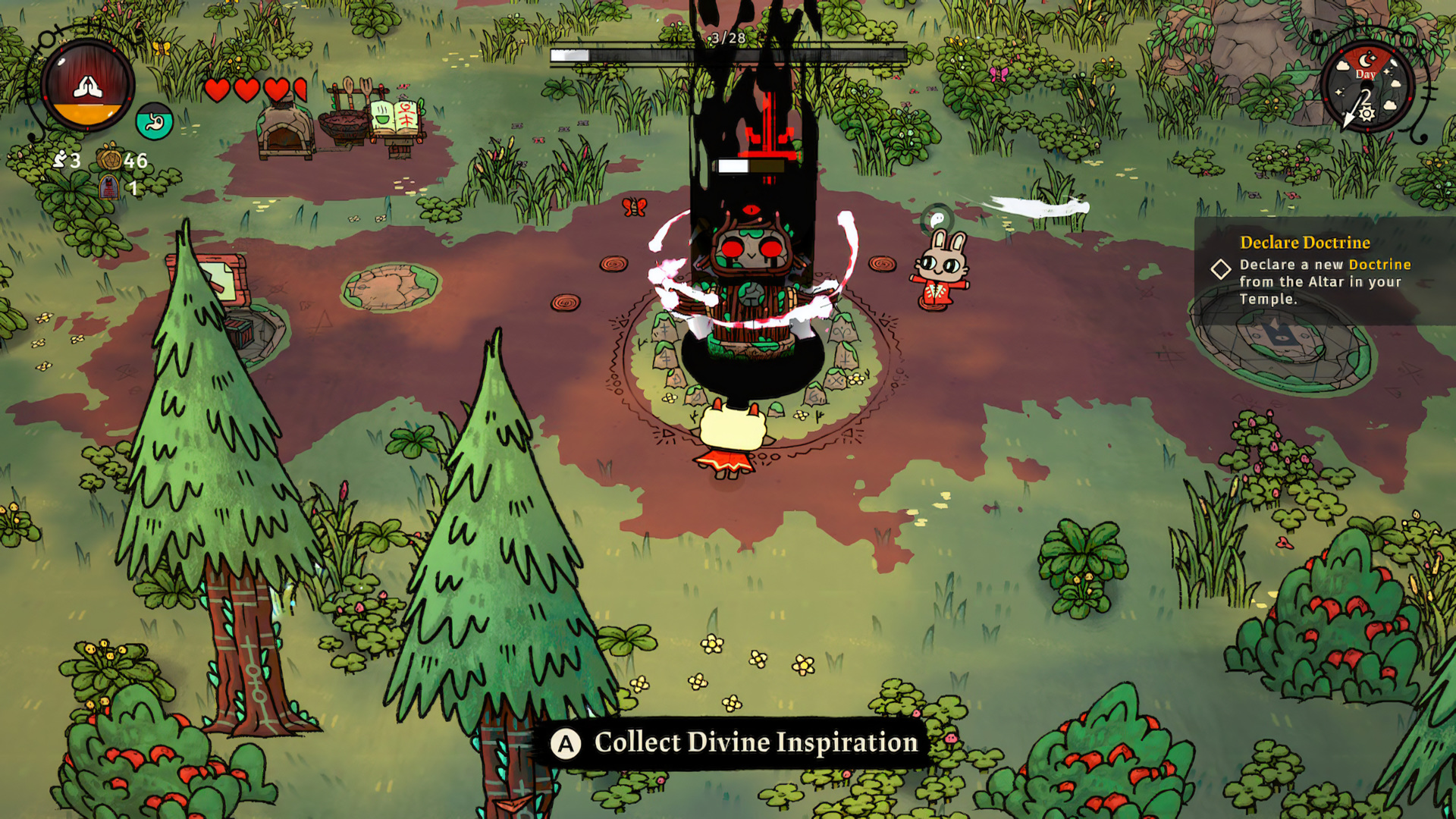 A Divine Inspiration beam. The right-side tracker: "Declare a new Doctrine from the Altar in your Temple", is the game's nudge that the new point should fork your cult's policy. Source: Game UI Database.
Once you have a point, you spend it at the Shrine, one node at a time. One point unlocks one building blueprint. The blueprint can then be built (multiple times if it's stackable) using raw materials in the Build menu.
The tree itself
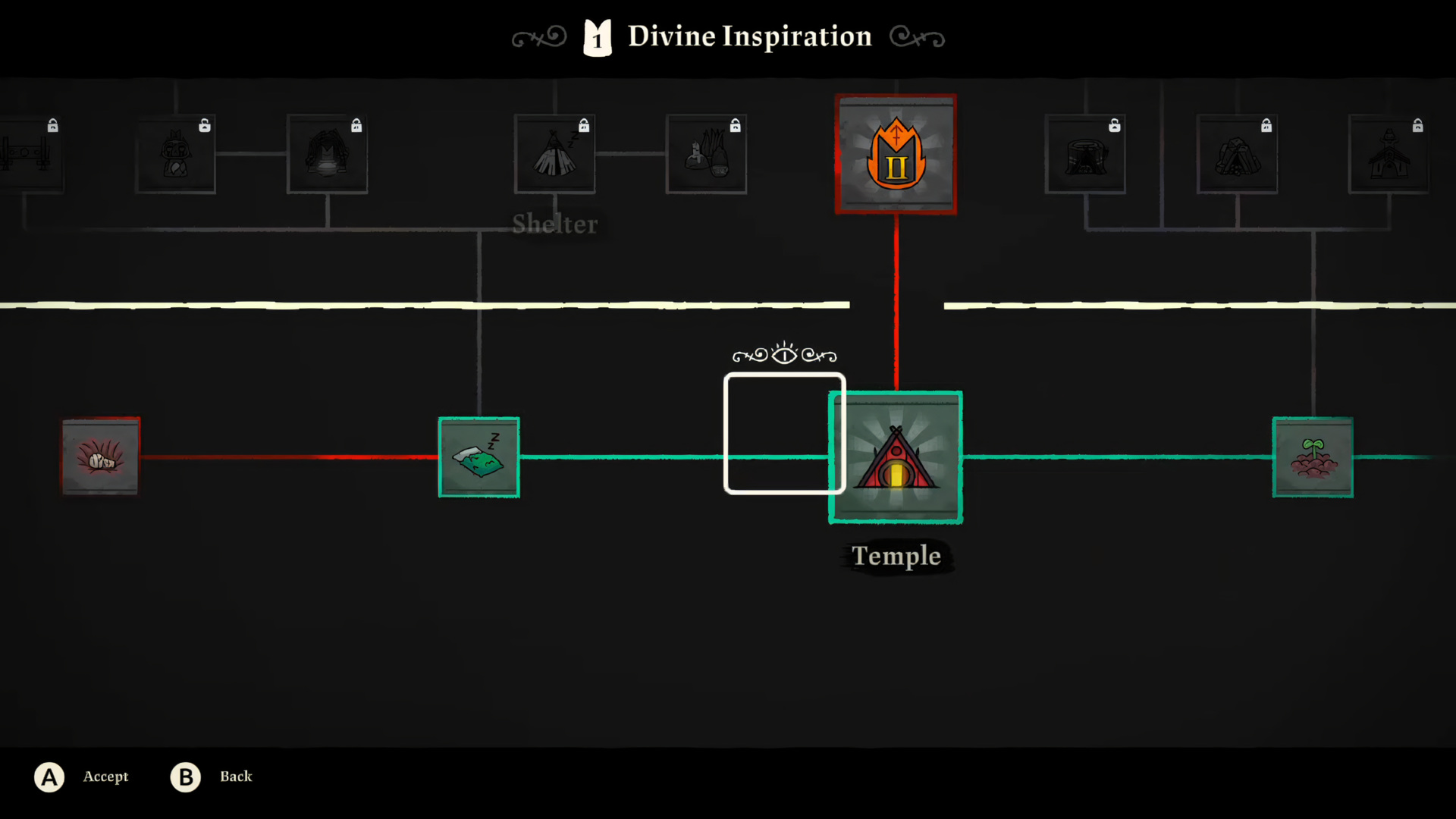 The Divine Inspiration tree. The visual grammar: teal paths are unlocked / available, red paths indicate the prerequisite path; nodes show small icons (the building's silhouette). The currently-targeted node is the Temple II upgrade: a tier-2 Temple, which itself unlocks more Doctrine slots and more Ritual capacity. The tree is laid out in rough categories (Shelter, Food, Decoration, Refining, Faith, Health) running top-to-bottom. Source: Game UI Database.
The tree is shaped like the nested-progression-graph pattern: short prerequisite chains, multiple parallel categories, and a hard upper gate on each row that requires a Cult Level raised through Sermons. So progression is two-axis:
- Horizontal: pick a category to push (Food first if Hunger is climbing; Decoration if you need morale; Refining if you keep running out of refined lumber).
- Vertical: Cult Level gates rows; you can't reach the second tier of any category until your overall cult has matured.
A node, in detail
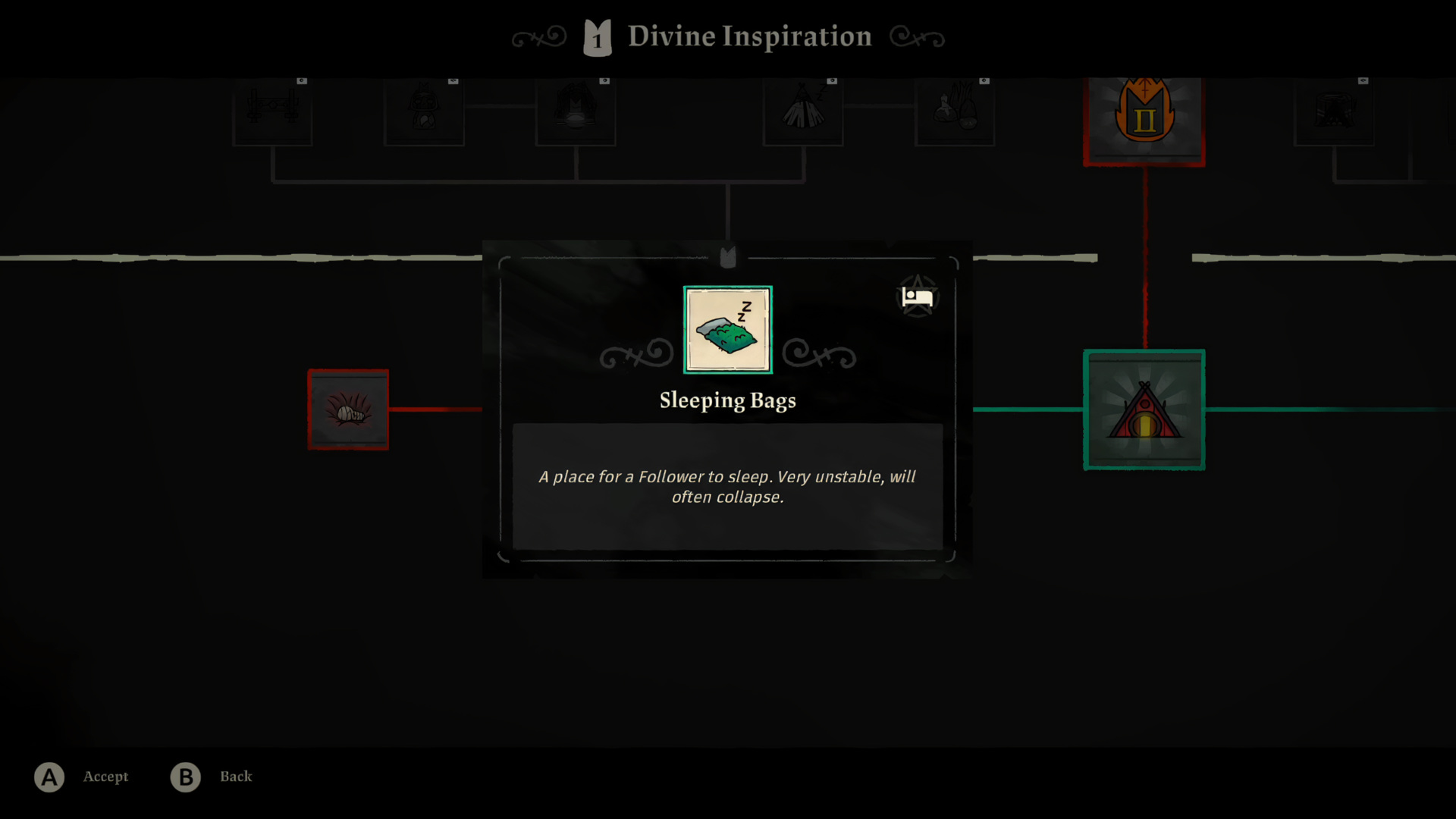 A node tooltip: Sleeping Bags. Each node previews what the building does plus a small flavour note ("Very unstable, will often collapse", a warning that this is the floor-tier option in this branch, and you should plan to replace it). Source: Game UI Database.
Building a blueprint
After unlocking, build it from the Build menu:
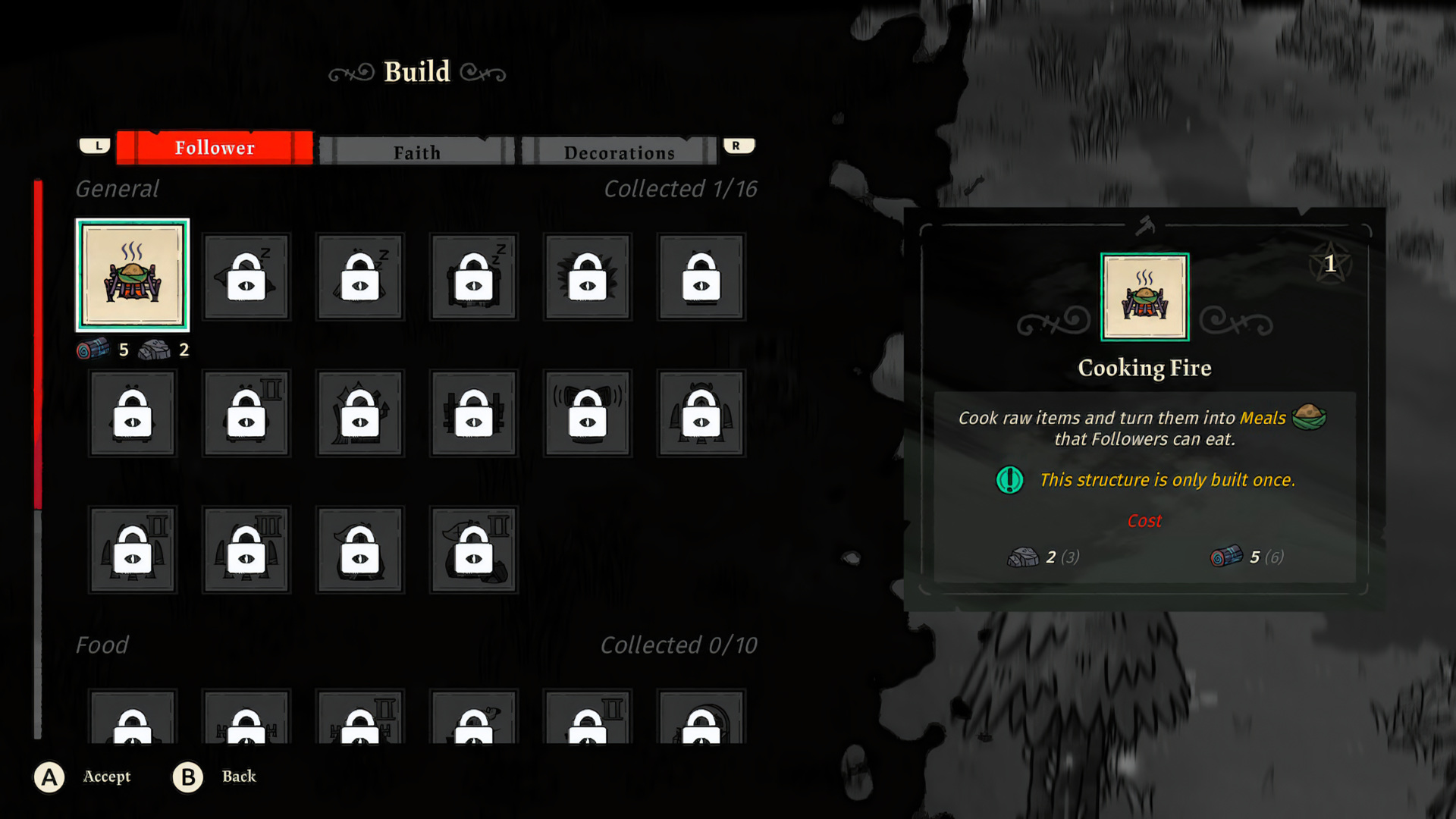 The Build menu. Tabs separate Follower (work / shelter / food), Faith (rituals / props), Decorations. Cooking Fire selected; cost displayed as ramp (current cost shown / next-tier cost in parens). The "1/16 General buildings collected" counter doubles as an unlock-collection meta. Source: Game UI Database.
The unlock-build separation as a design choice
Many colony sims fuse "unlock" and "build", once you have the materials, you can place. Cult of the Lamb deliberately separates them:
- Unlock costs Divine Inspiration (one-time, gated by Sermons / Crusades).
- Build costs raw materials (repeated, gated by Crusade loot).
This creates two pacings:
- A fast pacing for placing things (you go on a Crusade, return with lumber, build five things).
- A slow pacing for what kinds of things you can place (you ascend Doctrines / Sermons / quests to spend a Divine Inspiration on the new building category).
The trade is that you can specialise hard. A cult that pushes Food → Refining gets a self-sustaining feed loop early but lacks Health buildings when the first sickness wave hits. The Divine Inspiration tree forces the player to make meta decisions on top of immediate ones.
How the tree gates dungeon depth
The wire-up to Crusades is one step removed but real:
- Better Food → followers stay alive longer → cult population higher → unlock the next Bishop's Land sooner.
- Better Shelter → fewer dissent events → fewer hub fires to put out → more time available for Crusades.
- Better Faith buildings → bigger Sermon Faith ticks → faster Doctrine declarations → bigger run-modifying Sermon upgrades.
- Better Health → less Sickness → less time spent on hub damage control → more time available for Crusades.
The tree is not "DPS upgrades for the dungeon." It's "infrastructure that buys you time to be on the dungeon side." This is structurally different from a Hades-style mirror that just makes the run easier; it makes the hub side cheaper, which indirectly funds the dungeon side.
Patterns this exemplifies
nested-progression-graph: prerequisite chains across category branches, gated by Cult Level rows.