Post-launch evolution: eight free updates → first paid expansion
The base game at launch (Aug 11, 2022, v1.0) was a complete arc. The cult shipped with one Doctrine tree per launch category, four Bishops, five weapons, the original combat system, and no NG+. Most of what people now consider Cult of the Lamb arrived after release, over eight free major updates spanning two years, then the first paid expansion (Woolhaven) in early 2026.
This page is the timeline plus the lessons baked into the cadence.
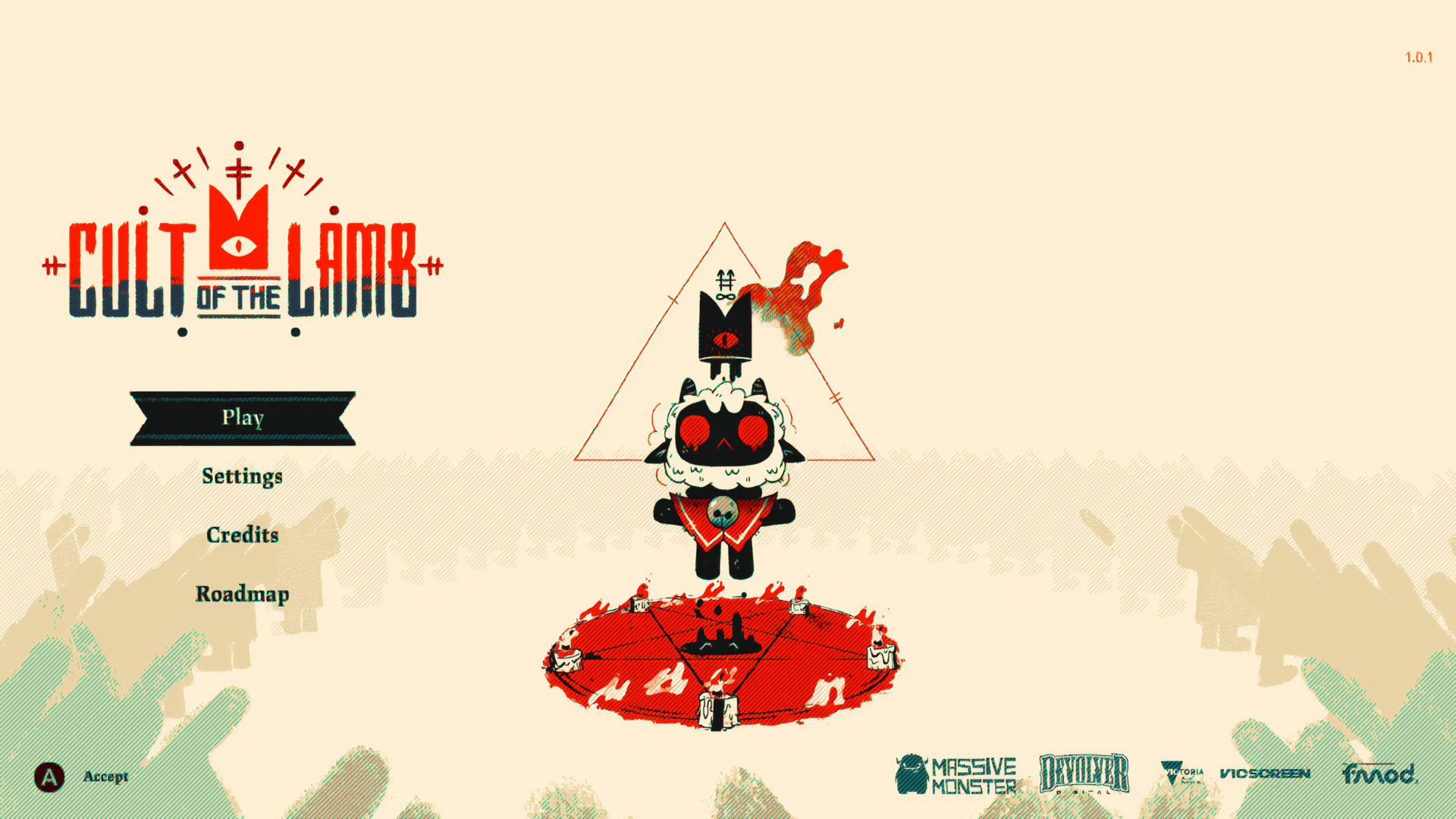 The 1.0.1 baseline this dossier's screenshots come from: i.e., before any of the major updates listed below. Worth keeping in mind when reading: "the original cult" is much smaller than the post-Woolhaven game. Source: Game UI Database.
Timeline
| Date | Update | Headline addition |
|---|---|---|
| Aug 11, 2022 | 1.0 launch | 4 Bishops, base cult sim, ~5 weapons / curses, no NG+ |
| Oct 24 – Nov 10, 2022 | Blood Moon Festival | Blood Moon ritual (40 Pumpkins → summons dead spirits for 3 days), Cursed Crow / Vampiric Demon / Skeletal Deer follower forms, Halloween decor, new track |
| Apr 24, 2023 | Relics of the Old Faith (1.2.0) | Post-game story arc, 37 Relics + Chemach NPC, heavy attacks on all 5 launch weapons, all bosses revamped, 5 Fleeces, 6 special followers (4 ex-Bishops + Baal + Aym), Purgatory boss-rush mode, photo mode, auto-difficulty assists, challenge runs, permadeath option |
| Apr 24, 2023 | Heretic Pack (paid cosmetic) | 5 follower forms (Moose, Gorilla, Goldfish, Mosquito, Opossum), 8 decor, Fleece of the Old Faith |
| Aug 21, 2023 | Don't Starve Together x Cult of the Lamb | Penitence Mode (must eat/sleep, permadeath), Webber follower form, Quick Start mode, secret decorations. Reciprocal items in DST. |
| Jan 16, 2024 | Sins of the Flesh | Sin as a new meta-resource, Mating Tent + Hatchery (procreation; egg → cultist), Blunderbuss weapon, Drinkhouse + alcohol tiers, Drum Circle, Leader's Tent (sleep / skip night), Tailor for follower fashion, new Doctrines |
| Aug 12, 2024 | Unholy Alliance | Local 2-player co-op across the full campaign (Lamb + Goat), back-to-back / critical-sync combat, co-op-only Tarots and Relics, Nursery building (up to 3 babies), new Fleeces, new follower traits, co-op minigames |
| Aug 12, 2024 | Pilgrim Pack (paid cosmetic) | Interactive comic by Carles Dalmau / Jojo Zhou (Jalala & Rinor), 5 new follower forms, 1 quest with 2 unique followers, 2 outfits, 5 decorations, 1 Fleece |
| Jan 22, 2026 | Woolhaven (first paid story DLC, $16.99) | New area Woolhaven (lambs' ancestral home), winter survival mechanics (blizzards, frostbite, warmth buildings), two new dungeons (Ewefall mountain exterior + The Rot interior), Ranching system (breed rare animals → wool/warmth/meat), Flail weapon type, Legendary tier for every weapon, snowlambs, snowball minigames, new follower forms / traits / quests, new deity Yngya |
What each update teaches the design analyst
Blood Moon: proof that limited-time events can become permanent
The Halloween festival started as a limited-time drop and was made permanent in November. The lesson: a seasonal event is a low-risk way to test a major new system (here, the Blood Moon Ritual and a whole class of dark-themed follower forms). If it lands, you fold it into base.
Relics of the Old Faith: the inflection update
This is the single biggest update and the one that retroactively transformed the game's Steam-review trajectory. The structural moves:
- Post-game story addresses "the credits roll feels too early."
- Relics add a fifth loadout axis, the missing surface area the launch loadout was thin on.
- Heavy attacks make weapons categorically different from each other.
- Auto-difficulty is the accessibility-first answer to "the bosses are too easy / too hard."
- Quick Start mode lets returning players skip the early-game grind.
- Purgatory + Permadeath are the hardcore endgame for the players who burnt through everything else.
This update is a textbook case of listening to the specific shape of player complaints and shipping a targeted fix per complaint, rather than a vague "more content" patch.
Don't Starve crossover: IP partnership as content moat
A clean crossover with another Devolver-adjacent indie roguelike adds narrative weight without much system risk, Webber is a follower form, Penitence Mode is a settings toggle. The cost is small; the cross-community marketing is large.
Sins of the Flesh: late-introduced mechanic
Adding procreation 18 months after launch turned the follower lifecycle from recruitment → death (a 1-way attrition loop) into recruitment → procreation → death (a self-sustaining loop). Late-introduced mechanics are usually risky because they invalidate prior decisions; CotL got away with it because the new system extended existing systems rather than replacing them.
The Leader's Tent is the specific design fix for the launch friction the index page calls out: time passes during Crusades. Add a "skip a night" verb three years in and the worst long-tail complaint about the hub clock loses its teeth.
See the pattern: late-introduced-mechanics.
Unholy Alliance: co-op as a fresh audience hook
Local 2-player co-op is the largest structural change. It introduces:
- back-to-back fighting / sync mechanics,
- co-op-only Tarots / Relics,
- a co-op-only "Nursery" building.
The lesson is more economic than design: a fully-co-op'd existing game opens up the audience to the "let's play with my partner" market, Steam reviews note that this update specifically drove a wave of new purchases.
Woolhaven: the paid pivot
After two years of free updates, Massive Monster shipped the first paid expansion. Julian Wilton (Massive Monster blog / well-played.com.au):
"This will be the last of our free updates for now. We have given a lot of love, and now it's time to get some money from people."
This is the correct shape of the transition: free updates built the long tail; paid expansion monetises the audience that the long tail produced. The transition was telegraphed openly rather than slipped in.
Cadence as a design philosophy
CotL is one of the canonical examples of live-service shape without live-service monetisation:
- No battle pass.
- No microtransactions inside the game.
- Paid cosmetic packs (Heretic, Cultist, Pilgrim) are entirely optional and separate.
- Free major updates on a roughly twice-a-year cadence for two years.
The result was that Steam reviews kept climbing post-launch (most games trend down), the player base kept re-engaging on each major drop, and the game's cultural footprint kept growing. The trade-off, confirmed by the Wilton quote above, is that the studio was funding two years of update work from launch sales alone. The paid pivot is the necessary closing of that loop.
What carries forward to indie design lessons
- Ship a complete arc first. CotL 1.0 had a full credits roll. The updates expanded within that arc rather than retrofitting an arc onto an open-ended game.
- Listen to specific complaints, not vibes. Relics of the Old Faith fixed five distinct named complaints at once.
- Late mechanics should extend, not replace. Procreation extended the follower loop; it didn't replace it.
- Make the time-cost of free updates honest. Don't pretend the studio can do this forever. The eventual paid pivot is OK: make it transparent.
- Crossovers cost little if they don't change the core. Webber's a sprite swap; Penitence is a toggle. High-perceived-value, low engineering cost.
See Lessons for the longer takeaways.