Hub & followers
The hub is the cult, a small physical settlement that grows from a single wooden shrine into a 30+ follower compound. Time passes here in real-time, including while you are on a Crusade. This page covers the three cult-wide stats, the follower lifecycle, and the day-to-day loop.
Three cult stats: Faith, Hunger, Sickness
The dashboard. Open the Cult tab and three meters dominate the screen.
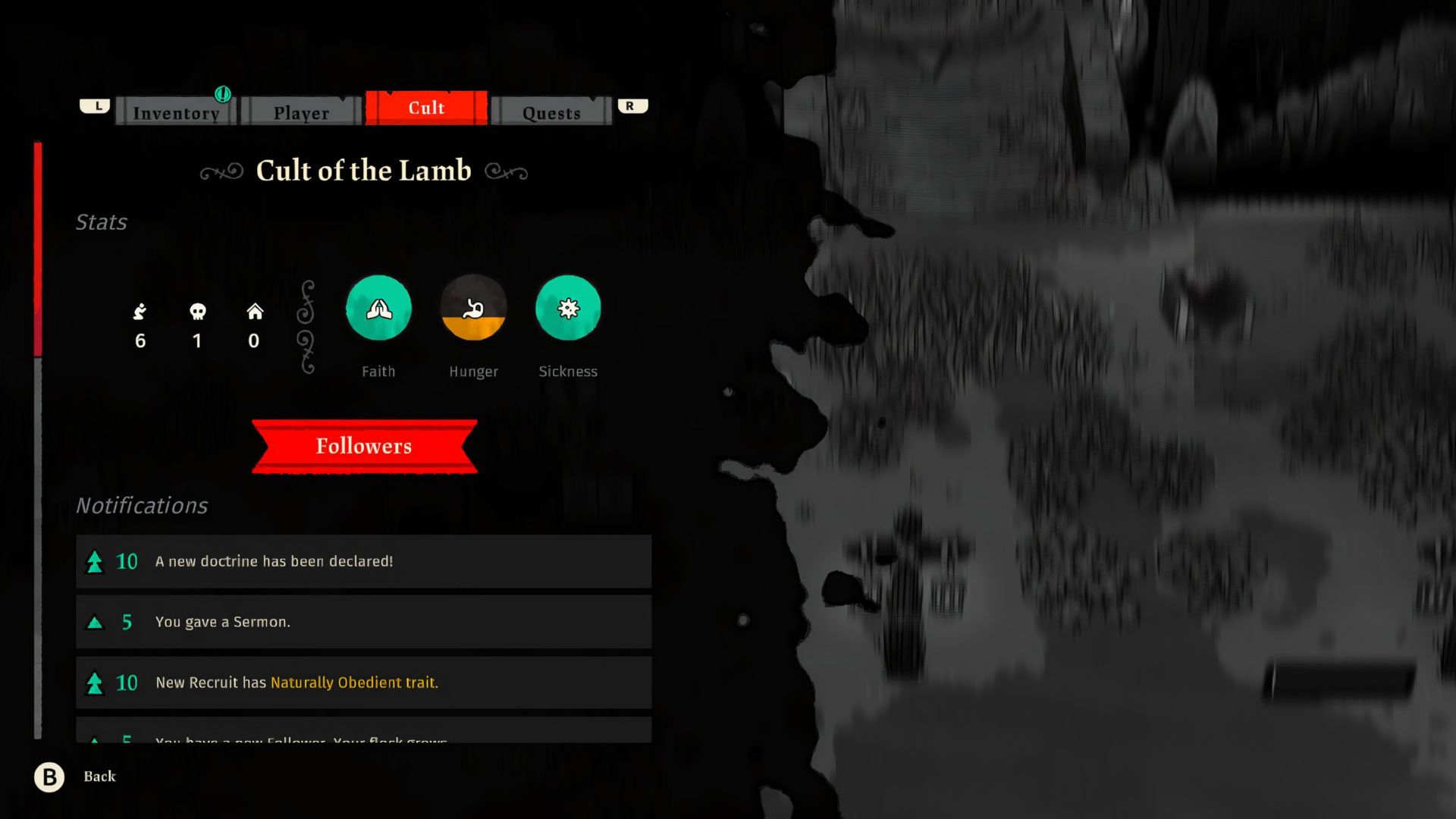 The Cult tab. Top row: Followers (6), Dead (1), Buildings (0). Three big circles: Faith (the lamb's authority pool), Hunger (cult-wide), Sickness (cult-wide). Notification log below: every cult-state change leaves a stamped entry, including the things you'd rather forget. Source: Game UI Database.
Faith
Your authority pool. Pings up from sermons (the daily ritual at the Temple), positive doctrines, levelled-up followers, completed buildings; pings down from follower deaths, starvation, sickness, dissent, breaking your stated doctrines.
If Faith hits zero the cult collapses into mass dissent, game-over risk. In practice, Faith is a slow-moving meter that demands ~3 minutes of attention per in-game day to maintain.
Hunger
Cult-wide. Followers eat from the Refectory (or its cheaper predecessors); if there's no food, hunger rises and they get sick or die. Some traits exempt (the "Don't Starve" trait literally means "doesn't get hungry"). The hunger meter is the most punishing stat to ignore because it cascades into sickness.
Sickness
Driven by sanitation (poop on the ground, dead bodies left out, low-quality food). Sick followers stop working and infect others; the Healing Bay (a mid-tree building) cures them. Sins of the Flesh (Jan 2024) added a sin-driven secondary axis but the launch trio is what you fight 80% of the time.
A fourth stat the screenshot doesn't show
The Sin meter was added by the 2024 Sins of the Flesh update, a counter generated by Drinkhouse / Drum Circle / Mating Tent activity and spent on procreation-tree buildings. See post-launch evolution.
The follower lifecycle
A follower starts as an NPC in a cage, cocoon, or shop, and ends as a corpse or a ritual ingredient. Six stages:
1. Acquisition
Three main funnels:
- Mini-boss rescue: the iconic "you beat me, I worship you now" beat.
- In-dungeon recruitment node: caged NPC in a Crusade.
- Bishop release: defeating a Bishop converts that Bishop's entire faction (10–20 followers at once).
- Eggs (post-Sins of the Flesh): hatch from the Hatchery.
- Plus side-quest rewards, shops, special events.
2. Indoctrination
The newly-arrived NPC gets walked to a Pentagram and ritually converted. The flow:
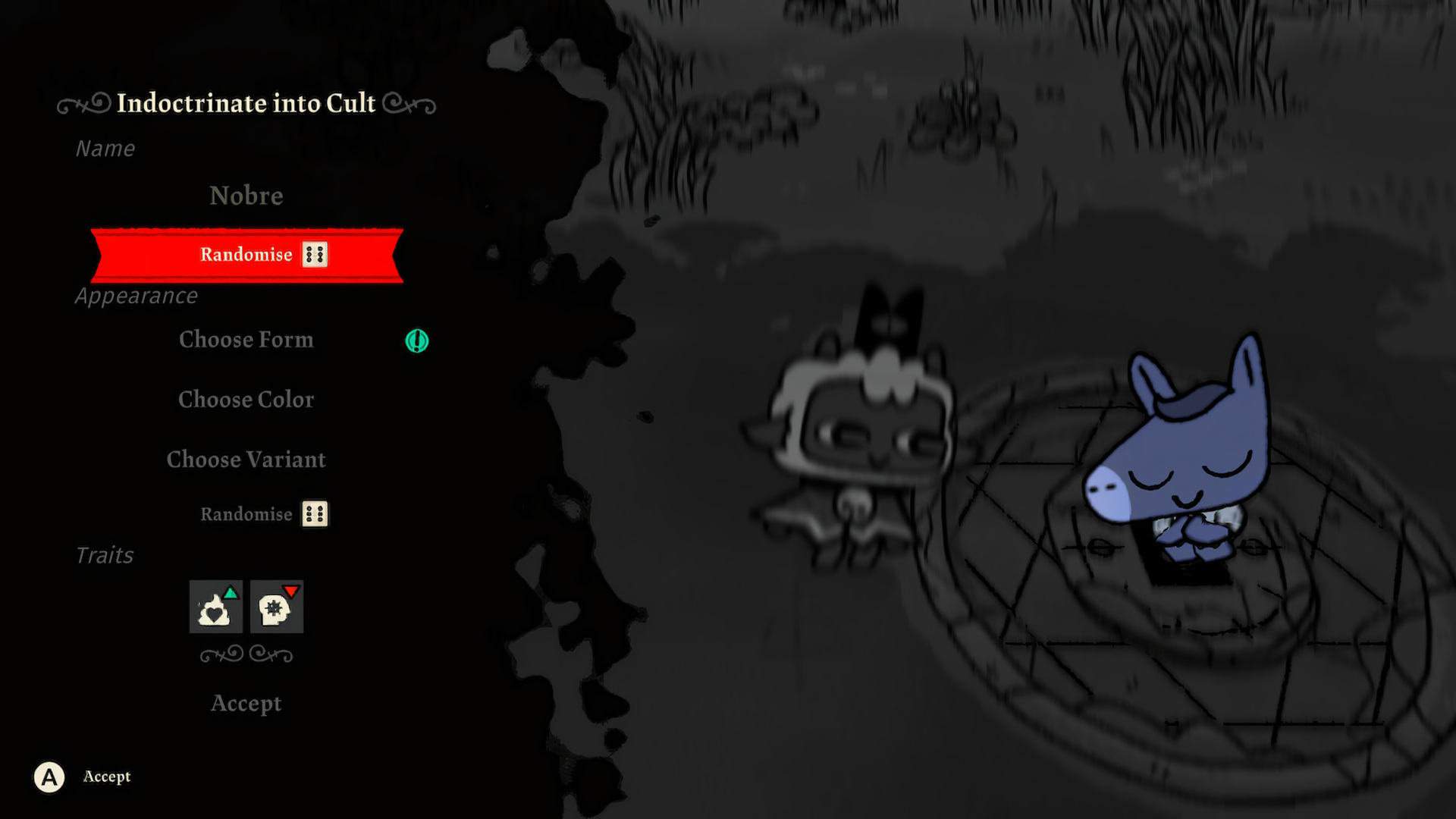 Indoctrination: every new follower gets a name (rollable), an appearance (form / colour / variant), and two traits (one positive, one negative). The Randomise button makes "I'll just keep what I rolled" the path of least resistance: which means most cults are a chaotic menagerie. Source: Game UI Database.
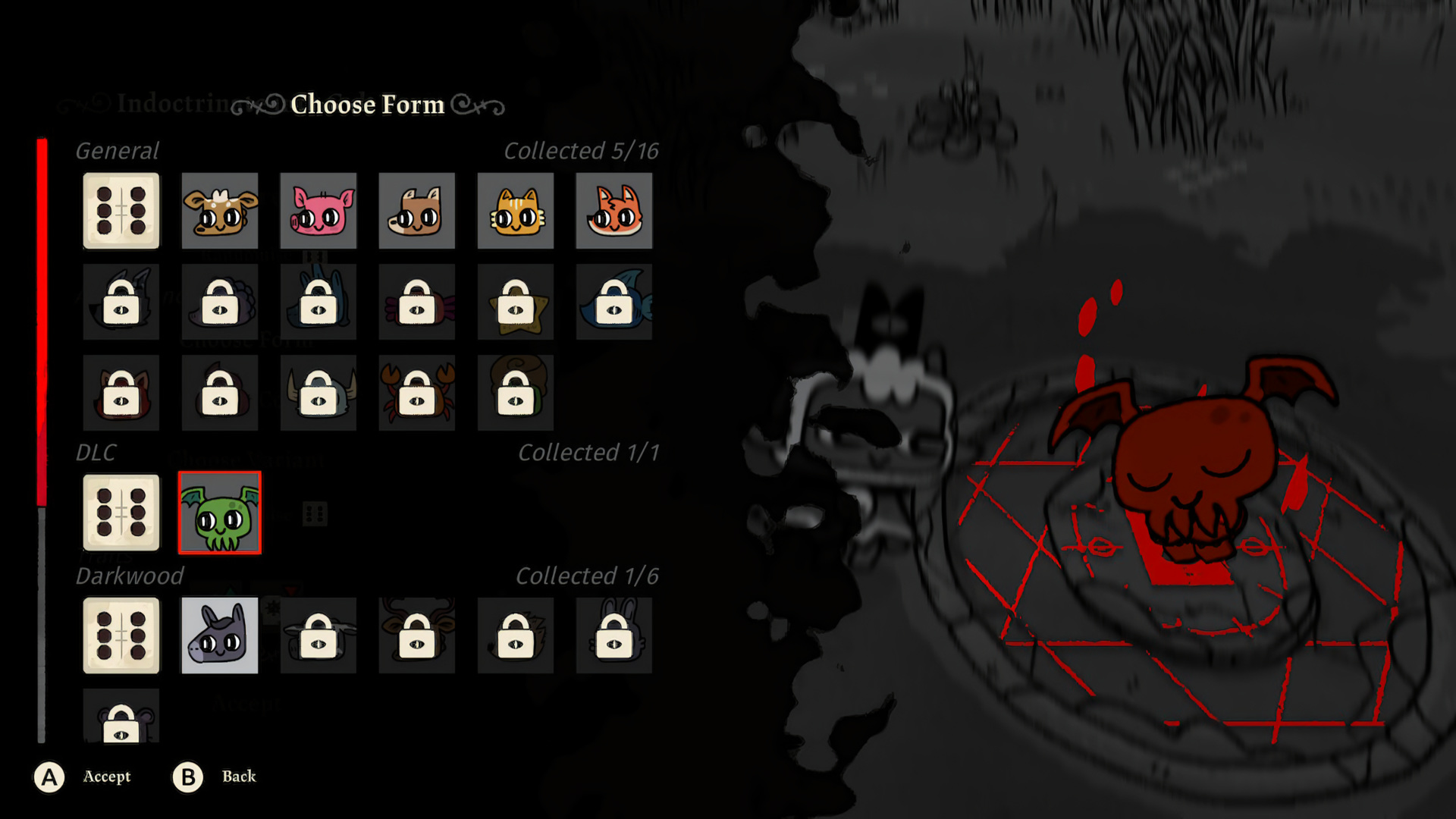 Choose Form: the form grid is itself a meta-collection: General unlocks for completing things, biome-specific forms (Darkwood / Anura / etc.) unlock for clearing that Land, DLC forms come with paid packs. The green Cthulhu is the Cultist Pack DLC selection. Source: Game UI Database.
Each follower rolls two traits, one positive, one negative. They are mostly permanent but can be erased via a Sermon (spending Faith to wipe a trait). The trait pool is huge and a lot of the comedy is in the negatives:
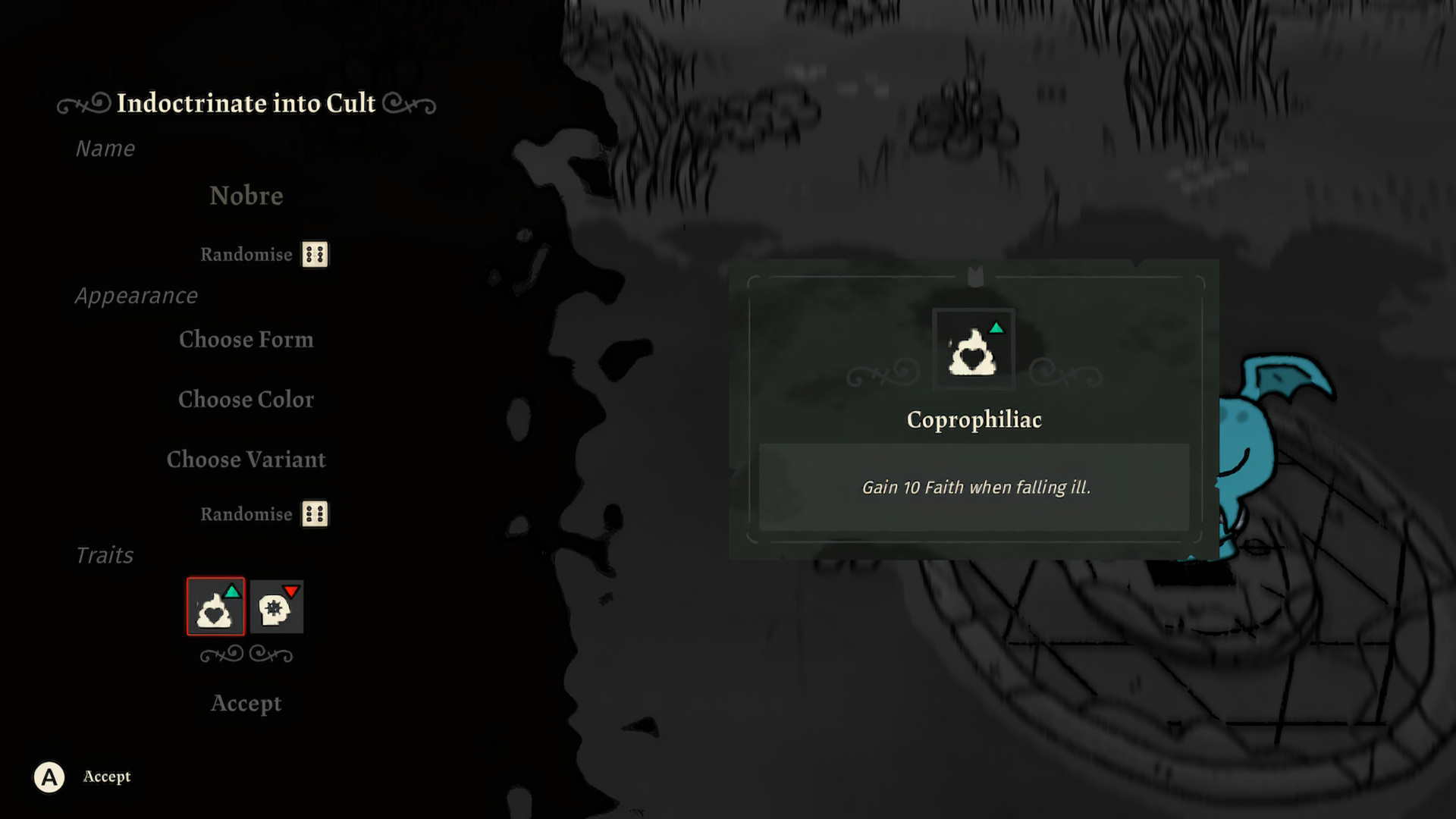 A trait inspection. "Coprophiliac: Gain 10 Faith when falling ill." Catalogued under positive (green up-triangle). This is the cute-vs-cult dialectic functioning as a tooltip: the trait is repulsive, the effect is mechanically good for you, and the UI does not blink. Source: Game UI Database.
3. Work + loyalty
Followers are assigned (or pick) jobs: Worship, Farming, Lumber, Stone, Kitchen, Janitor, Construction. Performing these generates Devotion at the Shrine (the input to the Divine Inspiration tech tree).
You can interact with any follower for one of several actions, which deepen their loyalty:
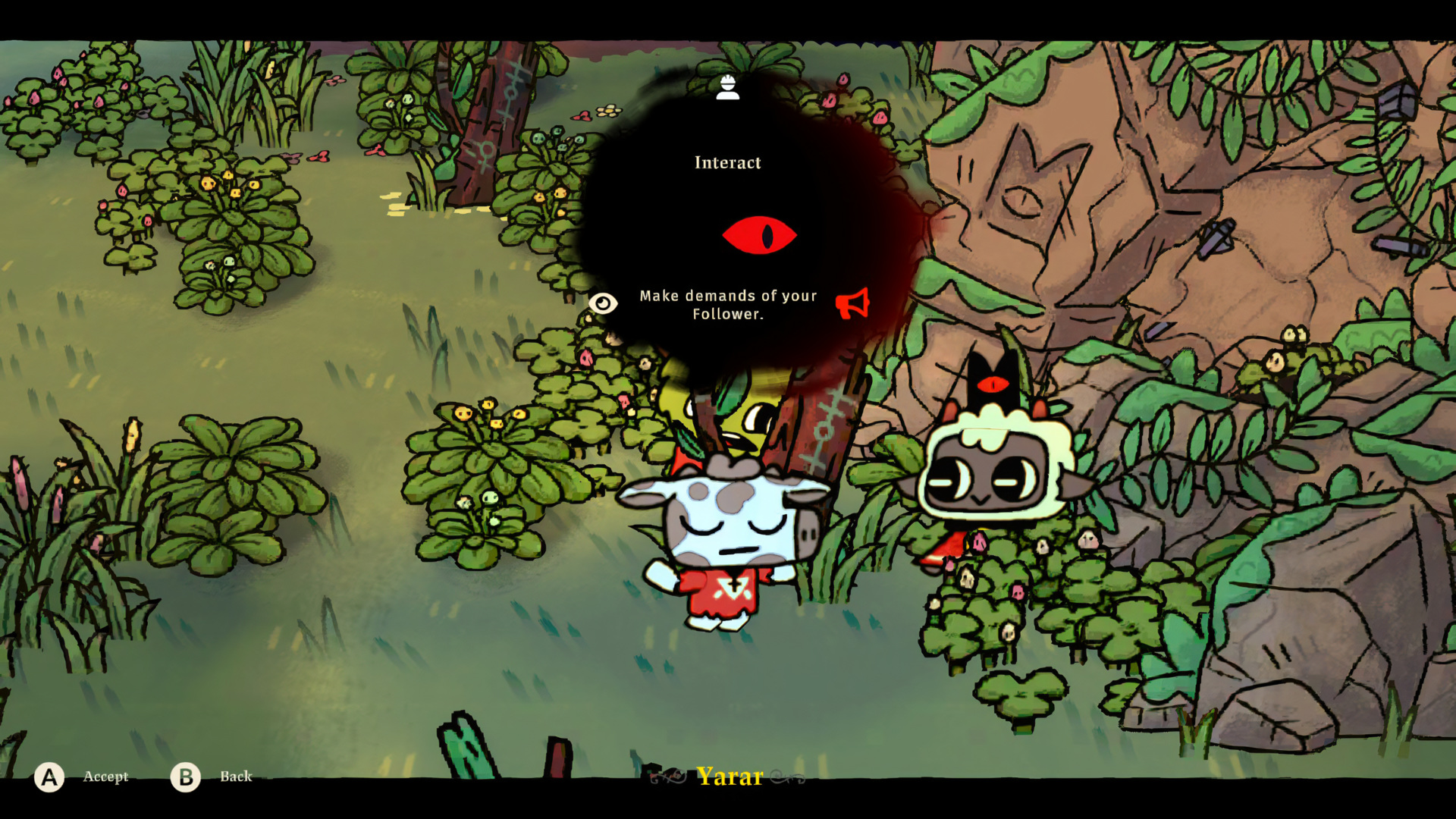 Follower interaction wheel. Bless, Give Gift, Read Mind (post-doctrine unlock), Extort Tithes, and the option to demand something from them. The interaction loop is intentionally Stardew-coded: a daily one-touch nudge per follower. Source: Game UI Database.
Loyalty has discrete levels; at each level-up the follower drops a Devotion pile and you can claim a reward. This loop is the "Test of Loyalty" quest the index page screenshots:
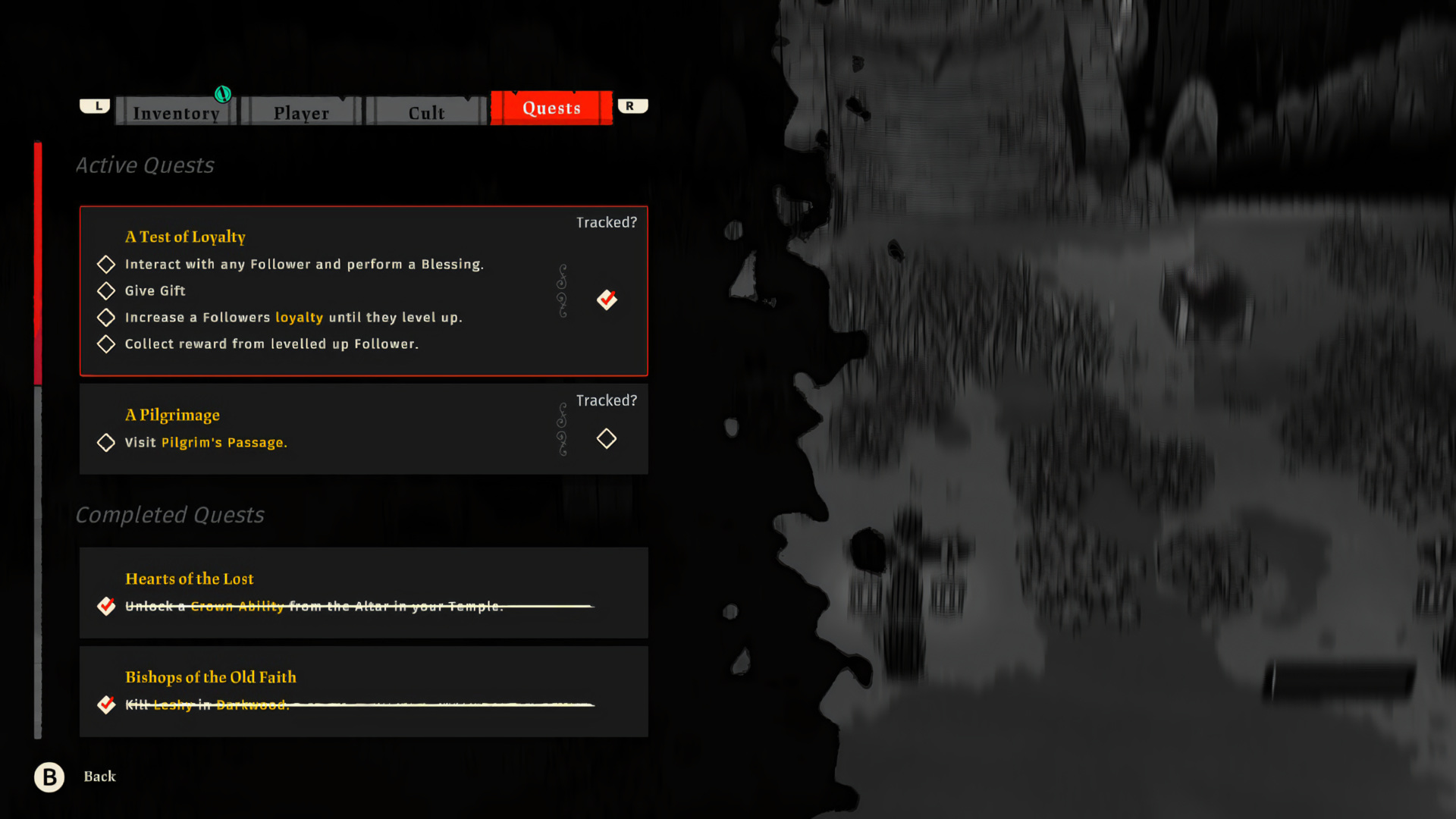 Active and completed quests. The "Test of Loyalty" walks you through the interaction loop end-to-end: a tutorial that becomes a permanent passive verb. Completed: "Bishops of the Old Faith, Kill Leshy in Darkwood" (the act-clear marker). Source: Game UI Database.
4. Dissent
If you break a Doctrine (e.g., "the dead are food" doctrine sworn but you funeral'd a corpse), or sacrifice followers too often, individual followers become dissenters, they spread debuffs and refuse work. The Prison building re-educates them; persistent dissent risks open rebellion.
5. Death
Five causes:
- Old age: every follower has a finite lifespan (multiple in-game weeks).
- Starvation: Hunger overflow.
- Sickness: Sickness overflow.
- Combat: Heretic raid events.
- Your hand: sacrificed at the Temple.
Death is logged as a permanent event ("You sacrificed Barbatos. Your Followers are uneasy about it."), the cult remembers.
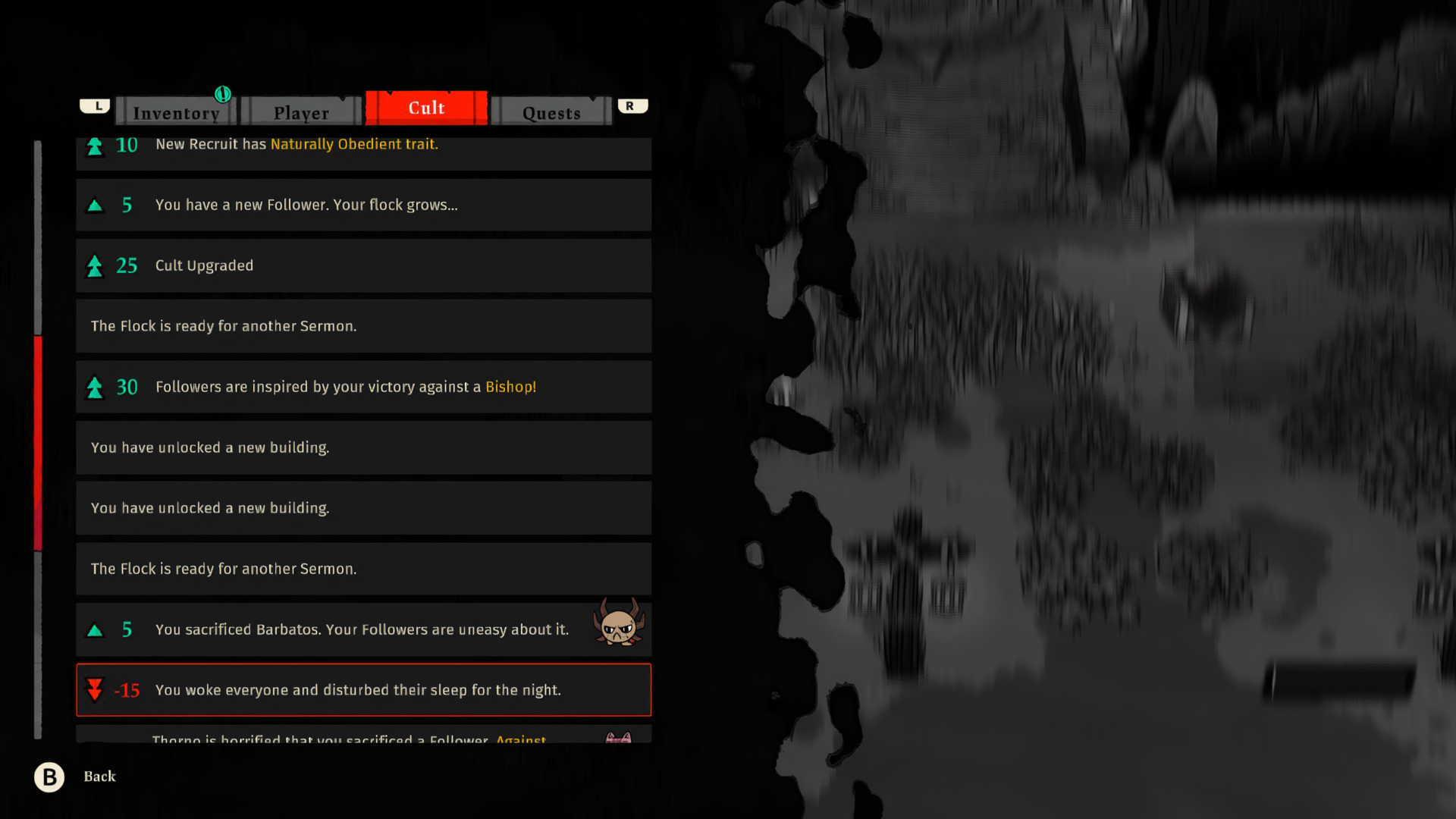 The notifications feed is the cult's ledger: every event tagged with a Faith delta. The "you sacrificed Barbatos" entry sits 3 lines below "Followers are inspired by your victory against a Bishop". Both are true at once. Source: Game UI Database.
6. Sacrifice & post-mortem
A dead follower's body can be:
- Buried (funeral, +20 Faith, dignified).
- Eaten (post-Sustenance doctrine, cuts Hunger spend but spikes Sickness).
- Used in ritual (Resurrection or other bone-spend rituals).
- Sacrificed alive at the Temple: bones, follower meat, immediate Faith spike.
The Lamb's most expressive verb is sacrifice. It's the only action that turns a named person into raw inputs. The game does not gate it behind morality; the only friction is the other followers' uneasy reactions.
The hub as a real-time clock
Time passes in the hub. A day is roughly 15 minutes of wall-clock time, and a day ticks forward whether you're playing it or in a Crusade. The implication:
- A back-to-back Crusade run means the hub is unattended for ~30 minutes of cult-time. Hunger, Sickness, and Dissent all climb.
- A long evening of hub maintenance with no Crusade means you're not making progress on Bishop-gating follower counts.
- The 15-min Crusade length is deliberately matched to a hub day so that the two halves cost the same time.
Massive Monster on the split: "It's quite an even split, but we also wanted to give players the freedom to lean more into either side of the game if they want."
This is the single hardest design tension in the game and the most-cited friction in negative reviews. See Design tensions.
Side activities
The hub also hosts several minigames that aren't strictly required but loop in their own resources:
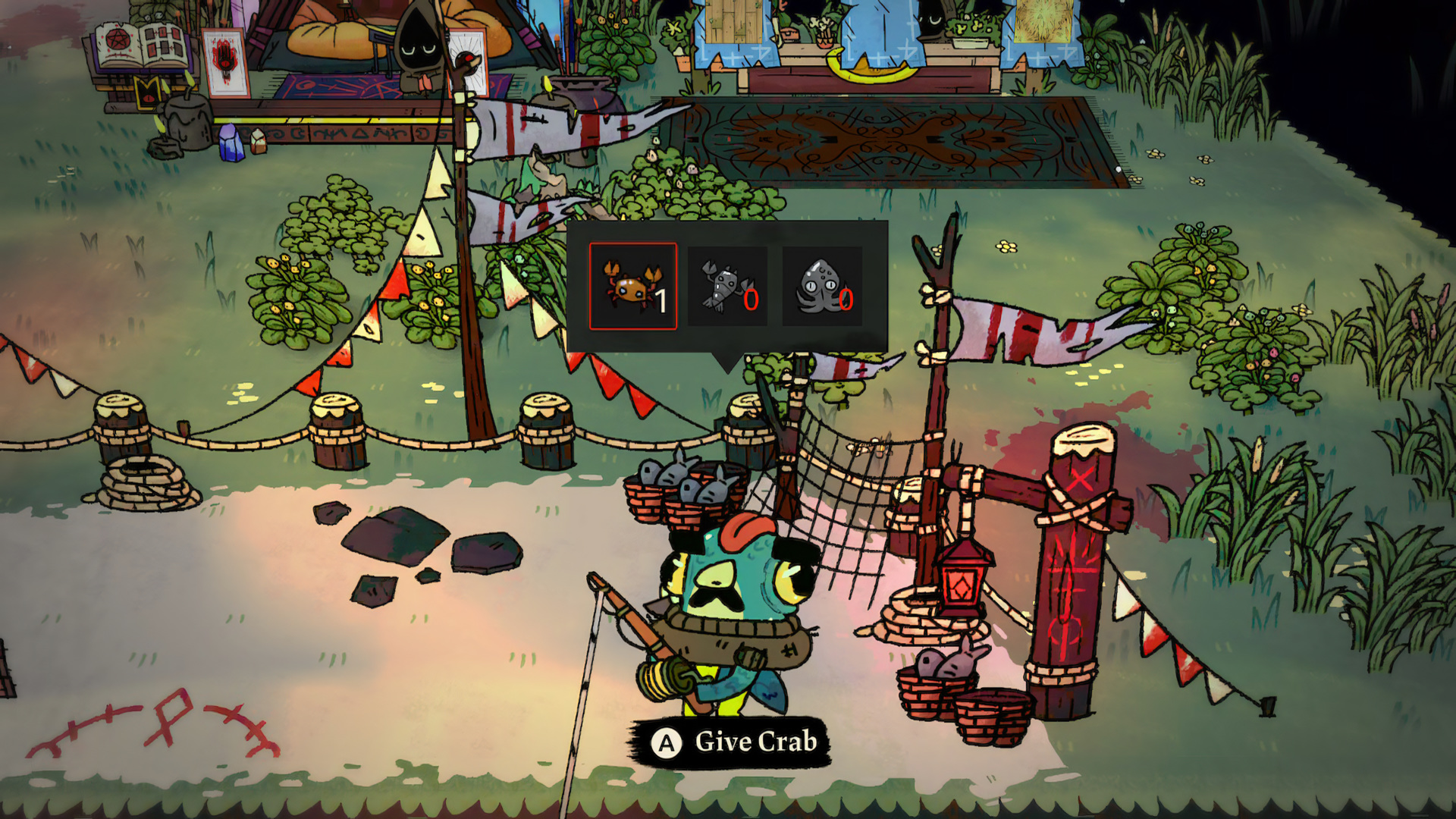 Fishing at the dock. The minigame yields fish (food) and rare items used in cooking and decoration. Knucklebones (a dice game), farming, mining, building, blessing, sermons, and event interactions round out the hub verb list. Source: Game UI Database.
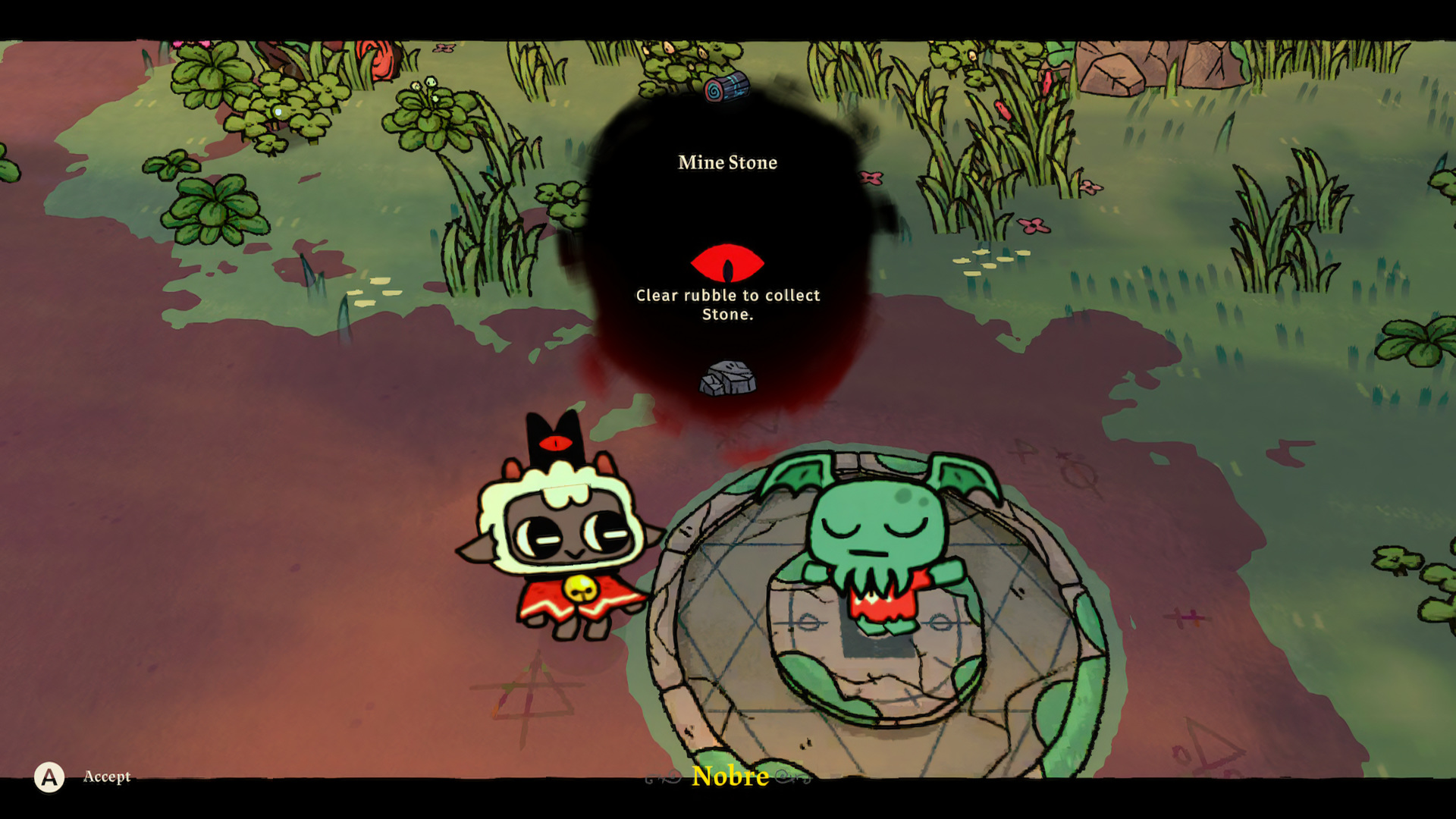 Captured enemies (here Nobre) can be put to work at hub shrines for resources: a slower, "free" parallel income stream. Eventually they can also be indoctrinated or sacrificed. Source: Game UI Database.
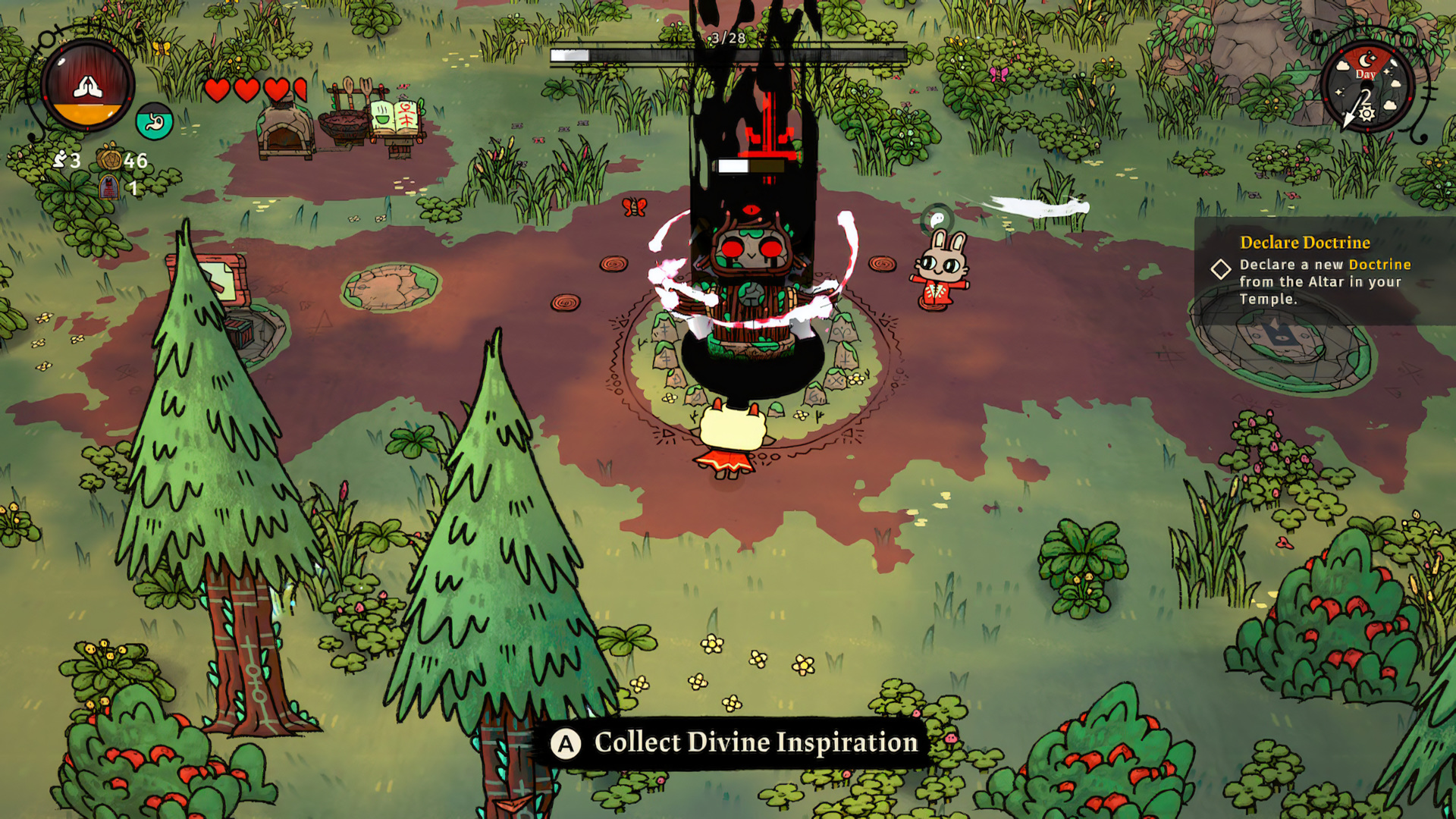 Divine Inspiration light beams spawn at the hub between Crusades: the secondary income for the tech tree. See Divine Inspiration tree. Source: Game UI Database.
What gets tracked in the hub view
Behind the play loop is a quiet inventory:
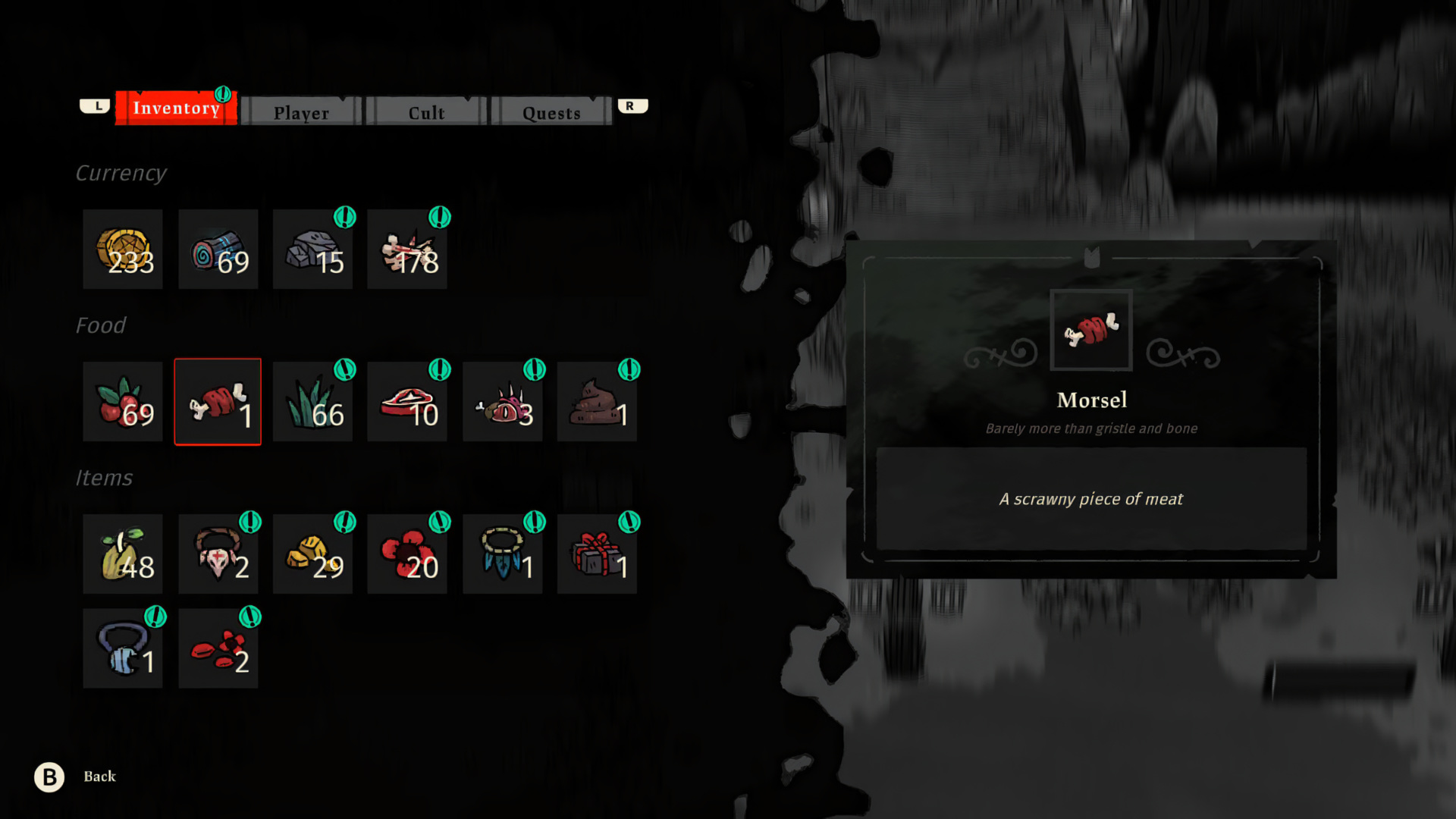 The unified inventory. Currencies (gold 233, lumber 69, stone 15, bones 178) sit above Food (berries, morsel, grass, meat, etc.) and Items. Bones: the ritual currency, are tracked at parity with gold. Source: Game UI Database.
The inventory is small and named. There are no abstract material categories; every line is a thing that exists in the world. This makes the dungeon-to-hub wire-up legible in the way an XP+gold pair never could.
Patterns this exemplifies
dual-life-loop: the central pattern. CotL is the cleanest contemporary example because the day-length cadence matches the run length exactly. (Also tagged on Moonlighter 2; an uncurated cross-game pattern at present.)