Through the ludonarrative resonance lens
A reading of MMBN's mechanics through the ludonarrative resonance lens, does what the player does affirm what the game says it's about?
Mechanic read: Folder & chip codes, NaviCust, Program Advance, and the battle system.
Verdict: Affirms, and unusually directly. The fiction is "Lan Hikari's PET lets him jack his Navi MegaMan.EXE into network devices to fight viruses." The verbs of the mechanics are programmer-verbs. There is no other game on this site where the mechanics-as-fiction fit is this literal.
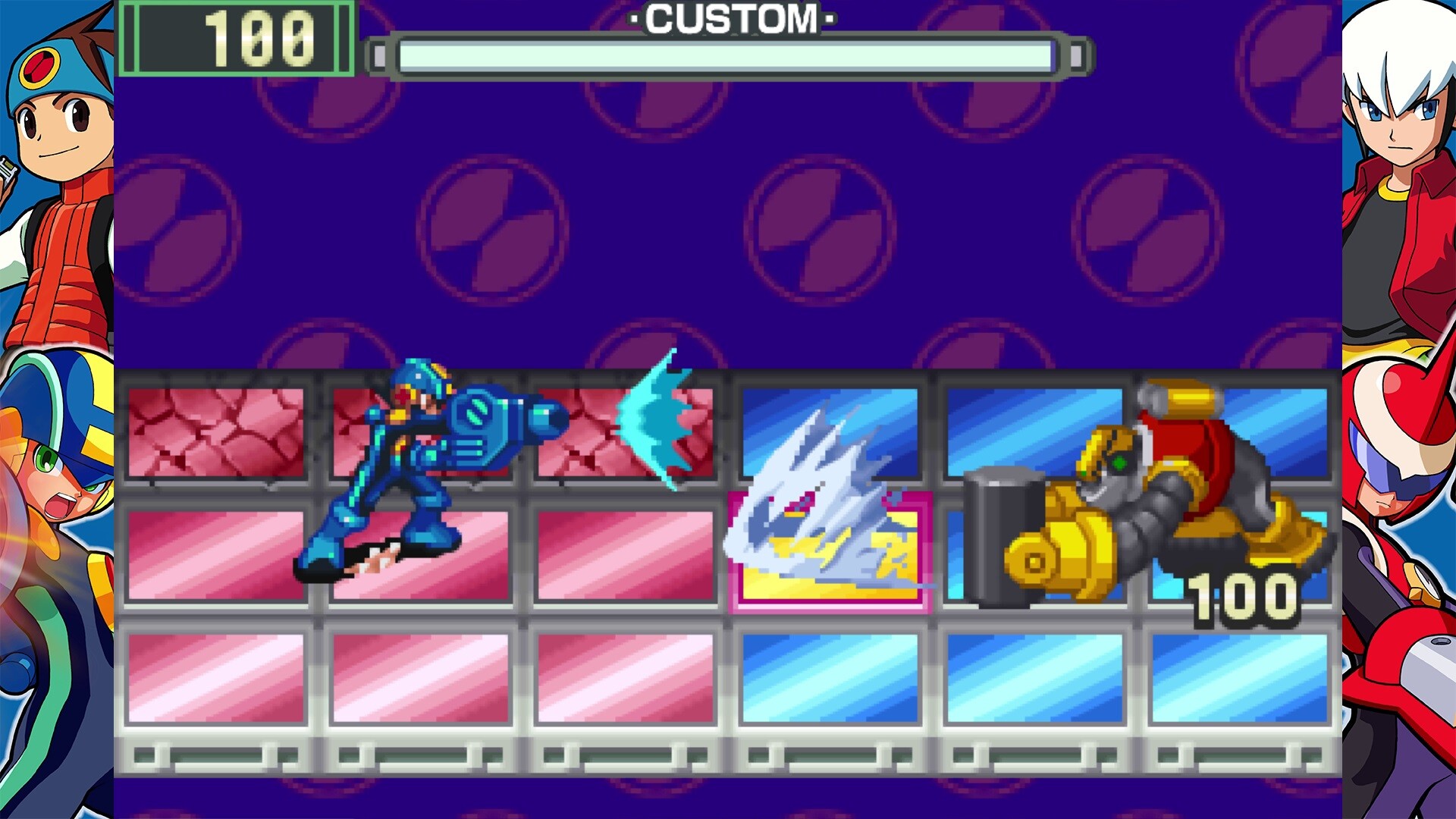 The single iconic frame of the entire series. The Custom Gauge filling in real time IS the fiction's "PET buffering your next dispatch of compatible code." Source: Steam (Legacy Collection).
Why it lands
Most games translate fiction into mechanics by analogy: a "spell" is a damage ability with a cooldown. A "skill tree" is metaphorical character growth. The translation step is where resonance leaks. MMBN doesn't translate, the mechanics are the fiction's literal nouns:
- Folder = a 30-chip data deck. Lan literally curates a folder of chip data on his PET.
- Chip codes (A-Z + ★) are explicitly "command codes." Code-letter compatibility is presented as runtime-compatibility: chips with the same letter can be dispatched together because their command interfaces match.
- Custom Gauge = dispatch buffer. It fills in real time; tap Custom and the PET draws the next batch of chips into your hand.
- NaviCust = literal hardware customisation on MegaMan's motherboard. You install programs on a 4×4 grid; programs that overlap or clash with each other create bugs, which manifest as in-combat debuffs. The "plus tile" trick is a literal hardware exploit.
- Program Advance = combo recipe. "Cannon-A → Cannon-B → Cannon-C in the same hand" produces ZetaCannon. The fiction's explanation is that the chips link into a runtime sequence; the mechanical effect is the same.
The verbs of the loop are: assemble a folder, manage code compatibility, dispatch your hand from the buffer, install hardware patches, exploit the runtime. Those are programmer-verbs. The fiction's protagonist is literally a kid programming his AI buddy.
What makes the resonance dense, not nominal
A weaker version of this game uses the same combat shell with fantasy skin: chips become spells, codes become elements, NaviCust becomes a stat tree. That game would still work, it would be orthogonal-but-fine, like Slay the Spire. MMBN chose the rare path of making the fiction's nouns the mechanics' nouns, with no translation step.
The split between Lan (Operator) and MegaMan.EXE (Navi) doubles down: Lan handles the overworld, NPC dialogue, jacking-in points, between-mission errands. MegaMan handles real-time combat, panel positioning, dodging, chip dispatch. The fiction's promise, "you are an operator, your Navi is the executor", is literally what the controls split.
What the loop says
I am a sixth-grader with a PET. My partner is the AI living inside it. I curate his executable code; he dispatches it in real time. We are co-debugging a runtime in a hostile environment.
That sentence describes both the moment-to-moment combat and the entire premise of the world.
Where it could have failed
The same loop with a fantasy reskin would be a competent action-card hybrid that ranked among Spire's neighbours. The MMBN move that holds the resonance together is the refusal to translate. "Chip codes" are not metaphorical compatibility; they are literally what the fiction says they are. "NaviCust bugs" are not a stat penalty; they are runtime hardware faults. Each refusal-to-translate is a mechanic decision that another studio would soften for accessibility.
The lens diagnoses why the series's identity is so durable across BN1 → BN6: the team kept refining the programmer-feel rather than papering over it.
See also
- Mechanic pages: Folder & chip codes, NaviCust, Program Advance, Battle system
- Lens (overview): Ludonarrative resonance
- Adjacent pattern:
code-constrained-deckbuilding: code-compatibility as a loadout constraint because the fiction says runtime compatibility matters.