The deck as the build
Most card games treat the deck as input: you draw, you play, you reshuffle. Balatro treats the deck as equipment. Tarot Cards mutate cards; Spectral Cards transform them; Enhancements / Editions / Seals stack three orthogonal modifier dimensions on each card.
By Ante 8, your deck is no longer a standard 52-card poker deck. It is a curated weapon.
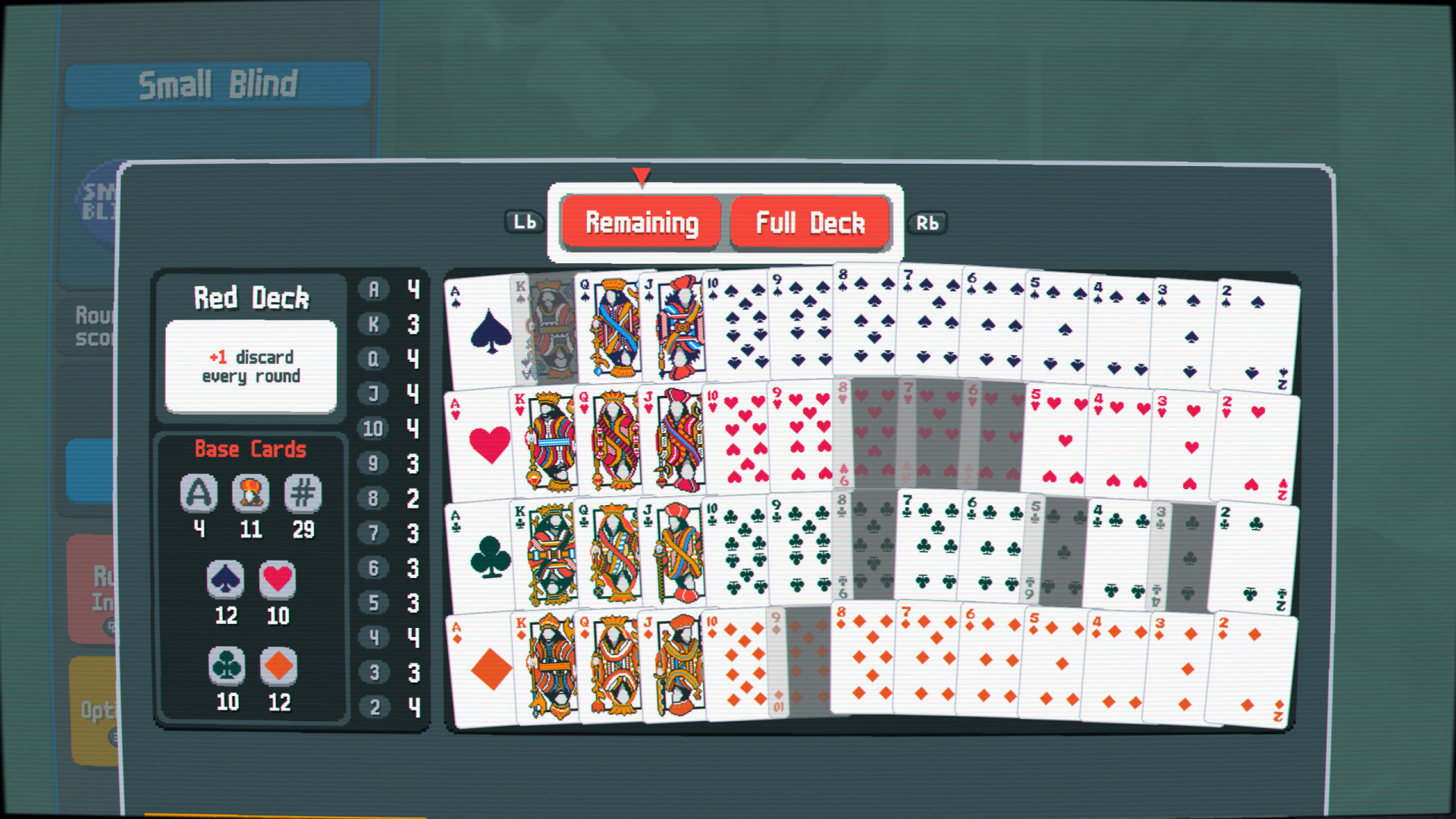 The Full Deck reference page shows what's currently in the deck, including greyed-out cards that have been drawn this round, removed via Tarot, or destroyed. Suit and rank counts in the sidebar update live as the deck mutates. Source: Game UI Database.
Three orthogonal modifier dimensions
Each playing card can carry up to one of each:
| Dimension | What it does | Examples |
|---|---|---|
| Enhancement | Replaces / adds the card's pip behaviour | Bonus (+30 chips), Mult (+4 mult), Wild (any suit), Glass (×2 mult, 25% break), Steel (×1.5 mult while held), Stone (no rank/suit, +50 chips), Gold (+$3 if held end of round), Lucky (15% +20 mult / 1/15 +$20) |
| Edition | Visual variant + bonus | Foil (+50 chips), Holographic (+10 mult), Polychrome (×1.5 mult), Negative (rare, doesn't take slots) |
| Seal | Trigger on specific events | Gold ($3 on score), Red (retrigger card), Blue (Planet on round end), Purple (Tarot on hand discard) |
So a single playing card can be: Polychrome Glass Two of Hearts with a Red Seal. That card alone adds chips, ×1.5 mult, ×2 mult on score, 25% break-on-use risk, retriggers itself, and counts as a Heart for suit synergies.
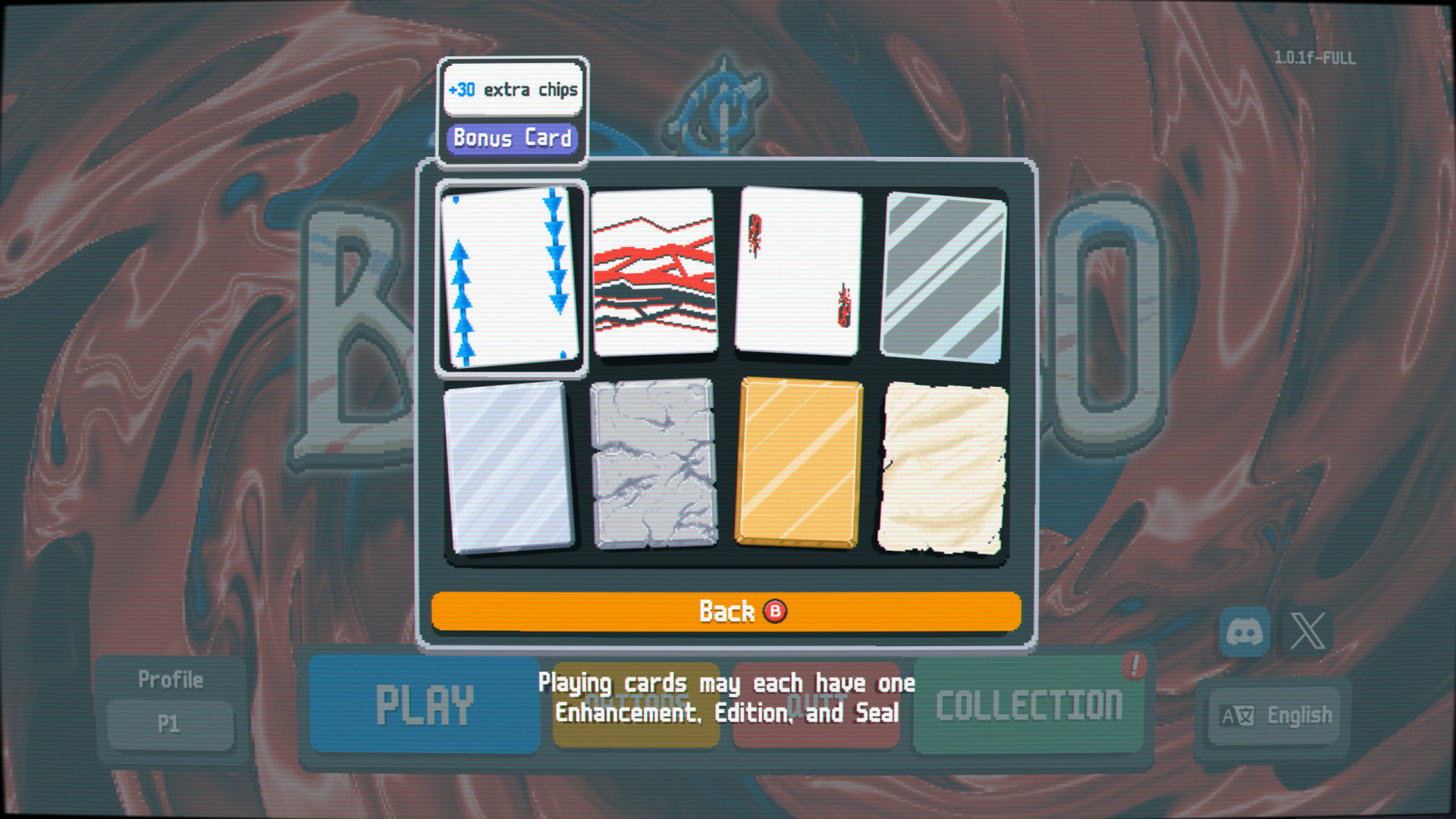 The 8 Enhanced Card variants. Each replaces or augments a playing card's behaviour. The "Stone Card" (no rank, no suit, +50 chips) breaks the card's identity entirely. Source: Game UI Database.
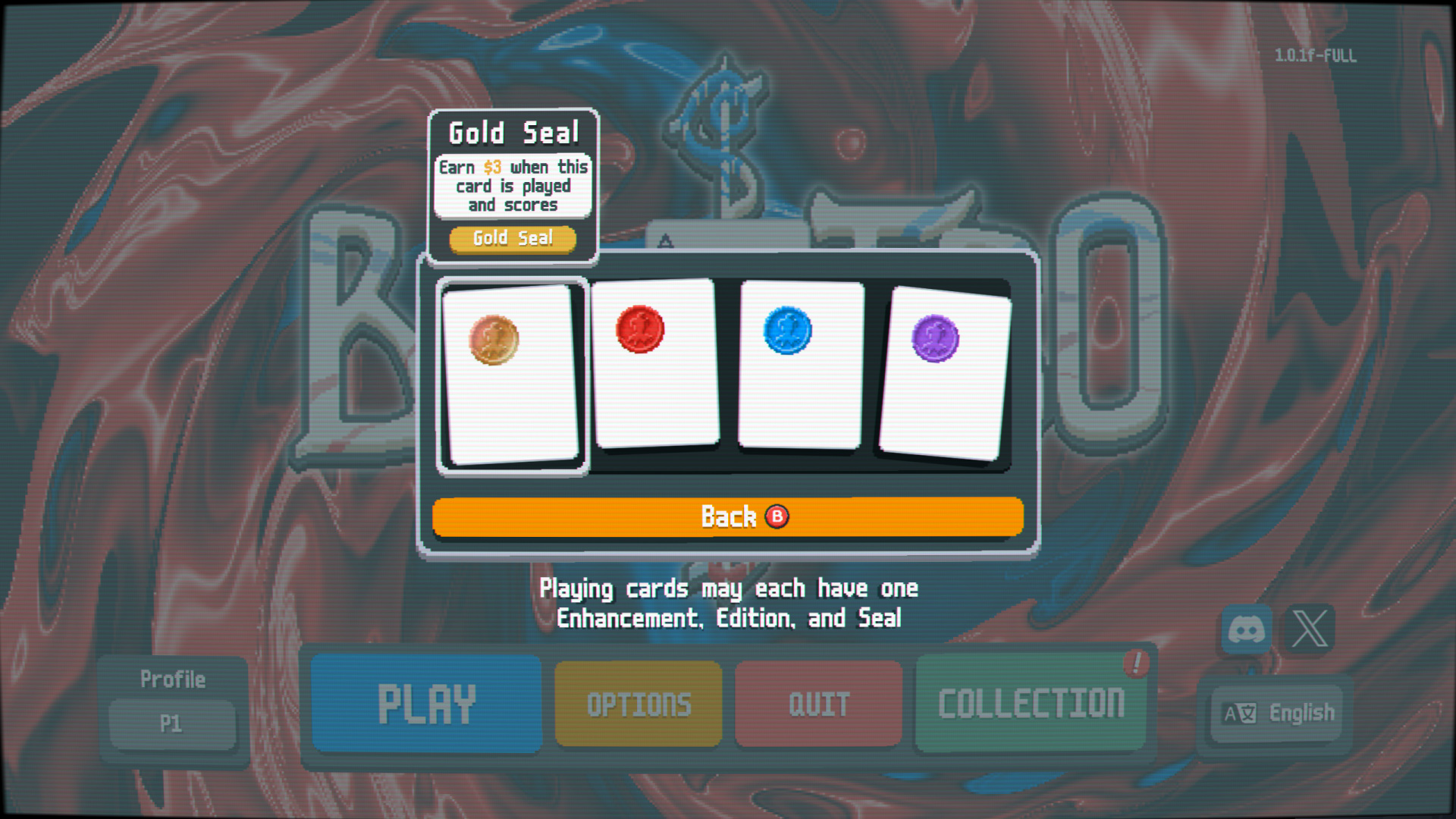 Seals are a per-card modifier dimension orthogonal to enhancements and editions. A card can have all three. Source: Game UI Database.
Tarots: the deck-mutation layer
Tarot Cards (consumables, ~22 of them) are the primary mutation tool. Each does one of:
- Mutate cards (Strength: enhance to next rank; Death: copy one card to another; Tower: convert to Stone Card; Hierophant: enhance 2 selected to Bonus)
- Add cards (Wheel of Fortune: 25% chance to add an edition to a Joker; The World: change suit of selected to Spades)
- Destroy cards (Hanged Man: destroy 2 selected, for thinning)
- Generate consumables (The Magician: enhance to Lucky; Hermit: gain $X based on conditions)
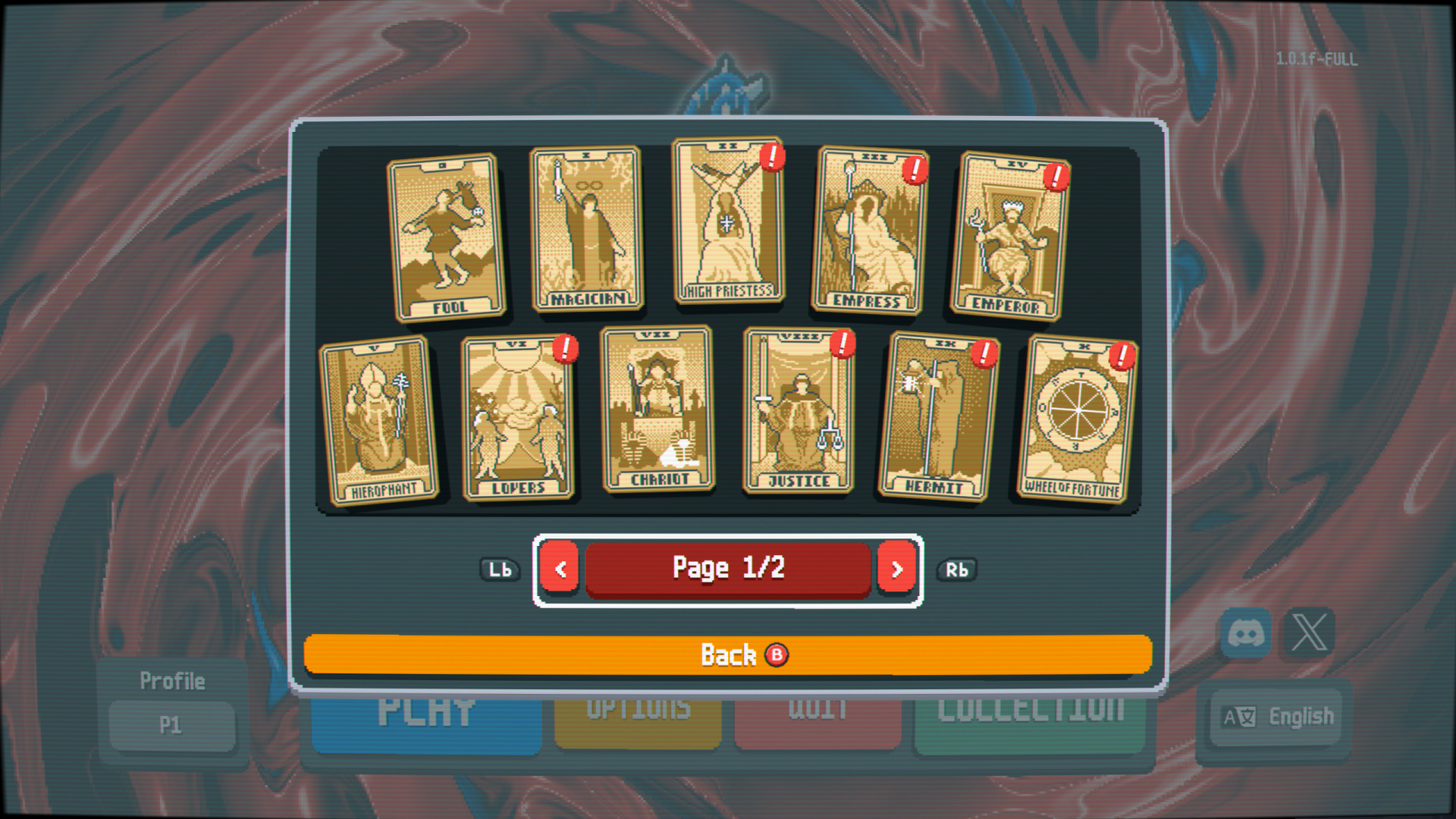 The Tarot collection page. Each card maps onto a specific deck-mutation effect. Drawn from Arcana Packs in the shop, or generated by Spectral cards / certain Jokers. Source: Game UI Database.
Spectral Cards: the dangerous mutation layer
Spectral Cards are rarer, stronger, and usually carry a cost.
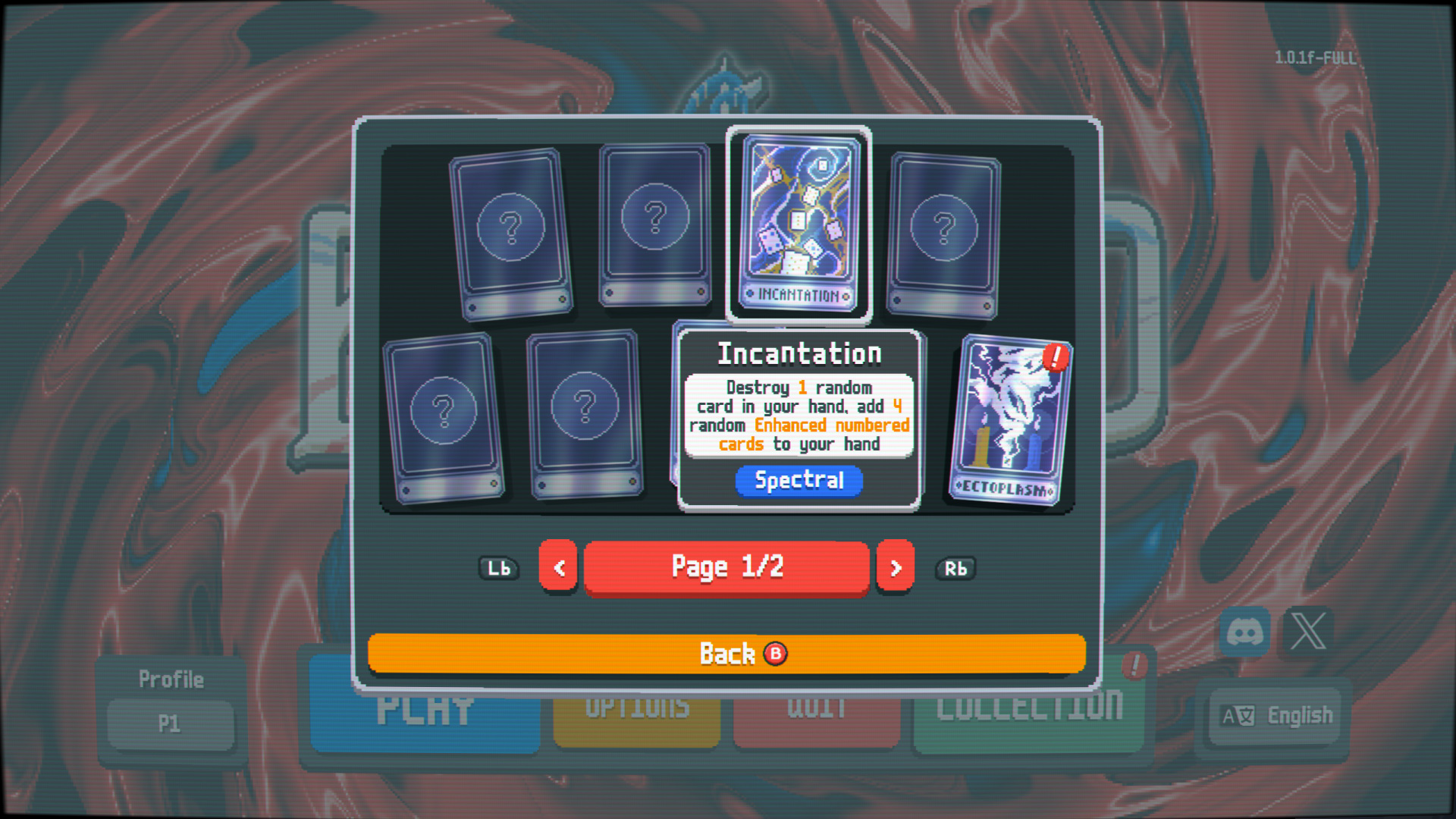 Spectral Cards are rare consumables that mutate the deck more aggressively. Each typically pairs an upside (gain Enhanced cards, copy a Joker, etc.) with a real cost (destroy other Jokers, lose hand size, etc.). Source: Game UI Database.
Examples:
| Spectral | Effect |
|---|---|
| Familiar | Destroy 1 random card in hand, add 3 random Enhanced face cards |
| Grim | Destroy 1 random card in hand, add 2 random Enhanced Aces |
| Incantation | Destroy 1 random card in hand, add 4 random Enhanced numbered cards |
| Talisman | Add a Gold Seal to 1 selected card |
| Aura | Add a random Edition to 1 selected card in hand |
| Wraith | Create a random Rare Joker, set $0 |
| Ectoplasm | Negative Edition to a random Joker, −1 hand size for the run |
| Soul | Spawns a Legendary Joker |
| Ankh | Create a copy of a random Joker, destroy all other Jokers |
| Cryptid | Create 2 copies of a selected card |
| Hex | Polychrome Edition on a random Joker, destroy all other Jokers |
The "destroy all other Jokers" pattern on Ankh / Hex is the canonical bonus-with-drawback: accept catastrophic loss for one specific powerful upgrade. Most experienced players keep a Spectral in reserve for the right moment.
Subtractive deckbuilding done right
Balatro's deck mutation is a strong instance of subtractive-deckbuilding: the removal of cards is itself a build move.
- Thin the deck with The Hanged Man (destroy 2 cards) so you draw your good cards more often.
- Filter by suit by destroying off-suit cards in a Flush build.
- Replace ranks with The World (change suit) or Strength (rank up) to consolidate face cards in a Baron build.
A run that doesn't thin its deck is not building. Most players' first Balatro run end with a 52-card deck and a confused mid-game; experienced players have a 35-card deck of selected cards by Ante 5.
The Spire reference is direct: Slay the Spire's "remove a card at the campfire / shrine" is the thinnest version of this; Balatro extends it into a full deck-mutation game.
What this teaches
- Equipment-as-input layer. When the input format (here, playing cards) becomes equipment, the design space multiplies. The same hand draws differently across runs because the deck is different.
- Three modifier dimensions per atom. Enhancement / Edition / Seal stack on each card. Most card games have one modifier dimension per card; Balatro has three. Combinatorial space scales 3 × N × N × N.
- High-cost mutations are necessary. A run without Ankh / Hex risk-taking caps at moderate scores. The dangerous Spectral Cards are what unlock the highest builds. Don't soft-cap your most powerful tools.
- Subtractive deckbuilding requires a removal verb. Tarots (Hanged Man) and Spectrals (Familiar/Grim/Incantation) all destroy cards while replacing them. Pure removal is rarely satisfying; replace-with-better is.
Patterns this exemplifies
subtractive-deckbuilding: Tarots and Spectral Cards thin and re-shape the deck. Balatro is the strongest expression of this pattern in the knowledge base, more aggressive than Slay the Spire.bonus-with-drawback: Spectral Cards (Ankh, Hex, Ectoplasm) carry hard drawbacks. Glass Cards (×2 mult / 25% break). Stone Cards (huge chips, no rank or suit so they break poker hands).equipment-as-input-layer: the input format (a 52-card deck) is itself moddable. Uncurated.