Battle system
The reason the series exists. 6×3 grid combat in real time, with a deck-draw step embedded in the action.
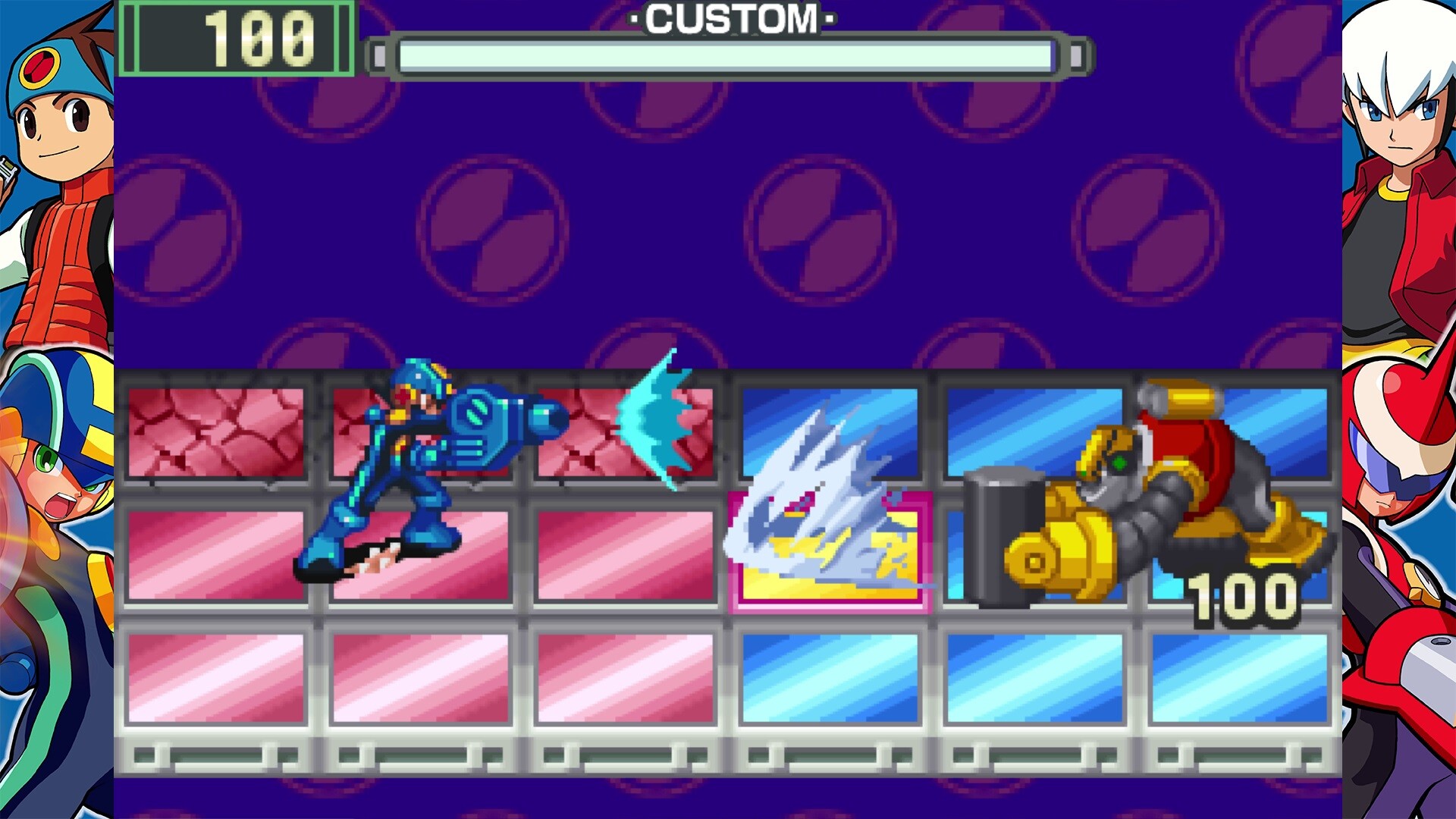 The grid (3×3 each side), the Custom Gauge across the top, an HP counter top-left. MegaMan slides D-pad-style between panels and fires the buster in real time; the gauge fills, you tap Custom, and combat freezes for the chip-draw screen. Source: Steam.
The 6×3 grid
The battlefield is two 3×3 grids facing each other. MegaMan controls the left side; enemies control the right. Movement is one panel per D-pad press: discrete tiles, but you slide between them in real time, dodging between bullets in the gaps.
Panel state is half the combat:
| Panel type | Effect |
|---|---|
| Normal | Standable, no effect |
| Cracked → Broken | Step off → cracks. Step off again → broken (un-standable). |
| Ice | Slides you to the next valid panel (FloatShoes immune from BN3) |
| Grass | Heals Wood-element actors; doubles incoming Fire damage |
| Sand, Poison, Lava, Holy | Later additions; element-modifier panels |
| Stolen (via AreaGrab/Steal chips) | Annexed enemy columns physically shrink the opponent's space |
Panels are resources. Stealing them compresses the opponent's dodge options. Cracking panels under a flying enemy sets up a free-damage moment when they land.
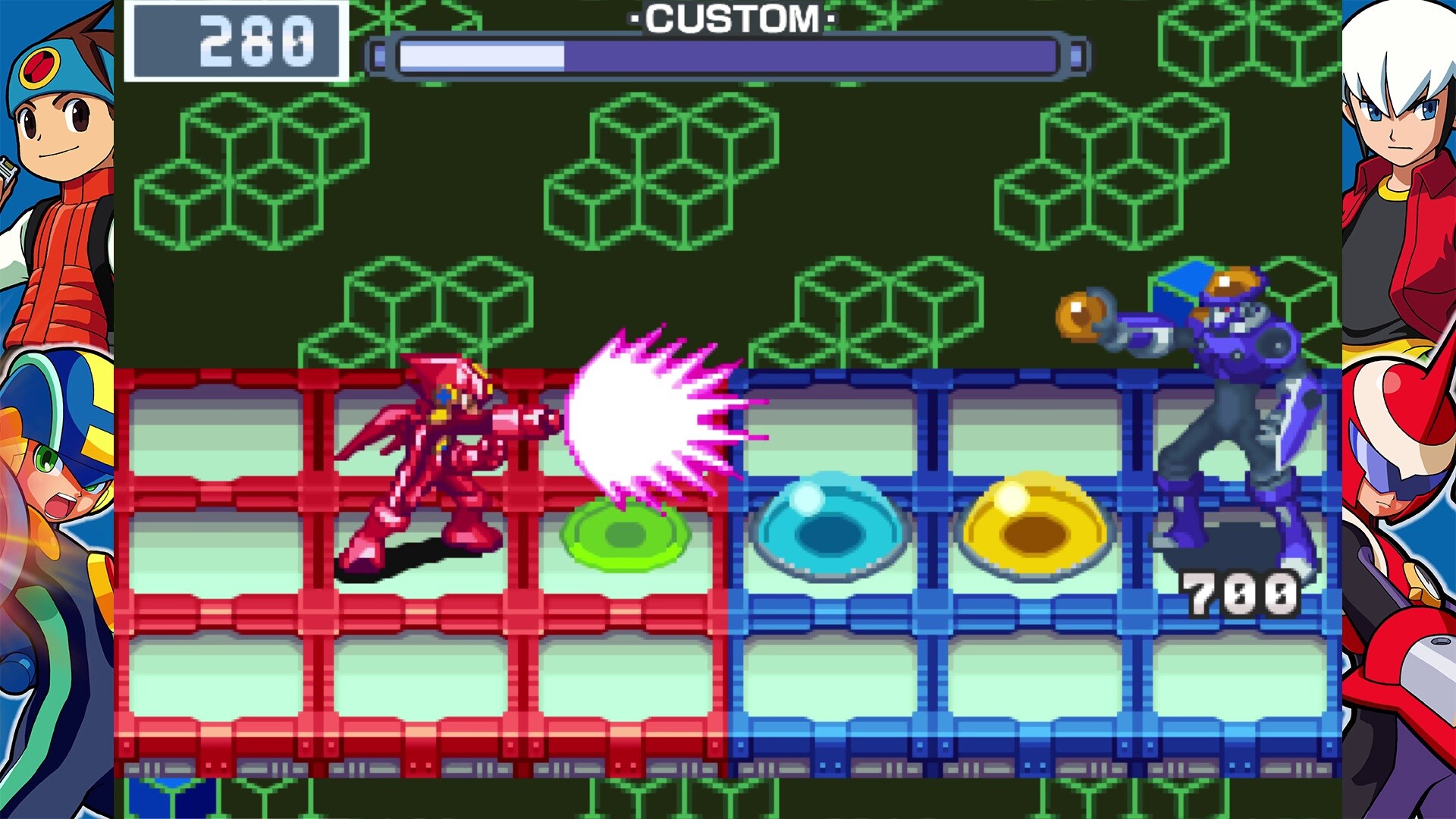 Grass panels in green; cracked and broken panels visible. Panel state is half the tactical layer. Source: Steam.
What's distinctive about grid + real-time
Most grid combat games are turn-based (Fire Emblem, FFT, Into the Breach). Most action games are continuous-movement (Diablo, Souls). BN's hybrid is rare:
- The grid is positional puzzle thinking: which column to stand in, which panel to crack first.
- The real-time-ness is reflex play: when to dodge a charging enemy, when to switch rows.
The combination means a fight is both a chess problem and an action sequence. Skill at one isn't enough. Players who only think tactically die to attack timing; players who only react die to positional ambushes.
The Custom Gauge: the rhythm
A bar at the top of the screen fills in real time during combat (~8–10 seconds normally). When full, press Custom (L or R on GBA, default trigger button on Legacy Collection); the action freezes and you're back at the chip-draw screen.
This is the genuinely original move. Not "menu → combat → menu" alternation. Not pause-and-resume planning. The draw step is itself a real-time tactical resource:
- Hitting enemies fills the gauge faster. You can attack to recharge your hand sooner.
- Taking damage slows the gauge. Defensive play means you're stuck with the chips you already played.
- Some chips refill the gauge instantly (FullCust). These become defensive lifelines: get hit, no chips, FullCust, fresh hand.
- Chip cost scales with chip tier: Standard chips cost 1/3 gauge per use, Mega chips 2/3, Giga chips spend the whole bar. So mega-stacking your folder means longer dry stretches between hand refills.
The result is an oscillating rhythm: spend the chips you have → dodge bullets while the gauge fills → tap Custom → draw → repeat. Combat is paced by your own resource cycle, not by enemy turns or skill cooldowns.
Mega Chips and Giga Chips
Two upper tiers of Battle Chips (introduced fully in BN3):
- Mega Chips: powerful named effects (Navi summons, signature attacks). Folder cap: 5 Mega chips, only 1 of each name.
- Giga Chips: game-defining ultimate effects (FullSynchro double-damage, screen-clearing attacks, mid-tier boss summons). Folder cap: 1 Giga chip per folder.
Both cost more Custom Gauge to use and are restricted in what they can combine with at the chip-draw screen. The cap turns them into commit choices: your one Giga is your run's defining ace card.
What reviewers and the community keep saying
Praise: almost universal. Jeremy Parish (1UP) called it the "sole reason for the series' success." The combination of "sharp thinking and quick reflexes" is repeatedly cited as the genre's signature. Folder-building, PA recipe discovery, and the rhythmic Custom Gauge are described as uniquely satisfying. The Legacy Collection's reception (2023) repeatedly remarked on how well the system holds up two decades later.
Critique: the system has known weak points. BN1's difficulty curve is rough. Random virus encounters in the cyber world are slogs on replay. The series' AI difficulty plateaus by mid-game; chip-stacking makes the late game easy if you've collected the right Mega chips. BN4's structure (forced multi-playthroughs of an inferior version of the system) is universally panned.
Telegraph through tile state
Attacks aren't surprise events; they're announced on the grid. Before a wide-area chip fires, the affected tiles flash red. Before a charging enemy lunges down a row, that row highlights. Heat / lava / poison panels visibly mark hazardous floor in advance. Cracked panels warn that the spot will become un-standable on the next step. The grid is the telegraph surface.
This is the same insight as Spire's intent icons or PoE2's wind-ups, rendered into the spatial vocabulary of the grid itself. The 6×3 board has 18 tiles; the player can scan the whole arena in one glance, so "show what's coming where" is cheap to communicate. Reaction is positional (slide left, jump rows) rather than a dodge-roll button.
Patterns this exemplifies
real-time-grid-tactics: discrete tile movement in a real-time combat fight. The defining BN move.draw-step-as-tactical-resource: the Custom Gauge is the original mechanic here. Card draw becomes something you fight to enable.enemy-intent-telegraph: colored / blinking tile highlights mark incoming attacks. Telegraph through the grid rather than icons or wind-ups.