Weather, doubles, and held items
Three battle layers Gen 3 either introduced or reworked. They look small individually; together they doubled the surface area of the combat system and locked in the modern competitive shape.
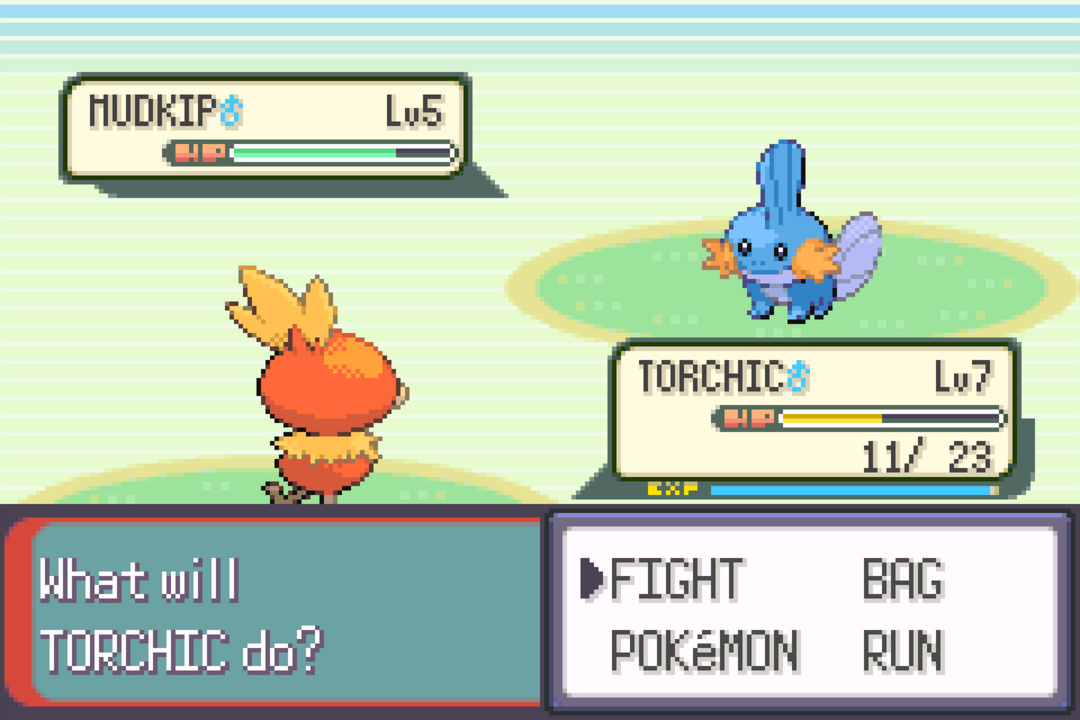 The default battle layout: two Pokémon, four actions (FIGHT / BAG / POKéMON / RUN). Everything weather, doubles, and held items add operates inside this frame. Source: Game UI Database.
Weather as a global state
Weather existed in Gen 2 (Sunny Day, Rain Dance, Sandstorm as 5-turn moves you cast yourself). Gen 3 made it a persistent ability-driven layer:
| Weather | Boosts | Reduces | Ongoing effect |
|---|---|---|---|
| Sun | Fire 1.5× | Water 0.5× | Solar Beam fires in 1 turn (was 2) |
| Rain | Water 1.5× | Fire 0.5× | Thunder accuracy 100% (was 70%) |
| Sandstorm | Rock SpD ×1.5 | : | Damages all non-Rock/Ground/Steel for 1/16 HP each turn |
| Hail | (none: Gen 4 added Blizzard 100% acc.) | : | Damages all non-Ice for 1/16 HP each turn |
The change in Gen 3: legendaries Groudon and Kyogre have abilities that summon their weather permanently (Drought / Drizzle). And Tyranitar's Sand Stream does the same for sandstorm.
So weather stops being a 5-turn move you spend a slot on, it becomes a team identity. Build a Drizzle team (Kyogre + Water-type teammates) and every turn of every battle is rain. Build a Sand team and your Tyranitar is +50% Special Defense for free. The rest of the team is built around the abilities.
Competitive Pokémon's first major meta, Weather Wars, runs from Gen 3 (when Drought / Drizzle were introduced) until Gen 6 (when they were nerfed to 5-turn duration). Three full generations of competitive play structured around an emergent property of three abilities.
Double Battles
Gen 3 introduced 2v2 battles. Each side has two active Pokémon simultaneously. New mechanics:
- Spread moves: Earthquake hits both opponents AND your ally. Surf hits both opponents (and any ally, in Gen 3). Hyper Voice and similar hit both opponents only.
- Targeted moves: most single-target moves now require choosing a target. New depth: hit the partner instead of the threat to set up a switch?
- Helping abilities: Helping Hand (boost ally's next move), Follow Me (redirect attacks to self), Wide Guard (block spread moves), introduced or extended in Gen 3.
The standard mainline tournament format from Gen 3 onwards is VGC, Doubles. Single battles are widely played casually but Nintendo's official competitive format has been Doubles for over 20 years.
The key design payoff: doubles forces the player to think two units at a time, which makes positioning, sacrifice, redirect, and protect all real verbs. Single battles are tactical; doubles are positional.
Held items as a sub-loadout
Each Pokémon can hold one item. Gen 2 introduced this; Gen 3 expanded it dramatically.
The categories that became competitive standards in Gen 3:
| Item type | Examples | Effect |
|---|---|---|
| Choice items | Choice Band | +50% Attack, but locked to the first move used |
| Type-boost items | Charcoal, Mystic Water, Magnet | +10% damage with one type's moves |
| Status restorers | Lum Berry, Chesto Berry | Auto-heal a status condition once |
| HP/recovery | Leftovers | Restore 1/16 HP per turn |
| Switch/escape | Smoke Ball, Shed Shell | Always escape battle / switch through Trapping abilities |
| Damage-reducer | Focus Sash (Gen 4) | Survive a one-shot KO at full HP |
| Stat-rolls | Macho Brace | 2× EV gain (with stat penalty) |
Choice Band is the canonical Gen 3 add: +50% Attack, but you can only use the first move you select until you switch out. A textbook bonus-with-drawback. Pokémon designed around Choice Band (Heracross, Salamence) become extreme physical attackers, at the cost of being locked into one move.
Held items effectively introduce a second 1-slot loadout per Pokémon. So the per-individual loadout becomes:
- Moveset: 4 slots, hundreds of options.
- Held item: 1 slot, hundreds of options.
- Nature: 1 of 25 (set at capture).
- Ability: 1 of 1–2 (set at capture).
- EVs: 510 across 6 stats.
Five orthogonal loadout decisions per Pokémon, before you've thought about your other five teammates.
Why this generation specifically
Why did all three of these (weather-as-ability, doubles, expanded items) ship together in Gen 3?
The simplest explanation: Game Freak was rebuilding the engine for GBA. Going from Game Boy / Game Boy Color (Gen 1/2) to Game Boy Advance (Gen 3) gave them the headroom to add layers. Once they had Abilities (a new infrastructure for "passive effects"), weather-as-ability and Intimidate-on-switch-in fell out for free.
Junichi Masuda has framed Gen 3 as the engine generation, a clean rewrite that future gens would build on. Gen 4 added the physical/special split; Gen 5 added more weather (hail-Snow Warning, etc.); Gen 6 added Mega Evolutions and Fairy. But the architecture is Gen 3's.
What this teaches
- A "global state" layer multiplies the design surface cheaply. Weather adds one parameter to the battle loop and reshapes the entire metagame. The cost to the engine is small; the cost to the metagame is enormous.
- Per-unit single-slot items create a sub-loadout for free. Held items are 1 slot, but with hundreds of options, they're a real decision: and the decision is per Pokémon, so the team's items are six independent picks.
- Multi-target combat opens a positioning game inside a turn-based system. Doubles lets you trade tempo, redirect aggression, and sacrifice: verbs that don't exist in single battles. The tactical depth roughly doubles.
- Engine generations are real. Pokémon's "decade-defining" mechanics (Abilities, weather-as-ability, doubles) all shipped in one generation because that's when the engine could carry them. Plan for the discontinuity; don't try to bolt every feature into the next minor revision.
Patterns this exemplifies
weather-as-global-modifier: turn-based combat with a cross-board state (weather) that boosts/reduces moves and triggers abilities. Uncurated; Pokémon is the canonical case.bonus-with-drawback: Choice Band (+50% Attack / locked to one move), Macho Brace (2× EV gain / halved Speed), Toxic Orb (badly poisons holder, but enables Guts / Poison Heal / Quick Feet abilities). Gen 3 introduced or popularised most of these.