Series evolution (BN1 → BN6)
One game per year, 2001–2005, on the same engine. The combat shell stayed essentially frozen; everything else iterated.
The frozen core
| Element | Same across all 6? |
|---|---|
| 6×3 grid | ✅ identical |
| Real-time + chip-draw rhythm | ✅ identical |
| Folder of 30 chips | ✅ identical |
| Letter-code rule | ✅ identical from BN2 (★ added) |
| Buster + Charge Shot | ✅ identical |
| Panel state mechanics | ✅ baseline same; new types added each game |
This is what made yearly iteration possible. Every BN player picks up the next entry and the controls feel identical. The new content is in the layers above.
What changed each entry
BN1 (2001): the foundation
- 5-chip Hand, no ★ wildcard
- Linear stat upgrades (no NaviCust yet)
- ~36 Program Advance recipes
- No Mega/Giga distinction; chip caps were just count-based
- Notoriously rough difficulty curve; story is bare-bones tutorial-shaped
BN2 (2001): the deepening
- ★ wildcard code introduced: a flex slot in deckbuilding
- Style Change prototype (still play-pattern-earned, would be formalized in BN3)
- Sub-chips (HP recovery, escape) added
- Expanded panels (Sand, Holy)
- More PAs; deckbuilding gets meaningfully deeper
BN3 (2002): the design apex
- Mega Chips and Giga Chips introduced with caps (5 Mega, 1 Giga)
- NaviCust replaces linear stat upgrades: the iconic block-puzzle (see NaviCust)
- Style Change formalized: 4 elements × 5 types
- The arguable peak. Most retrospectives put BN3 at the top.
BN4 (2003): the messy entry
- Tournament structure (3 separate "tournaments" = forced multi-playthroughs)
- Soul Unison replaces Style Change: deterministic, story-unlocked
- Dark Chips: morality system; powerful chips with permanent stat penalties
- Full Synchro: perfectly-timed counter-attacks deal 2× damage
- Universally regarded as the franchise's low ebb. Forced playthrough structure + unbalanced Souls.
BN5 (2004): the experimental entry
- Liberation Mission mode: strategy-grid combat segments interspersed with normal battles
- Soul Unison expanded: party-of-Navis, larger roster
- Chaos Unison: DarkChip + Soul fusion (1 turn, high risk)
- One-PA-per-battle restriction added (controversial)
- BN5 is structurally weird: half normal BN game, half team-tactical mode. The pure-BN audience didn't love it; the experimentation paid back in BN6.
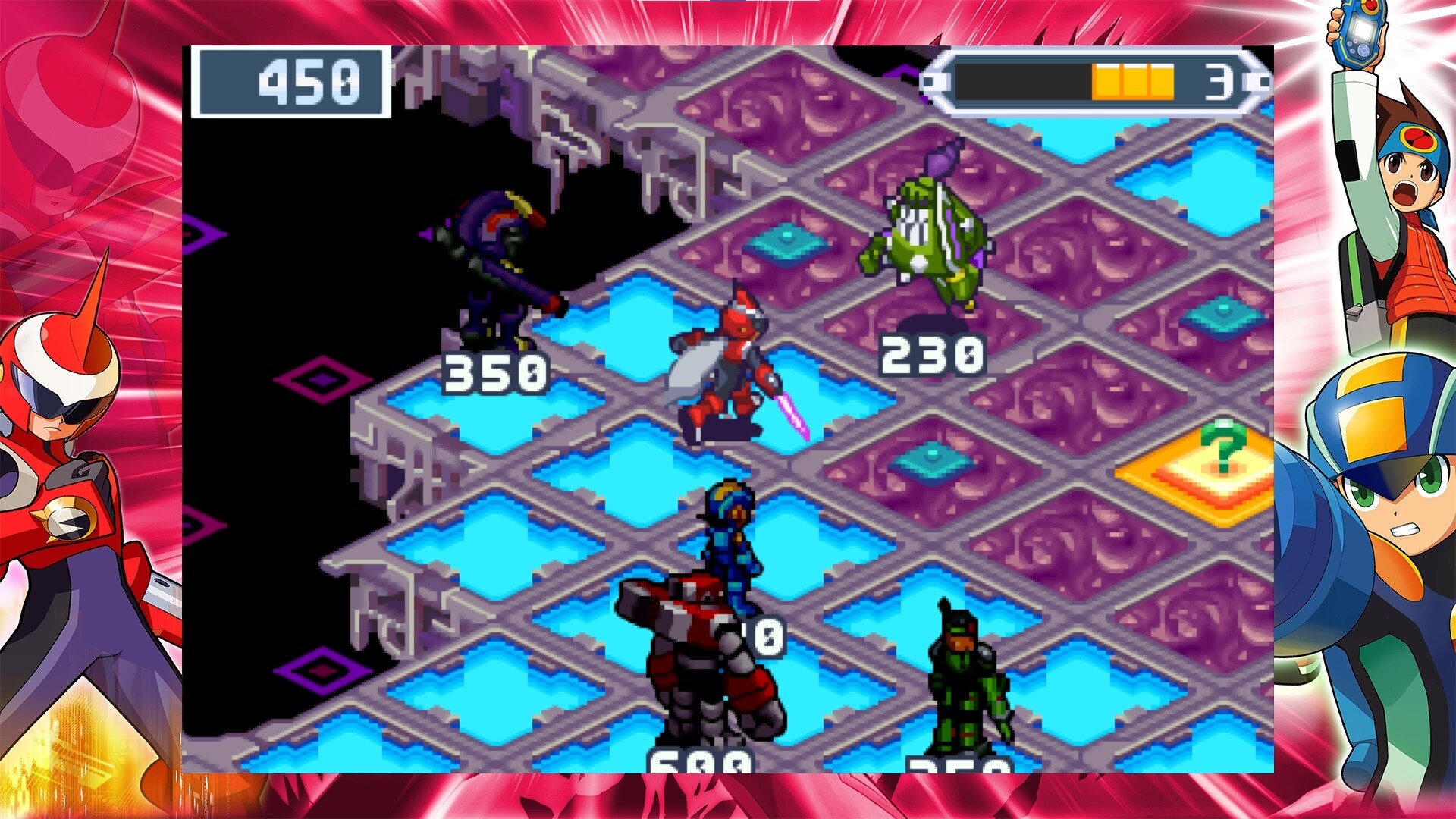 BN5's Liberation Mission mode: strategy-RPG-style grid combat between normal battles. Capcom's experimental detour. Source: Steam.
BN6 (2005): the polish finale
- Cross System: version-locked transformation roster (Falzar / Gregar)
- Beast Out: temporary super-form with Bug Out fallback
- NaviCust expanded to roughly double effective area; Compression Codes added
- Multi-PA restored (BN5's restriction walked back)
- Refined virus AI, polished sprites
- The synthesis. Most refined battle pacing in the series. Effectively the "definitive" BN.
Reading the series shape
The shape is a two-act trajectory:
- BN1 → BN3: ramping up. Each entry adds a clean new layer (★ code, NaviCust, Style Change, Mega/Giga distinction). BN3 is the design's clean peak.
- BN4 → BN6: experimentation, reaction, synthesis. BN4 tries deterministic Souls and morality; BN5 tries strategy-grid; BN6 walks back the bad ideas, keeps the good ones, and lands the final form.
The lesson: a 5-year iterative cycle can converge if you keep failing forward. BN4's bad ideas weren't disasters because BN5 corrected them; BN5's experimentation wasn't a dead end because BN6 distilled what worked. Live design via shipping > live design via planning.
Cost of yearly iteration
Director Masakazu Eguchi and producer Keiji Inafune have referenced the punishing schedule in retrospect:
"As they had one year to work on each game, including bug checking and fixes, the development schedule was constantly tight." Kataoka, Frontline JP Part 2 (2022)
Inafune has also noted that BN3 was originally intended as the series finale; BN4–6 were market-driven extensions. The fact that the series still landed BN6 as a coherent capstone despite the "shouldn't have existed" pressure is a notable design accomplishment.
What this teaches
- A long-running series doesn't have to drift. PoE1 spent 12 years drifting toward speed-clearing; BN's combat in BN6 is recognizably the same as BN1 because the team consciously didn't touch it.
- Frozen core + iterating periphery is a stable design strategy. The Capcom team had a known-good engine and used the design budget on the meta-systems above.
- Bad ideas in iteration #N can be productive if iteration #N+1 corrects them. BN4's mess was useful: it taught BN5 what didn't work, which taught BN6 what to keep.
Patterns this exemplifies
iterative-yearly-refinement: five years of iterating meta-systems on a frozen combat core. Capcom's working model for the BN series.