Patch board
The single most-stealable design idea in Sparklite, and the reason the game shows up in design-pattern conversations more than its size would predict.
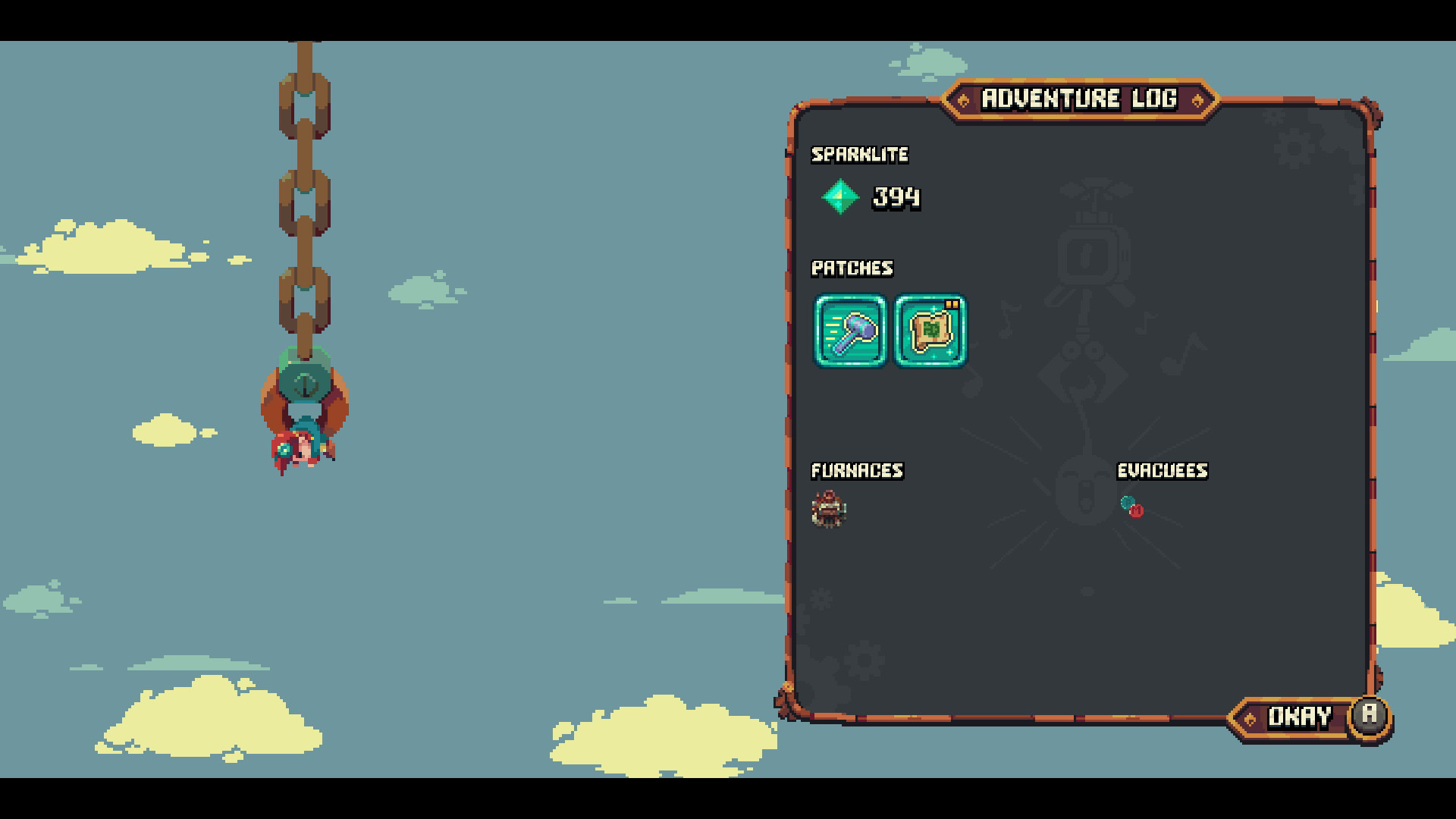 Adventure Log: Sparklite currency (394) plus the patches inventory list, which feeds into the Med Bay patch board. Source: Steam. The patch board UI itself is in the Refuge's Medical Bay; this view shows the patches the player has collected but not yet placed.
Structure
Patches drop from enemies and the world. They're applied on a grid inside the Refuge's Medical Bay. The board has three tiers, expanded by spending Sparklite on med-bay upgrades:
| Med-bay tier | Grid |
|---|---|
| 1 (start) | 3×3 (9 cells) |
| 2 | 4×4 (16 cells) |
| 3 (max) | 5×5 (25 cells) |
You can leave the descent to rearrange patches, but you can't change them mid-fight.
Patches have footprint
Patches occupy 1–4 cells with Tetris-shaped outlines. Stronger effects take more cells. The damage-up patch (which also upgrades the 2-hit combo to a 3-hit combo) takes 4 cells, that's nearly half a starter board for a single effect.
This footprint is the design move. It's not "better stats cost more gold", it's "better stats cost space you can't use for anything else."
Categories the player chooses between:
- Health (max HP)
- Defense (damage reduction per hit)
- Wrench damage (close combat)
- Energy (powers gadgets / sub-weapons)
- Gadget damage
- "Map marker" patches (reveal Titan / Vault / Furnace locations on the map)
Fusion: the pressure-release valve
Buy a workshop upgrade and small patches fuse. Two identical bronze patches → one silver patch with double effect at smaller footprint. Two silvers → one gold.
4× ¼-heart bronze patches (4 cells)
       ↓ fuse pairs
2× ½-heart silver patches (2 cells)
       ↓ fuse again
1× full-heart gold patch (1 cell)
This is the load-bearing piece of the design. Without fusion, low-tier patches would clog the board faster than the player can upgrade it. With fusion, the player has a clean conversion: more time → smaller footprint per unit of effect.
Why it works as a design pattern
It's a deliberate anti-power-creep mechanism that doesn't actually prevent power growth, it forces a constant choice about what kind of power.
- More health → less damage-up.
- Map markers → less defense.
- Damage-up means giving up four cells you can't use for anything else.
Every descent is a small archetype declaration: am I a tank this run, a glass cannon, a navigator? The grid forces commit.
It also creates a second-order loop: collect patches → outgrow board → invest Sparklite in tier or fusion → re-arrange → descend again. The grid isn't just inventory, it's a puzzle the player solves between runs.
Patterns this exemplifies
grid-inventorypower-creep-mitigationfusion-economyopportunity-cost-loadout
Compare with
- Warframe modding: a numeric+categorical version of the same idea: 60-point capacity + matching polarities. Read /games/warframe/modding.
- Slay the Spire decks: a combinatorial version: tighter deck = stronger draws. Read /games/slay-the-spire/deckbuilding.