Grid inventory
Lemma: Items live on an explicit 2D grid. Where you place them, not just how many, determines what they do or how much they're worth.
What it solves
A flat list inventory ("you have 23 items") is the most boring loadout possible. Adding spatial structure to inventory turns "having items" into "arranging items," which:
- Creates real opportunity cost without needing item counts.
- Surfaces synergies through adjacency / row / column rules.
- Gives the player a between-runs puzzle that scales with items collected.
- Makes raw quantity stop mattering past a point; placement is the cap.
Grid inventories are a special case of loadout-as-budget where the budget shape is explicitly spatial.
Variants across games
| Game | Released | Grid | Item geometry | Driving constraint |
|---|---|---|---|---|
| Mega Man Battle Network (NaviCust) | 2002 (BN3) | 4×4 → 5×5 (later doubled in BN6) | Tetris-shaped programs + Command Line constraint + same-color non-adjacency | Violations = Bugs (opt-in debuffs, not failures) |
| Sparklite (patch board) | 2019 | 3×3 → 4×4 → 5×5 | Tetris-shaped patches (1–4 cells per patch) | Footprint: bigger patches eat more cells |
| Moonlighter 2 (backpack) | 2025 | Fixed-size backpack grid | One cell per relic; tags trigger on placement | Adjacency: corners, rows, "POINTED at" rules |
The lineage matters
MMBN3 shipped this in 2002. Sparklite's patch board (2019) and Moonlighter 2's backpack puzzle (2025) are independent re-discoveries of the same core idea (Tetris-shaped buff blocks on a small grid with adjacency rules), but Capcom got there first by 17–23 years.
This isn't a "BN was a precursor" trivia note. It's a pattern stability indicator. When three teams independently land on the same shape over two decades, the pattern is genuinely strong. Each one tunes the rules differently:
- NaviCust: adjacency violations cause Bugs (debuffs you live with).
- Sparklite: the grid is the constraint; items don't conflict with neighbors.
- Moonlighter 2: adjacency triggers synergies; placement is positive, not negative.
Visual contrast
| Mega Man Battle Network: NaviCust 4×4 grid | Sparklite: patches awaiting placement | Moonlighter 2: backpack with synergy markers |
|---|---|---|
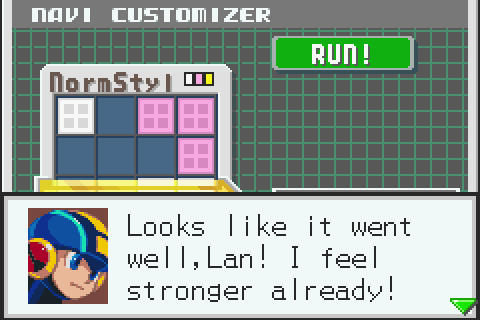 | 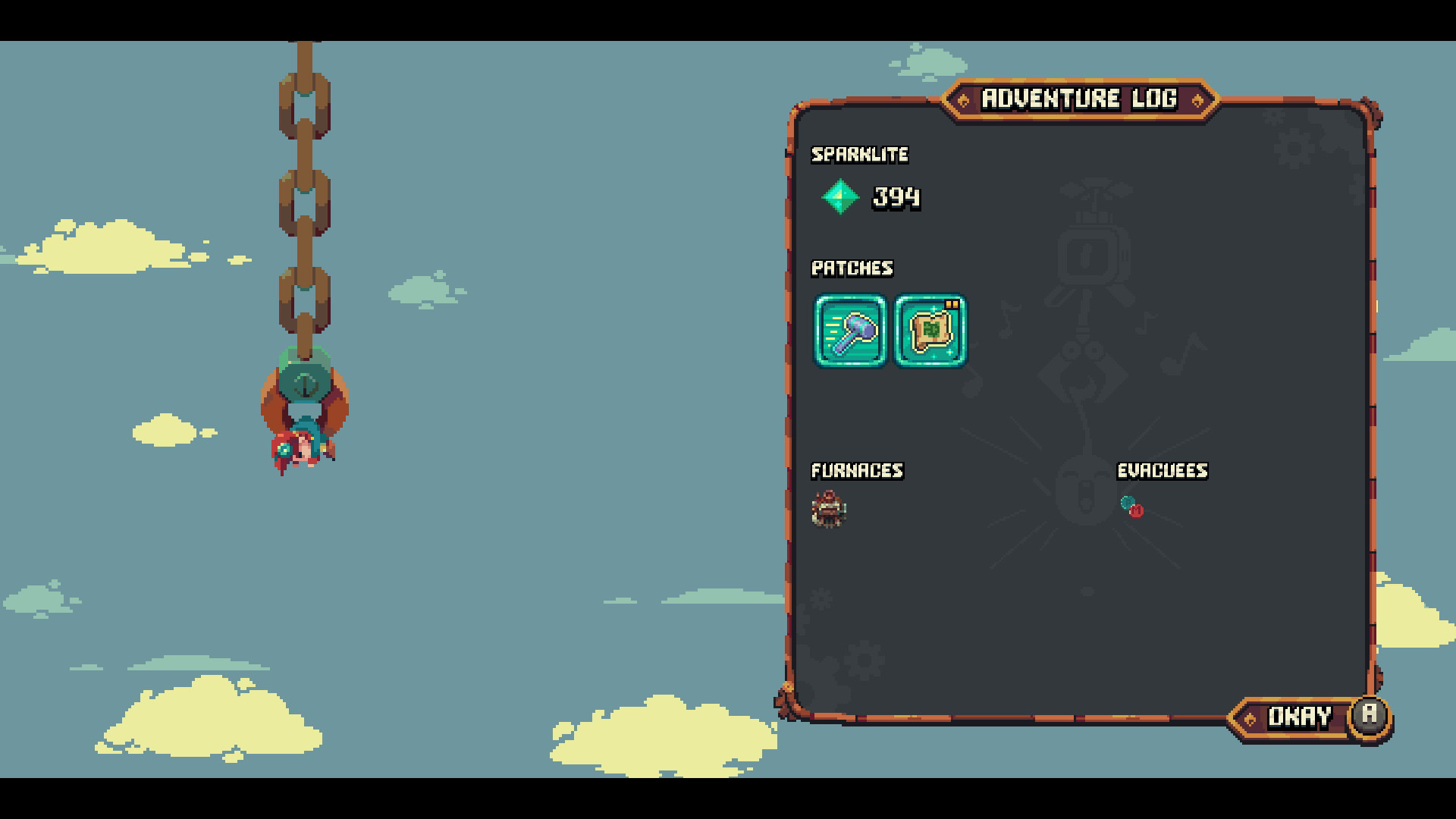 | 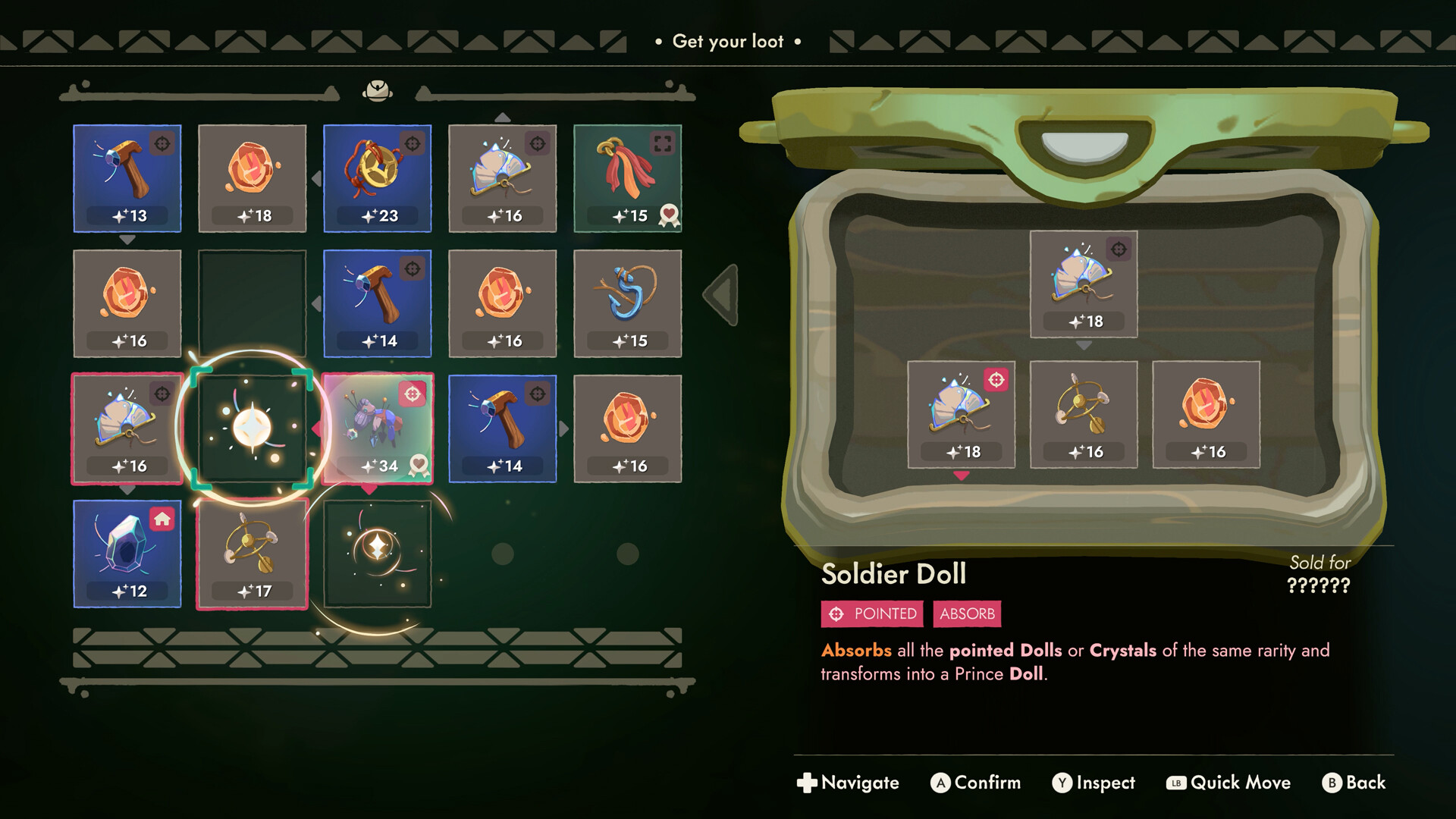 |
| Tetris programs on a 4×4 grid; the third row is the Command Line. Solid programs must touch it; striped programs must not. Violations cause Bugs (debuffs): opt-in to bend the rules. | Different patches have different shapes; the puzzle is fitting them. | All relics are 1×1; the puzzle is what's next to what. |
Three teams, three slightly different rule schemes, the same core insight: spatial packing > flat lists.
When to use this pattern
- Roguelites where you want loadout to be a between-runs puzzle, not just a stat sheet.
- Looter games where item count would otherwise be the whole game.
- Crafting / shopkeeping where item value can be made placement-dependent.
- Squad / party games where unit positions matter.
Avoid when:
- Items are too numerous to fit a meaningful grid (Diablo-style hundreds of items per run drowns the pattern).
- The action layer demands fast loadout swaps (grid puzzles take time).
Pitfalls
- Grid that's too small: feels punishing, players can't fit anything they want.
- Grid that's too big: defeats the point; the puzzle stops biting. A 4×4 is genuinely enough (NaviCust ships with 4×4 in BN3).
- Item shapes / tags too uniform: if every item plays the same with the grid, the spatial layer adds nothing.
- Synergy / constraint rules too complex to read: players need to see whether a placement is good. NaviCust shows the Command Line and color clashes. Sparklite shows footprint visually. Moonlighter 2 shows arrows. Without that visual feedback, the puzzle is opaque.
- Strict failure on rule violations: if breaking the rule rejects the placement, the system feels punishing. NaviCust's Bug-as-cost approach is more forgiving and produces more interesting decisions.
Adjacent patterns
loadout-as-budget: broader pattern; grid inventory is one specific budget shape.opportunity-cost-loadout: what the grid forces.fusion-economy: Sparklite and Moonlighter 2 both pair grid inventory with a fusion mechanic to keep the grid from clogging up. NaviCust uses Compression Codes (BN6) for the same purpose.bonus-with-drawback: NaviCust's Bug system is a textbook example: opt into chaos for a buff slot.