Backpack puzzle
The most original mechanic in the game and the reason it shows up in design-pattern conversations. The loot bag is a placement puzzle that determines its own price.
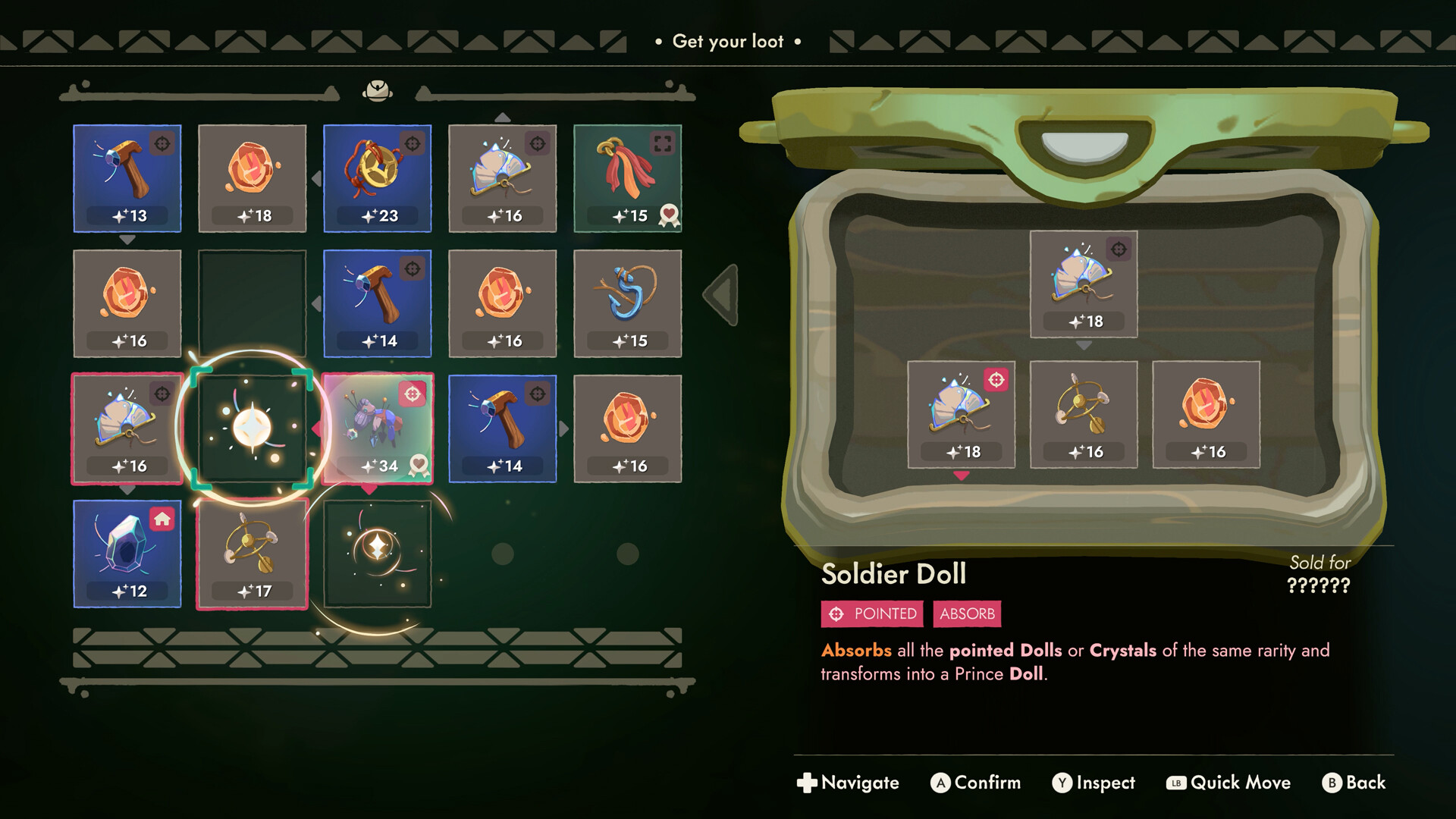 The backpack puzzle. Each cell holds a relic with a quality multiplier (e.g. +18, +34). The selected relic: Soldier Doll, has POINTED + ABSORB tags: "Absorbs all the pointed Dolls or Crystals of the same rarity and transforms into a Prince Doll." Source: Steam.
Structure
You loot relics in the dungeon. Each relic is a tile with:
- A base type (Doll, Crystal, Lantern, Charm, Spade, …).
- A rarity (common → epic).
- A set of placement tags:
Once Placed,Corner,Left-Right,Top-Bottom,Pointed,Row,Column,Adjacent, etc. - A conditional ability that triggers based on placement: bonus quality, transform into a higher-tier relic, burn neighboring relics for stat conversion, etc.
The backpack itself is a fixed-size grid. Where you place each relic determines what triggers.
Why footprint isn't the constraint: placement is
In Sparklite the constraint is space: bigger patches eat more cells. In Moonlighter 2, every relic is one cell, so the constraint is adjacency. A relic at a corner triggers different effects than the same relic in the middle. A relic placed next to specific other relics absorbs them or boosts them.
This is a more combinatorial version of the loadout-as-budget pattern. Sparklite is spatial-shape Tetris; Spire is deck-thinning combinatorics; Moonlighter 2 is grid-adjacency optimization, a kind of Tetris-meets-Sudoku for loot.
Quality stacking → price multiplier
Each placed relic accumulates a quality multiplier (e.g. +5%, +18%, +33%) from its own tags + neighbors. A common relic with +12 quality stacks can sell for more than a raw epic relic with no synergy.
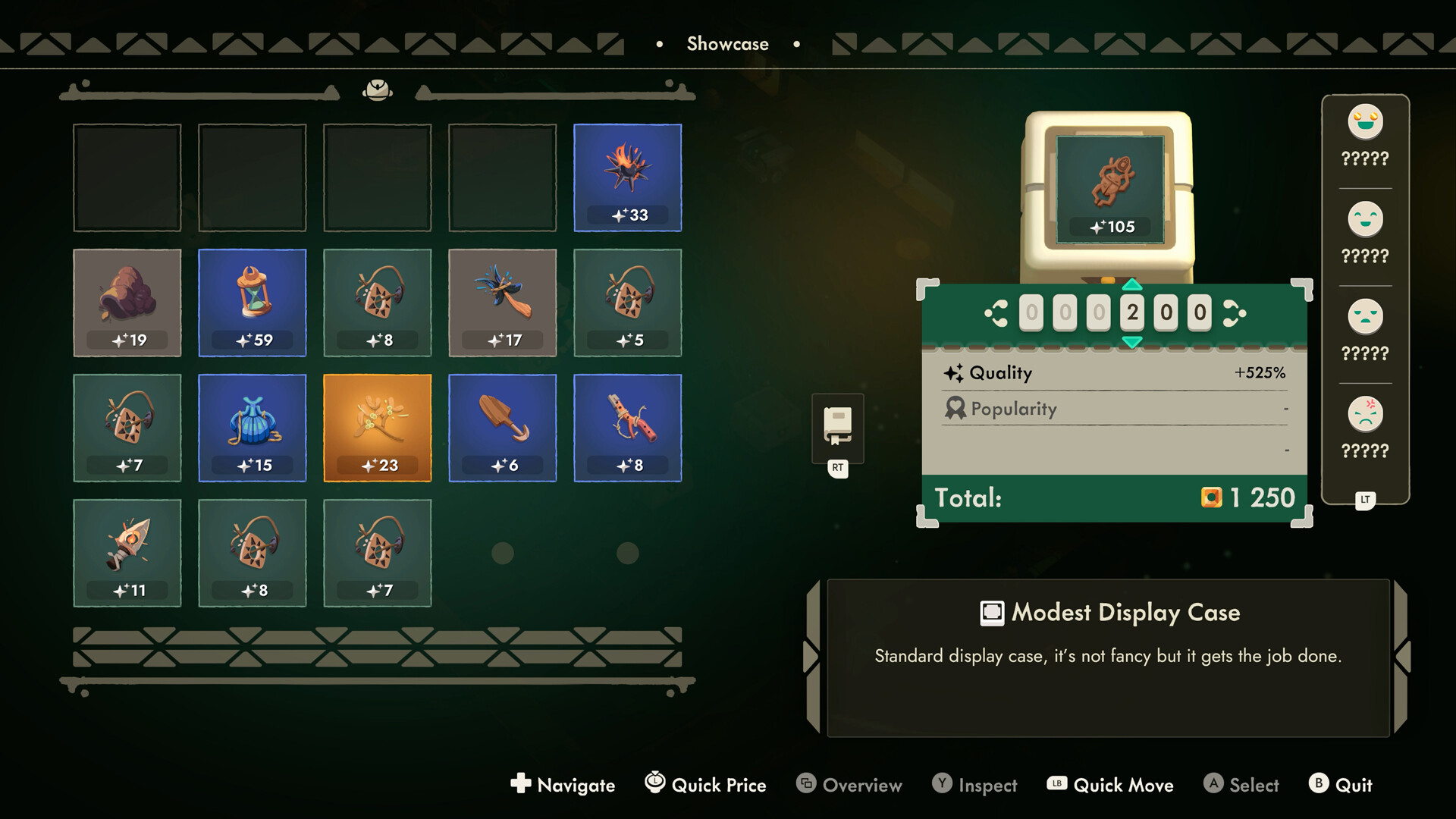 The sell-side view. Note the +525% Quality multiplier stacked on the displayed relic: that's the backpack puzzle's payoff arriving at the showcase. Customer reaction faces on the right tell you whether the price is right. Source: Steam.
So the loop is:
loot relic → place it adjacent to synergy targets in backpack
  → quality multiplier accumulates
    → showcase → quality × popularity = sale price
      → gold → invest in shop / village
"Burn" relics: fusion as space-management
Some relics burn other relics on placement: arrows show what gets consumed, trading those relics for a quality boost on the survivor. "Burn all common relics and add 4 Quality to this relic for each burnt relic."
This is functionally a fusion economy (cf. Sparklite patches, where two ¼-heart bronze patches fuse to one ½-heart silver). Same insight, different implementation: in Sparklite you fuse to reduce footprint; in Moonlighter 2 you fuse to amplify quality.
The strategic shape
Players quickly converge on a strategy: center your layout around 3–4 target relics whose quality you intend to stack as high as possible. Everything else is fuel, placed deliberately to feed those targets via adjacency or burn effects.
This is the same instinct as deck-thinning in Spire: don't try to optimize all your loot, optimize a small core of it.
Patterns this exemplifies
loadout-as-budget: the budget is grid-adjacency rather than total cells / total points.grid-inventory: explicit spatial layout matters.opportunity-cost-loadout: placing a relic in one slot precludes the synergies of every other placement.backpack-puzzle: the specific lemma. Loot value is a function of placement, not just quantity.fusion-economy: burn / absorb / transform mechanics consolidate loot at quality cost.