Path of Exile
Twelve+ years of refusing to make anything easier. Almost every design choice in PoE is a deliberate friction point, no auction house, no gold, sockets you can fail to colour, expansions you can fail to clear, builds you can fail to plan. The trade-off is that when something works, it's yours in a way no other ARPG replicates. The companion piece is Warframe, same era, both F2P, opposite philosophy on almost everything. PoE is what Warframe could have been if DE had decided that everything was load-bearing.
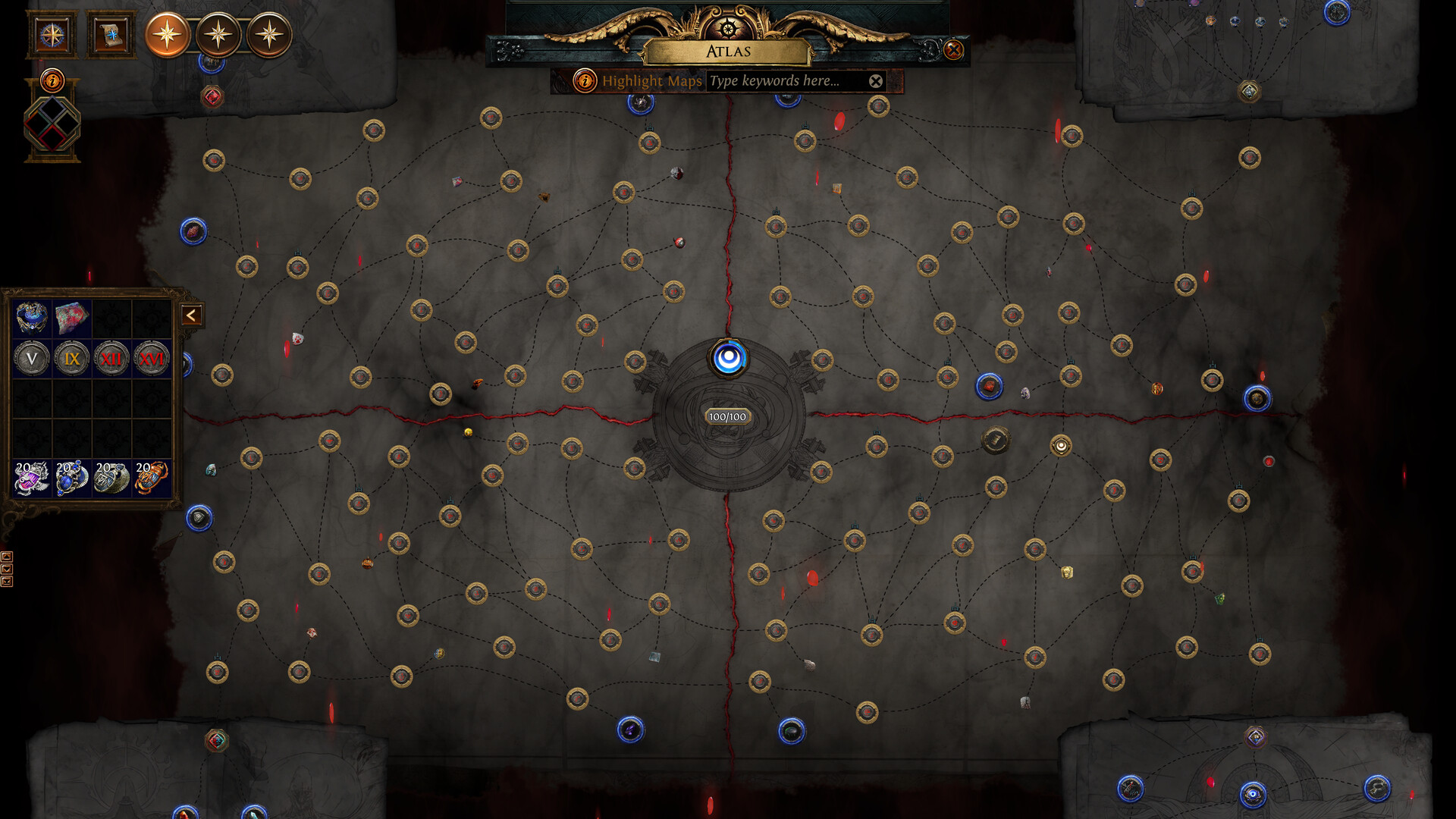 The Atlas of Worlds: PoE1's endgame structure. ~115 map zones, traversed in any order, gated by Voidstone progression. The campaign exists to teach you mechanics so the Atlas can use them. Source: Steam.
Snapshot
| Studio | Grinding Gear Games (Auckland, NZ; Tencent-owned since 2018) |
| Released | October 2013 (still in active development as of 2026) |
| Platforms | PC, Mac, PS4/5, Xbox |
| Run length | Endgame map: ~5–10 min. Pinnacle bosses: 5–30 min. League race: ~80–200 hours |
| Iconic mechanic | The 1500-node shared passive tree + skill gems as gear |
| Core dialectic | Friction over convenience: at every layer |
| Business model | F2P, cosmetics + stash tabs only; expansions free; supporter packs fund development |
| Sibling project | Path of Exile 2 (Early Access since Dec 2024); shipped as a parallel game, not a replacement |
Macro loop: the long arc
Campaign (Acts 1–10, ~10 hours skilled, ~30 hours new), 1× per character
  → Maps (Atlas, T1–T16), the actual game starts here
    → Maps drop maps; you sustain your own pool
    → Atlas Passive Tree shapes which league mechanics spawn in your maps
    → 4 Voidstones from pinnacle bosses raise the Atlas effective tier ceiling
    → Pinnacle bosses (Sirus, Maven, Searing Exarch, Eater of Worlds) gate currency tiers
    → Uber bosses gate prestige + chase rewards
  → Crafting cycle, the actual *actual* game
    → currency dropped from maps is fed into the affix-modifying engine
    → 2-mod rare → 4-mod rare → 6-mod rare → influenced rare → ...
    → mirror-tier item is the asymptote
  → Trade, the meta-meta-game
    → pathofexile.com/trade is the marketplace; in-game whispers complete the trade
    → currency you hold *is* your craft budget, in real time
  ← death in a map → 10% XP loss above level 67, map gone, loot lost
The campaign is the prologue. The Atlas is the game. Crafting is the meta-game. Trade is the meta-meta-game. Each layer wraps the previous one with another budget to optimize.
Mechanic deep-dives
- Passive tree: 1500 nodes shared across classes; class is a vector into shared geometry.
- Skill gems: skills as items, socketed into gear, linked to support gems; the 6-link as the canonical chase.
- Ascendancy: sub-class chosen mid-campaign via the Labyrinth; the only major gating that's a skill check, not RNG.
- Crafting & currency: there is no gold; every "currency" is a crafting reagent.
- Trade & economy: no auction house, deliberately. SSF, loot filters, the Vision.
- Atlas of Worlds: the post-campaign map system; maps as items; pinnacle bosses; the Atlas tree.
- Death & difficulty: 10% XP loss; HC; SSF; the cliff at level 95.
Through other lenses
- Ludonarrative reading: these mechanics read through the resonance lens. Verdict: orthogonal, fiction is decorative scaffolding around an honest math game, and that's the right call.
What this game teaches
- Friction can be the product. PoE's lack of convenience is what makes its rewards feel earned. Most games run from this; PoE leans in.
- One currency for everything beats gold + materials. When trade currency is crafting reagent, every transaction is a tradeoff between "buy" and "craft." Inflation has a built-in sink.
- Class as a starting position, not a class. The shared passive tree is the antidote to the "every Sorcerer plays the same" problem.
- Build power lives in the seams: skill + support + keystone + unique + ascendancy interactions. Not in stat bumps.
- Aspirational crafting > guaranteed crafting. GGG nerfs deterministic crafting subsystems on a 12–18 month cycle, on purpose.
- Delegate tooling to the community. GGG ships a filter language, not a default filter. NeverSink/FilterBlade are the de facto standard, updated weekly.
- Iteration over polish. 3-month league cadence, willingness to ship, willingness to nerf. The "Path of Nerfs" community joke is also the design.
- Two games are a valid response to design tension. PoE2 wasn't a sequel: it was a parallel canvas for re-examining decisions PoE1 had drifted from.
See lessons for the longer take and design-tensions for GGG's stated philosophy.