The chemistry engine
The signature design mechanic. Fire, ice, wind, water, and electricity are systemic rules that propagate through the world independent of any specific encounter. Wood catches fire; fire warms the air; warm air rises; updrafts carry the paraglider. Ice freezes water; ice melts in fire; metal weapons attract lightning during storms. None of this is scripted per-puzzle. It's the rules that are written, and the puzzles emerge when those rules collide with a specific terrain.
This is what programmer Takuhiro Dohta called the "chemistry engine" at GDC 2017, a small set of element rules that interact with the physics engine to produce the player-felt feeling that Hyrule responds to actions consistently, everywhere, all the time.
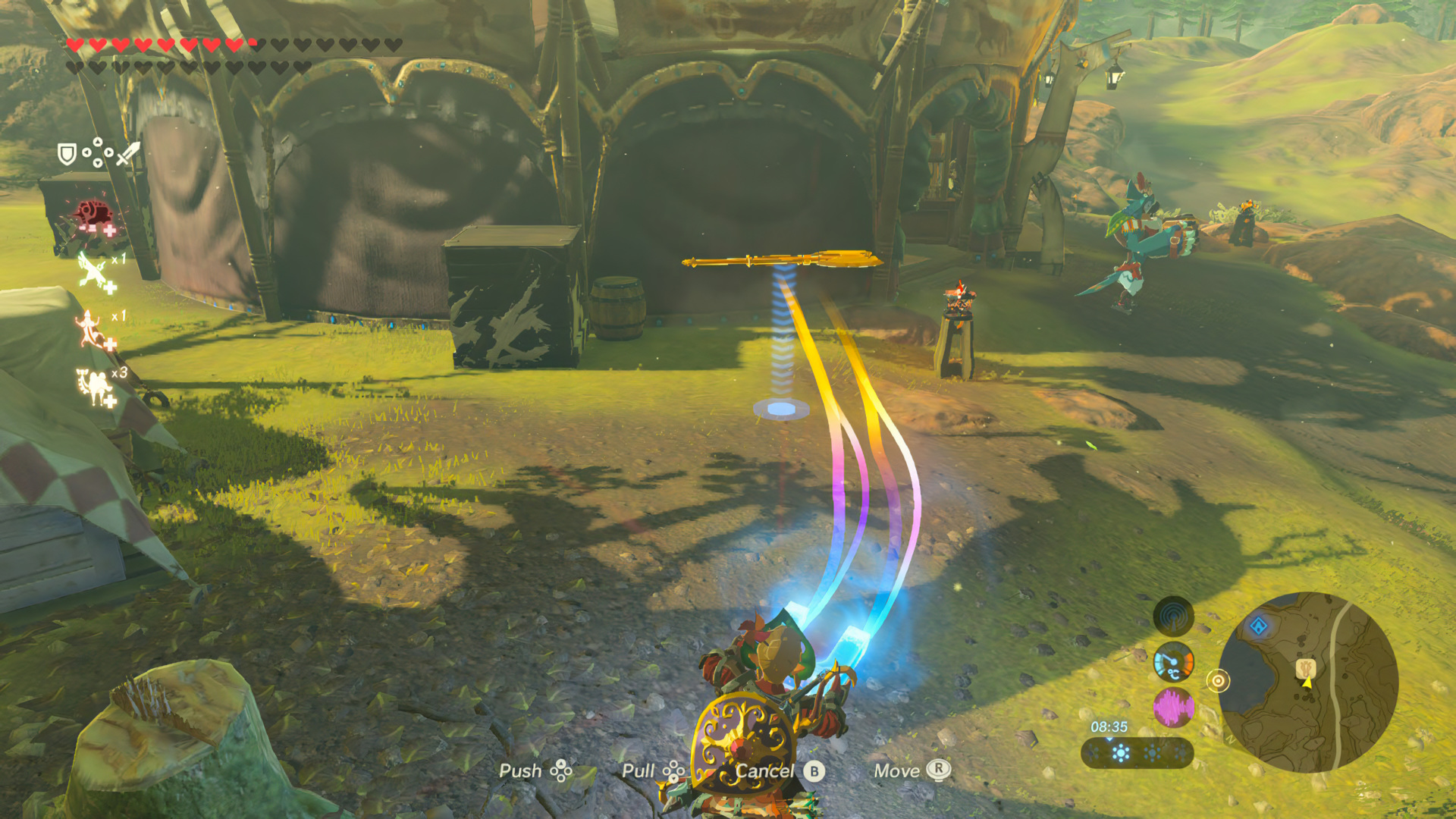 Magnesis is a "metal-only attraction" rule, applied universally: every metal object in the world reacts to it the same way. Source: Game UI Database.
The element rules
The chemistry engine's elements (and their canonical behaviours):
| Element | Causes | Reacts with | Notable interactions |
|---|---|---|---|
| Fire | Heats air → updrafts; ignites wood, grass, oil; melts ice; cooks meat; warms Link in cold biomes | Wood, grass, oil, ice, water (extinguishes), wind (extinguishes / blows around) | Burning grass produces an updraft; the player rides that updraft with the paraglider |
| Ice | Freezes water; cools Link in hot biomes; reduces enemy mobility on contact | Water (forms), fire (melts), warm wind | Cryonis rune creates ice pillars on water; freezing a Lizalfos disables it briefly |
| Wind | Blows fire / leaves / arrows; pushes lightweight objects; carries the paraglider | Fire (extinguishes), arrows (deflects), Korok seeds (reveals) | Stand at a cliff, drop a leaf, see the wind direction → paraglide that way |
| Water | Conducts electricity (everyone in a wet patch gets shocked); puts out fire; soaks Link (penalty in cold) | Fire (extinguishes), ice (forms), electricity (conducts) | Toss a metal weapon into a pond with electric enemies → AoE one-shot |
| Electricity | Stuns enemies; conducts through water and metal; drops weapons from hands | Metal, water, wood (ignites), Link's metal weapons (drops them) | A storm + a metal sword = guaranteed lightning death. Drop the sword. |
| Metal (with Magnesis rune) | Attracts to the Magnesis cursor; lifts/moves; dropped during electricity | Magnesis, electricity, magnets in shrines | Almost every shrine has at least one metal object as a Magnesis target |
These rules are universal. There's no special logic for "this fire interacts with this grass only in this shrine." Burn grass anywhere in Hyrule, get an updraft anywhere in Hyrule. The consistency is the design.
Why "multiplicative" is the load-bearing word
At GDC 2017, Fujibayashi described the team's shift from additive to multiplicative design:
"Additive design is when you keep adding things to the game. … Multiplicative design is when objects react to the player's action, and the objects themselves also influence each other."
, Hidemaro Fujibayashi, GDC 2017, via Thumbsticks
The mathematical framing is real:
- Additive: N items × M situations = N + M useful possibilities. Each item works in roughly one context.
- Multiplicative: N rules × M objects × O contexts = N × M × O. Each rule applies everywhere; every situation calls in 2–4 rules at once.
A practical example. The player wants to cross a metal grate that's electrified. Approaches:
- Throw a wooden weapon to break the grate (object → impact rule).
- Stand a metal box on top of the grate to displace the electric Pokémon-equivalent (Magnesis + metal-conducts-electricity rule).
- Wait for rain, drop a metal weapon into the water below the grate to short-circuit (rain + water + metal + electricity).
- Use Stasis to freeze the electrocuted enemy mid-shock, paraglide over (Stasis rule).
None of these are authored solutions. They emerge from the rules.
Where the engine shows up
The rule layer is most visible in shrines (where each puzzle is a controlled chemistry-engine demonstration) and in combat encampments (where the player improvises). It's almost invisible in the world because the rules are so consistent that players stop noticing them, fire-grass-updraft becomes a verb the player does without thinking, the same way a console-action player stops thinking about the dodge button.
A few canonical world-applications:
- Korok puzzles: many are wind-direction tests (drop a leaf or rock to see the wind, paraglide that way).
- Storm survival: heavy rain + metal sword = lightning danger. Drop the sword in the menu; lightning skips you.
- Combat improvisation: surrounded by Bokoblins on dry grass? Throw a fire arrow; the AoE burn drops 4 of them.
- Stealth options: Bokoblins around a campfire. Swim up the river behind, push a metal box over with Magnesis to crush them.
The cost: emergent solutions outpace difficulty design
The trade-off Fujibayashi accepts is that encounters cannot be balanced for any one solution. A camp of 5 Bokoblins is supposed to be a 1-minute fight. A clever player kills them in 8 seconds via fire-on-grass. A less-clever player takes 3 minutes and breaks 2 weapons. Both are correct; the game doesn't punish either.
This produces the famous BOTW property: two players who finish the game have had measurably different experiences. A speedrun completes in 23 minutes (paragliding off the Great Plateau, glitching into Calamity Ganon's chamber); a full-completion player takes 200 hours. Both are using the same rule set.
What this teaches
- Write rules, not encounters. A small system of universal rules generates more content than the largest content team can hand-author. The overhead is up-front design; the payoff is at-scale player surprise.
- Consistency is the load-bearing property. The chemistry engine works because fire-grass-updraft is true everywhere. Any exception makes players stop trusting the rules.
- Pair the rule layer with a small verb-set. Link has ~5 runes. The runes are also universal rules: Magnesis attracts metal anywhere; Cryonis freezes water anywhere. If the verbs were context-specific, the rule layer's consistency would not pay off.
- Some encounters get solved in 8 seconds. That's fine. The chemistry engine accepts that the same fight will be hard for some players and trivial for others. The expressiveness is more valuable than the difficulty curve.
Patterns this exemplifies
chemistry-engine: a small set of element rules + the physics engine, applied universally. The canonical case in commercial games. Uncurated.multiplicative-systems: Fujibayashi's framing. Uncurated; the BOTW page is the locus.
Adjacent patterns
bonus-with-drawback: most chemistry-engine moments are also drawbacks. Metal weapon = strong but lightning-magnet. Fire arrow = damage but starts a wildfire that dries out cooking ingredients. The trade is structural.late-introduced-mechanics: most rule combinations are not taught. The player discovers them across 30 hours and is rewarded for the investment.