Through the ludonarrative resonance lens
A reading of Slay the Spire's mechanics through the ludonarrative resonance lens, does what the player does affirm what the game says it's about?
Mechanic read: the entire loop, card draft, energy budget, map, relics, Ascension.
Verdict: Orthogonal, and that's the right call. Same shape as the PoE reading. The Spire setting is decoration around a pure mechanic-driven game; Mega Crit didn't pretend the fiction was load-bearing, and the result is one of the cleanest design surfaces in the catalogue.
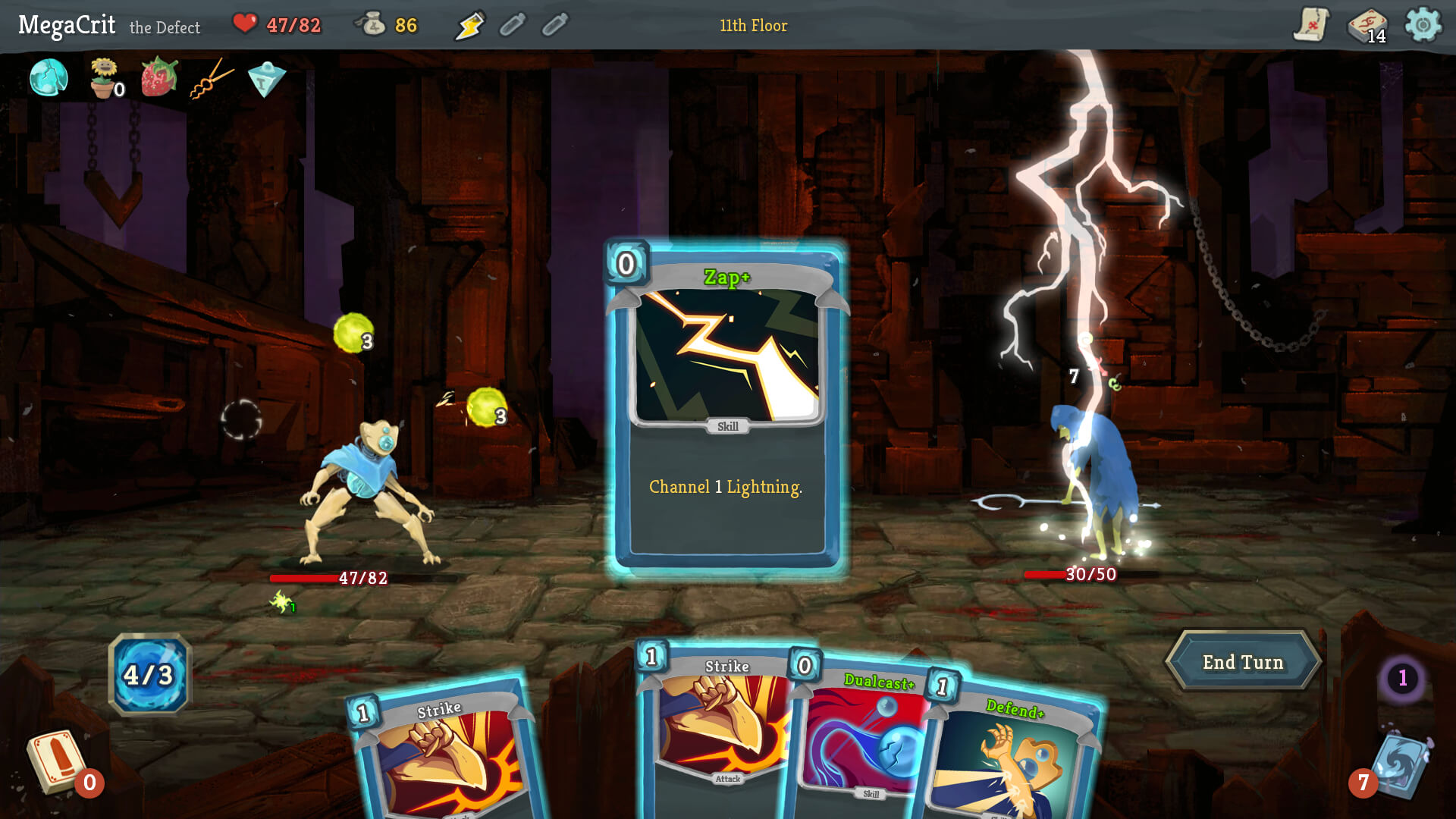 Every Spire mechanic on one screen: and none of them say anything specific about climbing a spire. The decoration is light; the math is the product. Source: Steam.
What the fiction is
There is a Spire. There is a Heart at the top of it. You climb it as one of four characters (Ironclad, Silent, Defect, Watcher). Each has a flavour, exiled warrior, fugitive thief, malfunctioning automaton, ascetic monk, but the flavour does no mechanical work. Spire Ascensions raise the difficulty without changing the fiction's stakes. The act-3 boss is a Heart; you slay it; that's the plot.
The fiction is a frame. It exists to give names to enemies, palettes to environments, and a justification for why card-draft-with-skip is happening in this universe. None of it is what makes the game work.
What the loop says
The loop says: you are optimising a deck under a 3-energy budget against telegraphed enemy intents on a procedurally-generated branching map. That description applies to every Spire run regardless of character or setting. The fiction is separable from the mechanic.
This is the diagnostic for orthogonality. Strip the Spire skin and the game is the same game. Reskin Ironclad as a wizard or a hacker or a chef, same deck, same energy, same draft. The mechanics don't reference the climb because the climb is decoration.
Why orthogonality is honest, not lazy
Mega Crit could have forced resonance:
- Bend the mechanics toward fiction. Cards that "only work on stone floors" because you're climbing through ruins. Relics that decay because you're tired. Energy that diminishes per floor because the Spire saps you. Each of these is thematic: and each would weaken the math.
- Bend the fiction toward the mechanics. Rewrite Ironclad as "the deck-curator who exists in the abstract probability space." Strip the climbing premise; it's a card game, not a tower-ascent. The game would lose its tone, gain nothing.
Either path trades a strength for nothing. Mega Crit instead picked: light fiction, heavy math, honest framing. The Ascension staircase is the long-term challenge surface, the climb metaphor is mechanical (each ascension layers a new modifier) but the climb fiction is unused. That's fine.
What forced resonance would look like (don't)
A Spire-clone trying to be more "narratively ambitious" might:
- Add voice-acted character backstories that reach into card semantics (Silent's cards "remember her past" with a memory mechanic).
- Tie deck-thinning to character growth ("she's letting go of the mercenary's life").
- Make relics into character mementos with diegetic explanations.
Most of those moves would make the game worse, they'd nudge the mechanics toward narrative justification rather than mechanical balance. Spire's clones that tried (Inscryption excepted, which made resonance the entire pitch) usually weakened their math.
Why this game is in the lens at all
Every lens needs orthogonal entries to stay diagnostic instead of moralising. Slay the Spire is the canonical light-fiction-heavy-math design posture, and naming it correctly, "this is orthogonal, and that's why it works", is what keeps the lens useful for designers picking how much resonance to chase in their own work.
See also
- Mechanic pages: Map & nodes, Combat, Deckbuilding, Relics, Characters, Ascension
- Sibling reading: Path of Exile: Ludonarrative reading (parallel honest-orthogonal case)
- Lens (overview): Ludonarrative resonance
- Adjacent pattern:
vision-driven-iterationvs.metrics-driven-balance: Spire's design philosophy explicitly treats the math as the product.