Combat foundation
The shared combat grammar across all four Xenoblade entries. Every game in the series is recognizably Xenoblade combat, even though each one adds new layers on top.
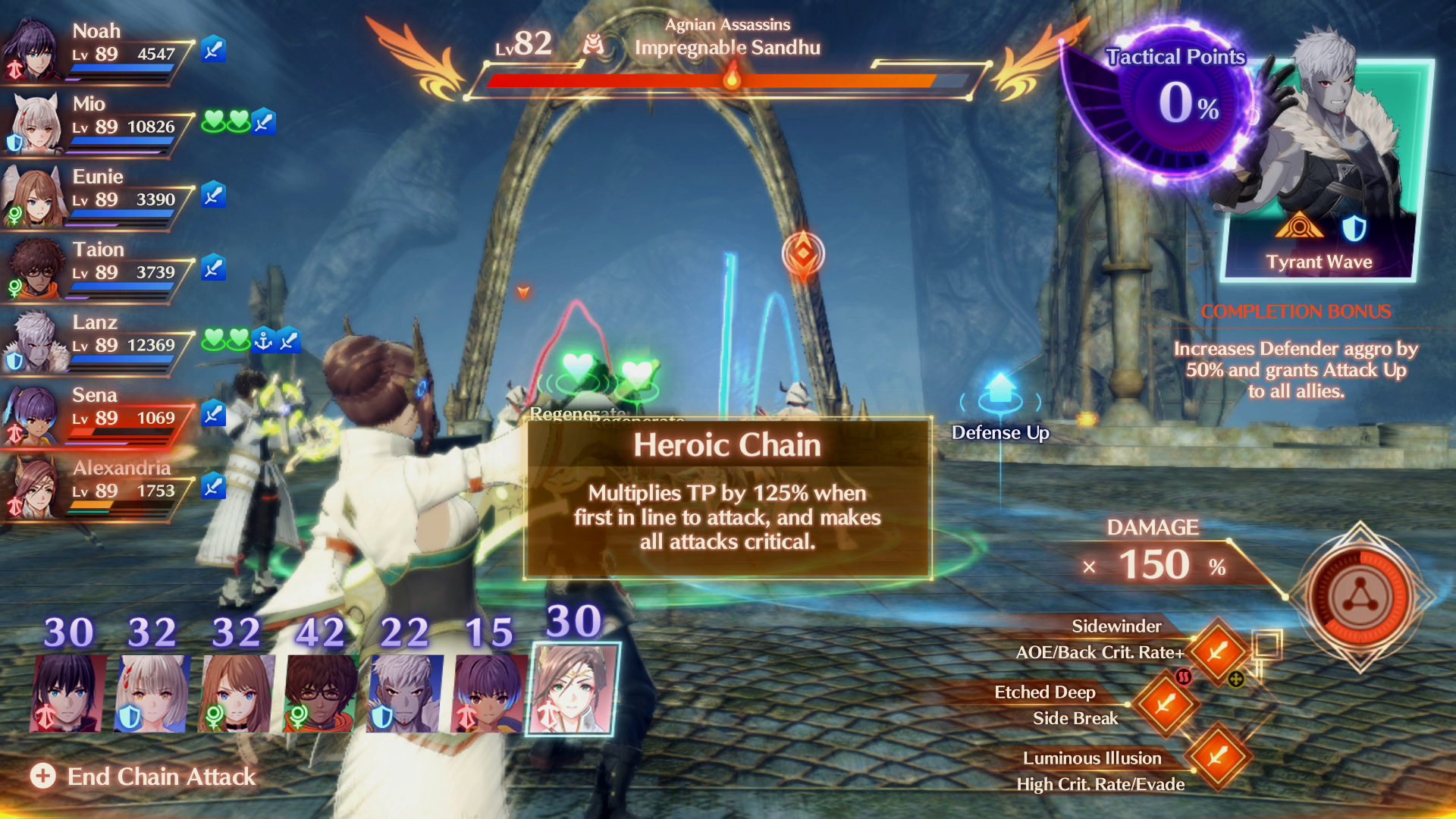 XC3 mid-chain-attack: the most elaborate version of the series's freeze-frame combo system. Seven party panels on the left, the boss "Aphlon Assassins · Impregnable Sandhu" centred, a Tactical Points gauge top-right, and a chosen tactic card mid-screen (Heroic Chain: "Multiplies TP by 125% when first in line to attack, and makes all attacks critical"). The chain-attack rules unfold across ~30 hours of campaign, players at hour 10 see chain attacks; players at hour 40 see a different game inside the same menu. Source: Game UI Database.
The grammar
Three things, every fight, every entry in the series:
Auto-attack happens by itself. Stand within range of an enemy with auto-attacks toggled on, and your character cycles through the basic-attack animation forever. This is the DPS background hum: it's what's happening when nothing else is.
Arts are on individual cooldowns. Each character carries 8 (XC1, XC2, XC3) or up to 12 (XCX) Arts: special abilities that cost no resource but recharge over time. Some recharge based on auto-attack hits, some on time, some on chain triggers. The art palette is the combat loadout. Choosing which 8 arts to slot is the loadout-as-budget decision.
Position matters. Every art has a side: front, side, back, at which it deals more damage or triggers a status. Most arts also have a state requirement (target must be Toppled, Broken, Dazed, Burst). So a fight is partly moving the camera, running around the enemy to hit Side or Back arts when they're not facing you.
The combination produces an oscillating rhythm: auto-attack ticks DPS, arts come off cooldown one at a time, you weave in arts at the right position for the right state. Combat looks frantic but is actually highly tactical.
Why this isn't an action game
The instinct on first watching Xenoblade combat is "this is an MMO." That's correct. The lineage is Final Fantasy XI / EverQuest 2 era MMOs, auto-attack + tab-target + active-ability rotation. Monolith Soft formalized that combat shape into a single-player, narrative game.
The trade-off vs. action combat (Souls, Bayonetta, modern Final Fantasy XVI):
- Reflex pressure is lower. You don't dodge a sword swing in real time; you trigger an art that Breaks the enemy so the next art can Topple them.
- Mental load is higher. You're tracking 8 cooldowns × 3 party members × 4 status states × multi-step combo chains, often while the camera is on you.
- Reads, not reactions. The skill ceiling is in recognizing what state the fight is in: who's tanking, what arts are up, which combo path is open, not in mashing a parry button.
This is also why Xenoblade combat doesn't feel "good" until ~hour 5–10. The auto-attack background is what carries the early game; the tactical layer only starts mattering once you have multiple arts unlocked, multiple party members controllable, and an enemy whose level requires the system. A new player can finish an early fight by mashing buttons. They cannot finish a hour-30 elite without committing to the system.
Status states and combo paths
Each entry in the series formalizes a sequence of states the enemy can be in:
| State | Set up by | Effect |
|---|---|---|
| Break | Specific Break-tagged arts | Enables Topple |
| Topple | Topple arts on a Broken enemy | Enemy is on the ground; can't act; enables Daze |
| Daze | Daze arts on a Toppled enemy | Extends the down state, deals bonus damage |
| Burst (XC2/XC3) | Final art in a chain | Massive damage finisher |
The combo path is Break → Topple → Daze → Burst. Pulling the full chain off, 4 different arts on 4 different characters in the right order, all positioned correctly, while keeping aggro on the tank, is the genre's minigame within combat.
Chain attacks
Every entry has some form of Chain Attack, a meta-combo system that fills a gauge during regular combat and, when triggered, hands the player a freeze-frame multi-art barrage:
| Entry | Chain attack form | Trigger |
|---|---|---|
| XC1 | Linked arts in sequence around the wheel | Affinity-driven gauge |
| XC2 | Element-stacking through Driver→Blade→Fusion combos | Combo-orb chains on the enemy |
| XC3 | Tactical Order menu: pick a hero, see a multi-art preview, with target-multiplier scaling | TP gauge, multi-pause, often run-defining |
| XCX | Soul Voice prompts during combat (auto-trigger if other party members deliver voice lines correctly) | Real-time, less menu-driven |
XC3's chain attack is the most over-the-top of the four, a fully menu-driven encounter-shaping system that often deals more damage in 30 seconds than the previous 5 minutes of regular combat. Late-XC3 fights are designed around the chain attack: take damage for 4 minutes, then chain-attack for 90 seconds, then repeat.
Compared to its peers
| Game | Combat shape | Auto-attack? | Position matters? | Pause-able? |
|---|---|---|---|---|
| Final Fantasy XII | Gambit-driven turns | Yes | No | Yes |
| Final Fantasy XVI | Action-combat (DMC) | No | Tactical-only | No |
| Final Fantasy VII Remake / Rebirth | Action with ATB pause | No | Limited | Yes |
| Persona 5 | Turn-based | No | No | Pause is the game |
| Tales of (Arise) | Real-time multi-character action | No | Yes | Limited |
| Dragon Quest XI | Turn-based | No | No | Yes |
| Xenoblade (any) | MMO-shape: auto-attack + cooldown arts + state combos | Yes | Yes | No (Chain Attacks freeze-frame the menu) |
Nobody else in major JRPGs does this combat shape. Xenoblade owns it.
Patterns this exemplifies
enemy-intent-telegraph: XC1's vision system is the most distinctive case in the genre. See vision system.loadout-as-budget: the 8-art palette is a fixed combinatorial budget; you pack it.