Shop economy + interest
The run economy is small and fast: a few dollars per round, a randomized shop, a compounding interest rule. The interest rule alone reshapes the entire game.
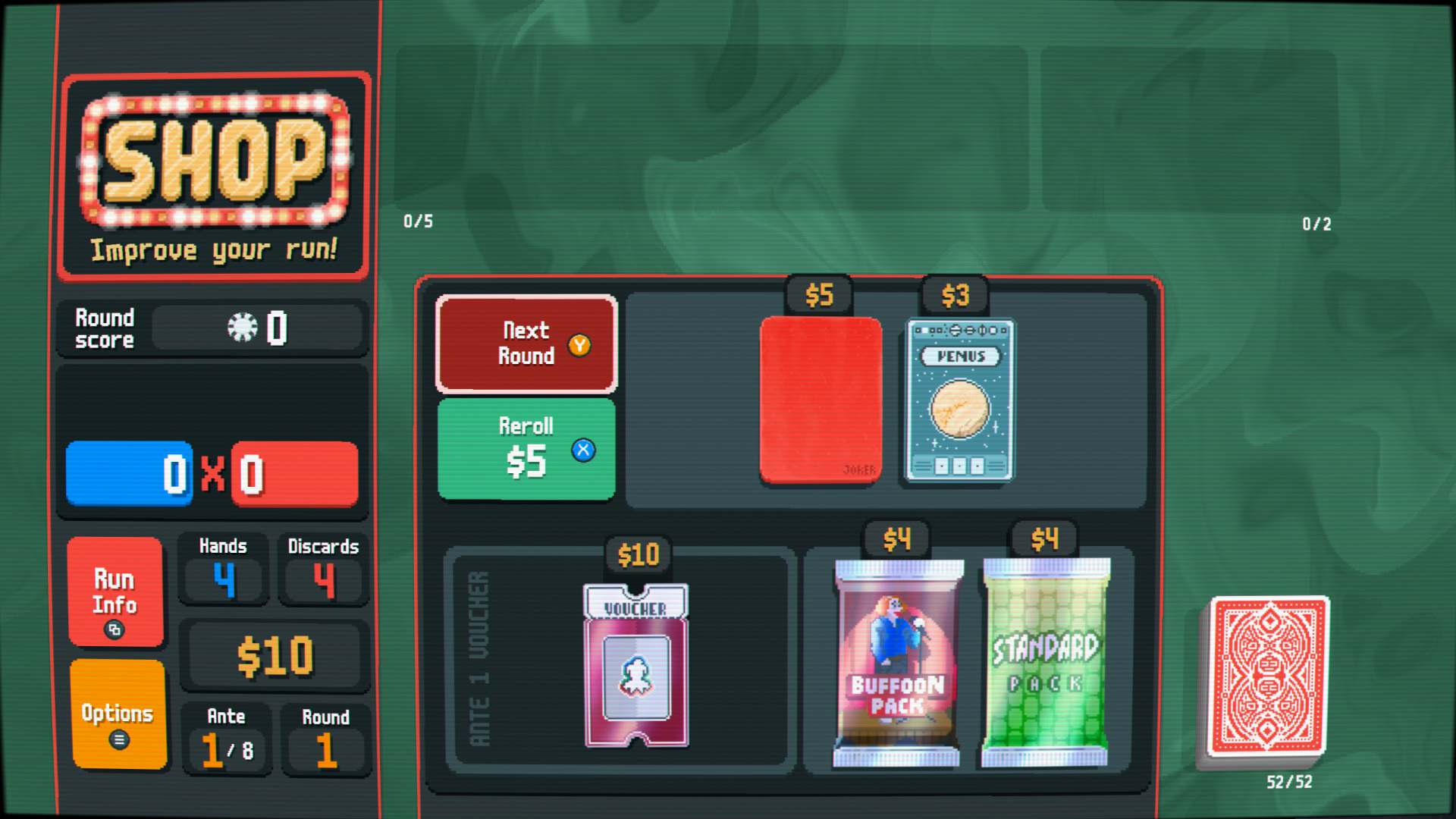 The shop after clearing a Small Blind. Reroll costs $5. The voucher slot ($10) is bigger than the player's bank: they cannot afford it this visit. Source: Game UI Database.
The income sources
Each cleared round pays out:
| Source | Amount |
|---|---|
| Small Blind base reward | $3 ($$$) |
| Big Blind base reward | $4 ($$$$) |
| Boss Blind base reward | $5 ($$$$$) |
| Hands remaining at round end | +$1 each |
| Discards remaining at round end | $0 (use them or lose them: not banked) |
| Interest | +$1 per $5 banked, capped at $5/round (so $25+ banked = $5 interest) |
| Various Jokers | (Cloud 9: +$1 per 9 in deck on round end; Egg: +$3/round; Rocket: +$1/round, +$3 on Boss) |
| Gold Seals on cards played | +$3 per scoring card with seal |
So a typical Boss-Blind clear pays: $5 base + $4 unused-hand + $5 interest = $14, plus joker income.
The interest rule (the load-bearing mechanic)
"Earn $1 interest per $5 banked, up to $5/round."
This single rule produces the central economic dialectic of Balatro: save now or spend now?
The $25 floor
To max interest, you need $25+ banked. Below that, you're leaving money on the table:
| Banked | Interest |
|---|---|
| $0–$4 | $0 |
| $5–$9 | $1 |
| $10–$14 | $2 |
| $15–$19 | $3 |
| $20–$24 | $4 |
| $25+ | $5 (cap) |
So every player learns to hoard to $25 minimum and spend only the excess. Crossing the $25 threshold is the early-game mid-run goal of most builds.
The greed-vs-spend trap
But the shop offers real upgrades. Skip the $5 Joker now → save $5 → next round earn +$1 from interest. Net: $1 + the opportunity cost of the Joker you didn't buy.
If the Joker would have multiplied your subsequent income (e.g. Egg: +$3/round), buying it pays back in 2 rounds. If it's a build piece, the value is harder to compute.
This is the same dialectic Slay the Spire's economy plays in (combat-then-shop, gold management, removal vs purchase) but more explicit: the interest is right there on the screen as a per-round subtotal. Players literally see the saving meter every round.
The reroll cost ladder
Each shop offers ~2 Joker slots + Voucher + 2 Booster Packs. Players can reroll the Joker offers for $5 base, then $6, then $7, costs reset on next shop.
So a heavily rerolled shop visit can cost $20+ to find the right Joker. This is a real luxury, most early-Ante runs skip rerolls entirely.
The Liquidation Voucher (one of 32 vouchers) reduces reroll cost to $1. A run with Liquidation re-rolls aggressively; a run without it reroles only when desperate.
Vouchers: the run-permanent shop modifiers
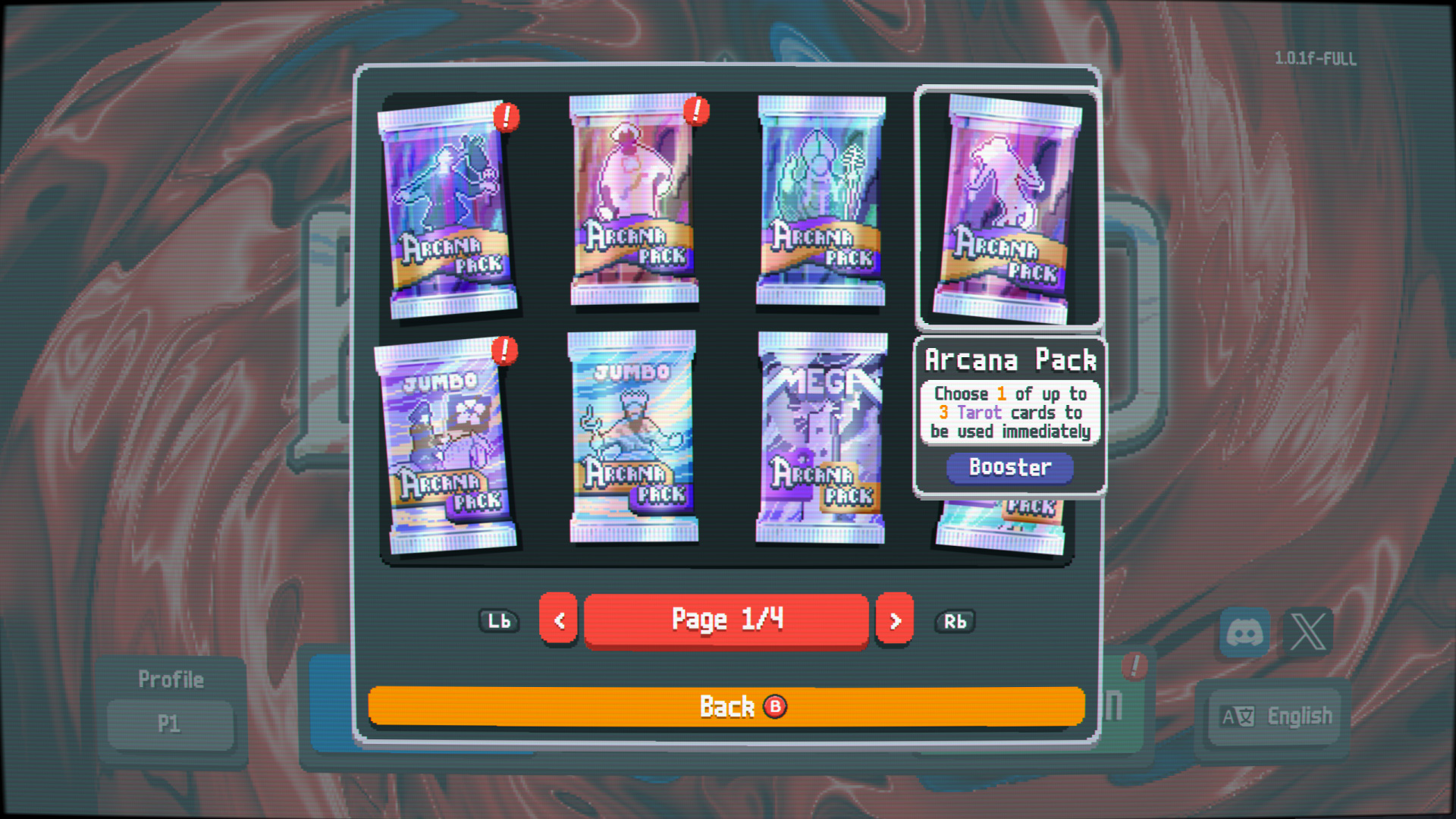 The shop's Booster Pack inventory. Each Pack is a temporary 2–5 card draft for a specific consumable type. Mega and Jumbo variants are larger / better-odds versions. Source: Game UI Database.
Vouchers are run-permanent. Buy one in the shop ($10), it persists across all subsequent rounds in the run. There are 32 of them, paired in tiers (the second tier requires the first as a prerequisite):
| Tier 1 voucher | Effect | Tier 2 (requires T1) | Effect |
|---|---|---|---|
| Overstock | +1 shop slot | Overstock Plus | +1 shop slot |
| Clearance Sale | -25% shop prices | Liquidation | -50% shop prices |
| Hone | Foil/Holo/Polychrome 2× more common | Glow Up | 4× more common |
| Reroll Surplus | Reroll cost -$2 | Reroll Glut | -$2 again |
| Crystal Ball | +1 consumable slot | Omen Globe | Tarots can appear in any pack |
| Telescope | First Celestial Pack of run gets the Planet for your most-played hand | Observatory | Planets in consumable slot give ×1.5 mult on their hand |
| Grabber | +1 hand per round | Nacho Tong | +1 hand per round |
| Wasteful | +1 discard per round | Recyclomancy | +1 discard per round |
| Tarot Merchant | Tarots 2× more common in shop | Tarot Tycoon | 4× more common |
| Planet Merchant | Planets 2× more common | Planet Tycoon | 4× more common |
| Seed Money | +$1 interest cap (max $6) | Money Tree | +$2 again (max $7) |
| Blank | (does nothing) | Antimatter | +1 Joker slot |
| Magic Trick | Playing cards in shop | Illusion | Cards in shop can be Enhanced/Editioned/Sealed |
| Hieroglyph | -1 Ante (skip ahead!), -1 hand per round | Petroglyph | -1 Ante again, -1 discard |
| Director's Cut | Reroll Boss Blind for $10 | Retcon | Boss Blind reroll free |
The Antimatter chain (Blank → Antimatter) is one of the most-purchased combos: skipping a useless voucher tier to unlock the +1 Joker slot. Sequencing matters.
What this teaches
- A single rule (interest) can reshape an entire economy. "+$1 per $5 banked, cap $5" is one line of code. It produces the run's central tension. Most economies lack a comparable load-bearing rule.
- Make the interest meter visible. Players need to see the saving floor to behave around it. Hidden interest (or implicit-only) doesn't change behaviour.
- Permanent run-modifiers (vouchers) are stronger than per-shop bonuses. Spending $10 once for run-permanent +$1/round interest cap pays back in 10 rounds. Buy them aggressively.
- Pricing tiers should pair gates. Tier 2 vouchers requiring tier 1 means buying Blank (does nothing) becomes valuable as a prerequisite for Antimatter (+1 Joker slot). Pair-gating turns useless items into ladders.
- The greed-vs-spend trap is the entire midgame. A run that hoards too much loses to under-built scoring. A run that spends too much dies to no-interest. The right behaviour is just enough: a soft cap at $25 with discretionary spending above.
Patterns this exemplifies
bonus-with-drawback: Hieroglyph voucher (skip Ante / lose hand) is the canonical case. Pay a permanent cost to skip a permanent threshold.greed-vs-spend-economy: interest creates a saving floor; the player must actively decide when to break it. Uncurated; Balatro is the canonical case.opportunity-cost-loadout: every shop choice forecloses others. The reroll cost ladder makes "look at one more option" itself a real cost.