Chamber paths
How the player navigates a run. Each biome is a directed acyclic graph of chambers: pick a door at chamber-end, see what reward it telegraphs, walk through. The graph is shallow (~12–20 chambers per biome) but the door icons let the player shape the run.
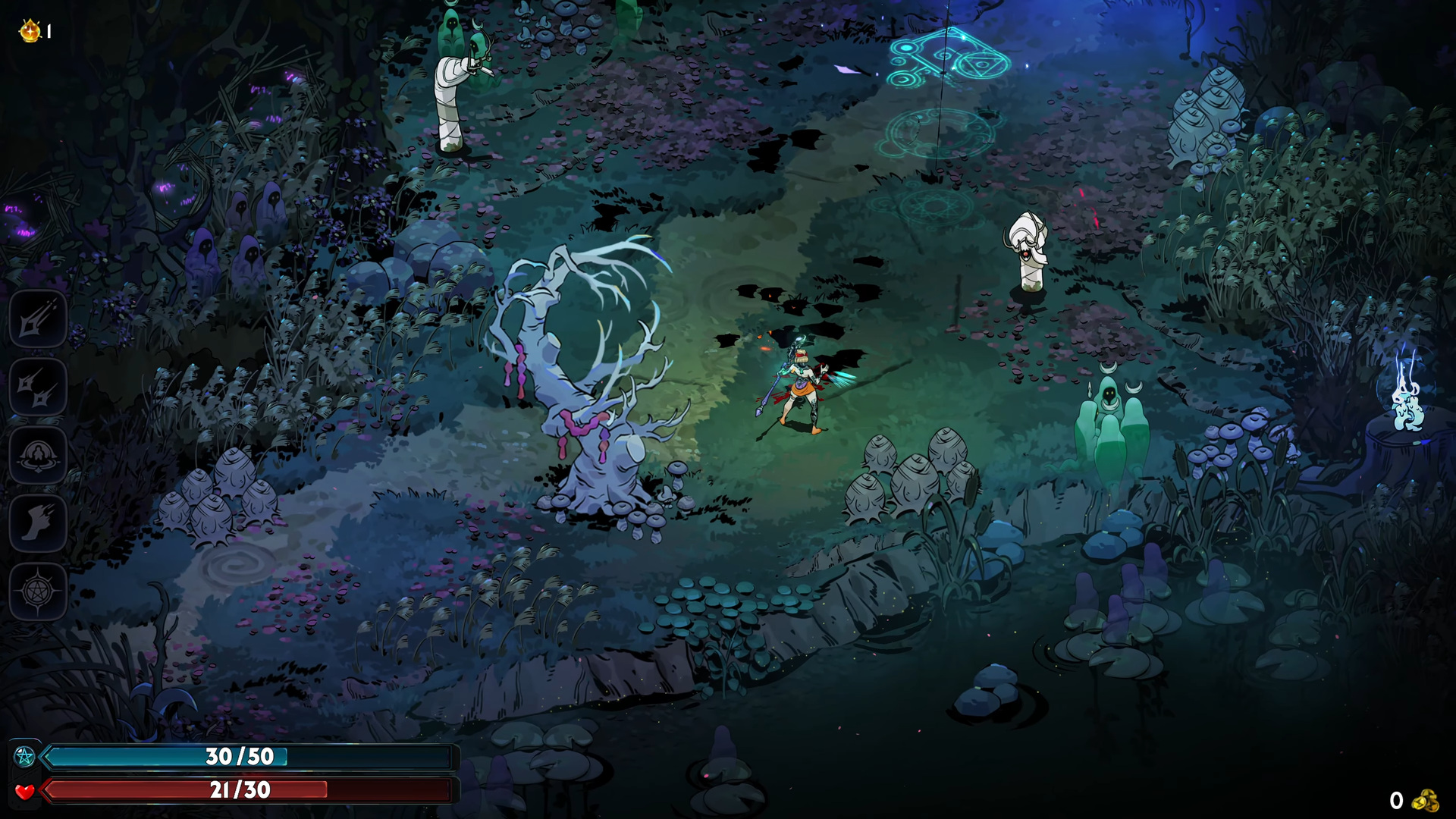 Mid-chamber exploration in Erebus. Top-left: gold counter (1) and Magick stack (under it). Left side: ability row showing equipped Cast / Sprint / Magick / Hex slots. Bottom-left: Magick bar (cyan, 30/50) over HP bar (red, 21/30). The HUD itself is minimal; most of the screen is environment art. Source: Game UI Database.
Reward door icons: the foreshadowing layer
When the player clears a chamber, the doors leading to the next chamber each show a reward icon:
| Icon | Reward |
|---|---|
| ⚡ god symbol | A boon from that specific god |
| 🔨 anvil | Hammer of Daedalus (weapon upgrade) |
| 💰 gold pile | Gold (currency for the in-run shop) |
| 💎 gem | Crystallized Currency (long-term meta-currency) |
| 🍷 nectar | Gift currency for hub characters |
| ❤️ heart | Healing chamber |
| 🌑 ⭐ ✨ | Various biome-specific currencies |
| 👁️ Charon | Shop chamber (spend gold) |
| ⛏️ pickaxe | Encounter sub-type or special chamber |
So when the player picks a door, they're picking the reward type they need most right now. Low health → take the heart. Low gold → take the shop. Need build commitment → take the god boon you're stacking.
This is branching-dag-map: the player picks the run's shape via partially-visible information about node types, exactly Spire's pattern. Hades and Spire share this design language explicitly; the studios were aware of each other.
Biome structure (Hades 1 reference)
Tartarus     (~14 chambers + mini-boss + biome boss)
   ↓
Asphodel    (lava biome, faster-paced enemies)
   ↓
Elysium     (knight enemies, pillar mechanics)
   ↓
Temple of Styx (4 sub-paths leading to final boss)
   ↓
Final boss → ending → start over
A typical run is ~20–40 minutes from start to credits-or-death. Hades 2's two-path structure is similar but branched: the descent (Tartarus → Erebus → Oceanus → boss) and the ascent (Surface → boss). Players can do either each run.
Handcrafted-PCG hybrid
Each chamber is a hand-authored room: a bespoke arena with set-pieces, traps, and enemy spawn locations. The procedural layer just decides:
- Which rooms get connected this run (from a pool of ~30 per biome).
- Which enemy spawns trigger.
- Which reward type each exit door offers.
- Which boons / hammers / shops are available.
So the moments are static (this trap room, this boss tell, this elite mini-arena), but the order and rewards shuffle. Same shape as Sparklite's tile-shuffled biomes or Warframe's tile-set missions; Hades just uses smaller arena-shaped tiles instead of corridor-shaped tiles.
Throwing-arc UI: telegraphing the player's own attacks
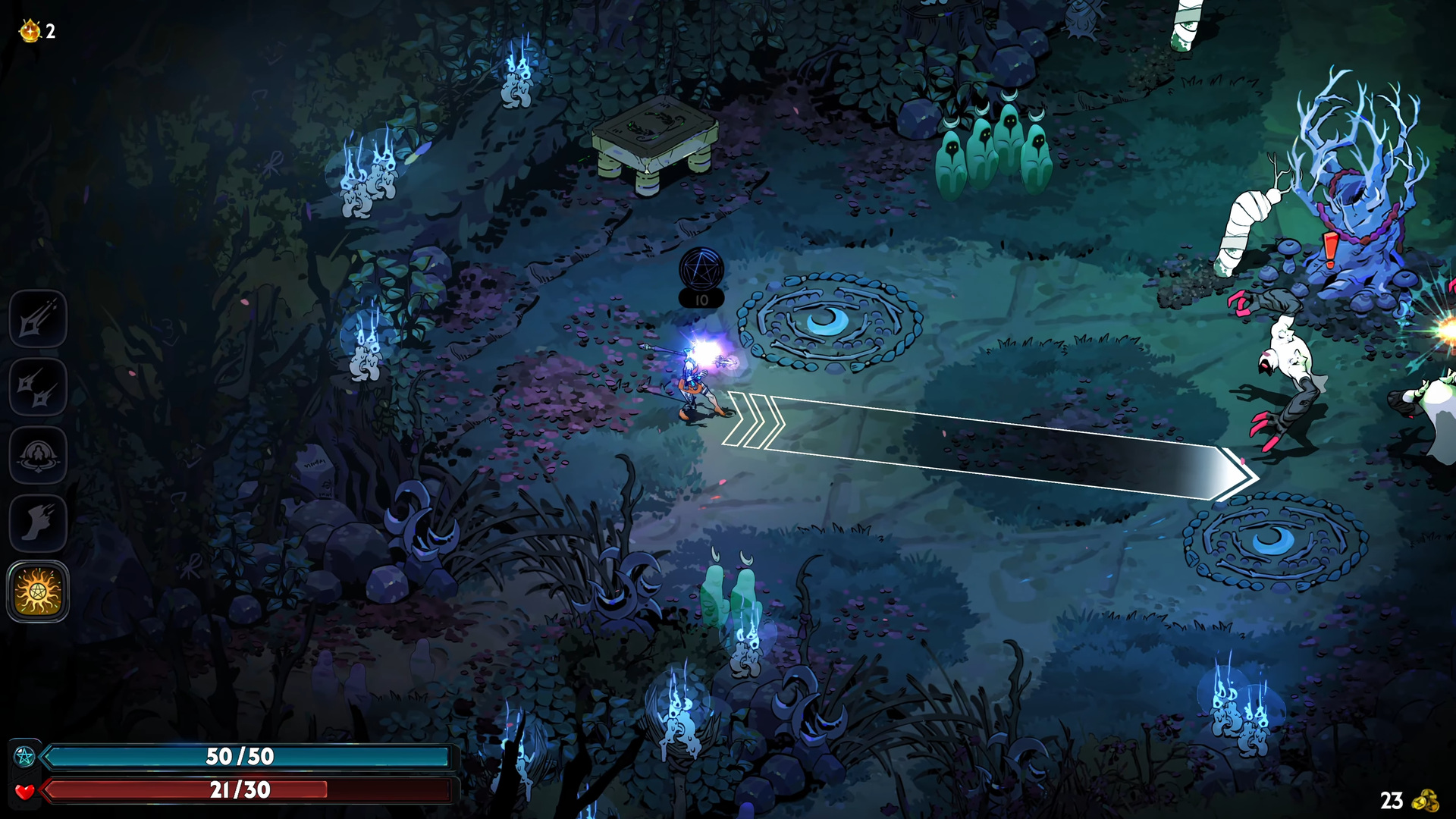 The throwing-arc UI showing the trajectory of an attack. The arc lets the player aim casts before committing, the same insight as
 enemy-intent-telegraph (Slay the Spire's enemy intent), but applied to the player's own moves. Source: Game UI Database.
Hades 2's UI shows the player's own attack telegraphs: where a Cast will land, the angle a thrown weapon will travel, the AoE of a Hex. This is unusual; many action games hide the player's own range. Hades's framing: the player should be able to read their own kit as cleanly as they read enemy intent. Combat becomes a 2-way puzzle.
Patterns this exemplifies
branching-dag-map: door-icon foreshadowing is the same shape as Spire's map.handcrafted-pcg-hybrid: arena-tile authored, run-order shuffled.