Modding system
Warframe is sometimes described as "a game where the buildcrafting is the game and combat is just where you test the build." That description points squarely at the modding system.
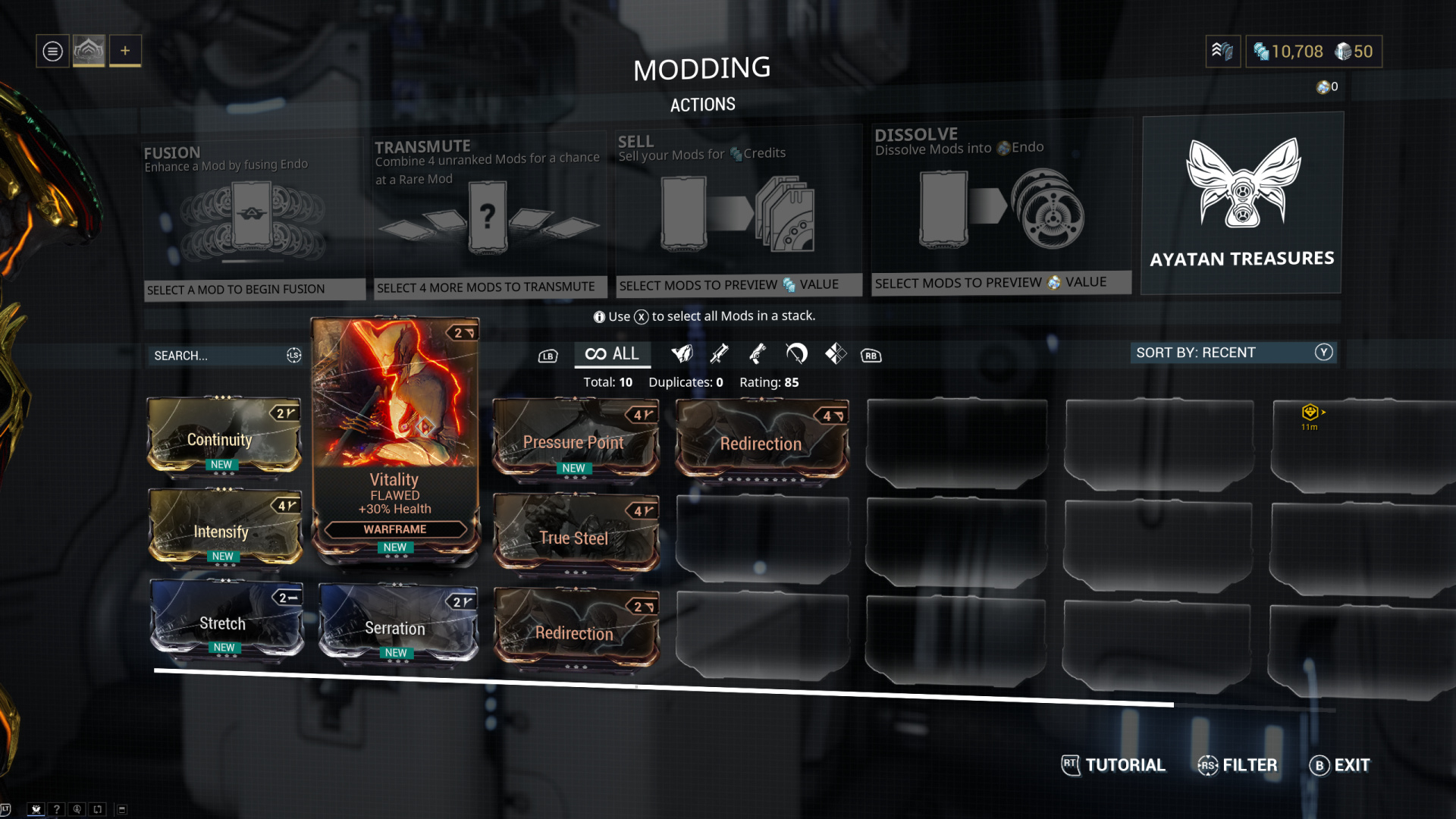 The Upgrade screen: capacity at the top, polarized slots in the loadout, mod inventory below. Every slot is a polarity-vs-cost decision. Source: Game UI Database.
Mod capacity: the budget
- Every gear piece has a base capacity equal to its rank, max 30.
- Installing an Orokin Reactor (frames) or Catalyst (weapons) doubles it → 60.
- Each mod costs N points to slot. You're packing a budget.
A typical endgame build is "60 points of perfectly-fit mods." That ceiling is permanent, you don't make a build bigger, you make it denser.
Polarity: packing efficiency
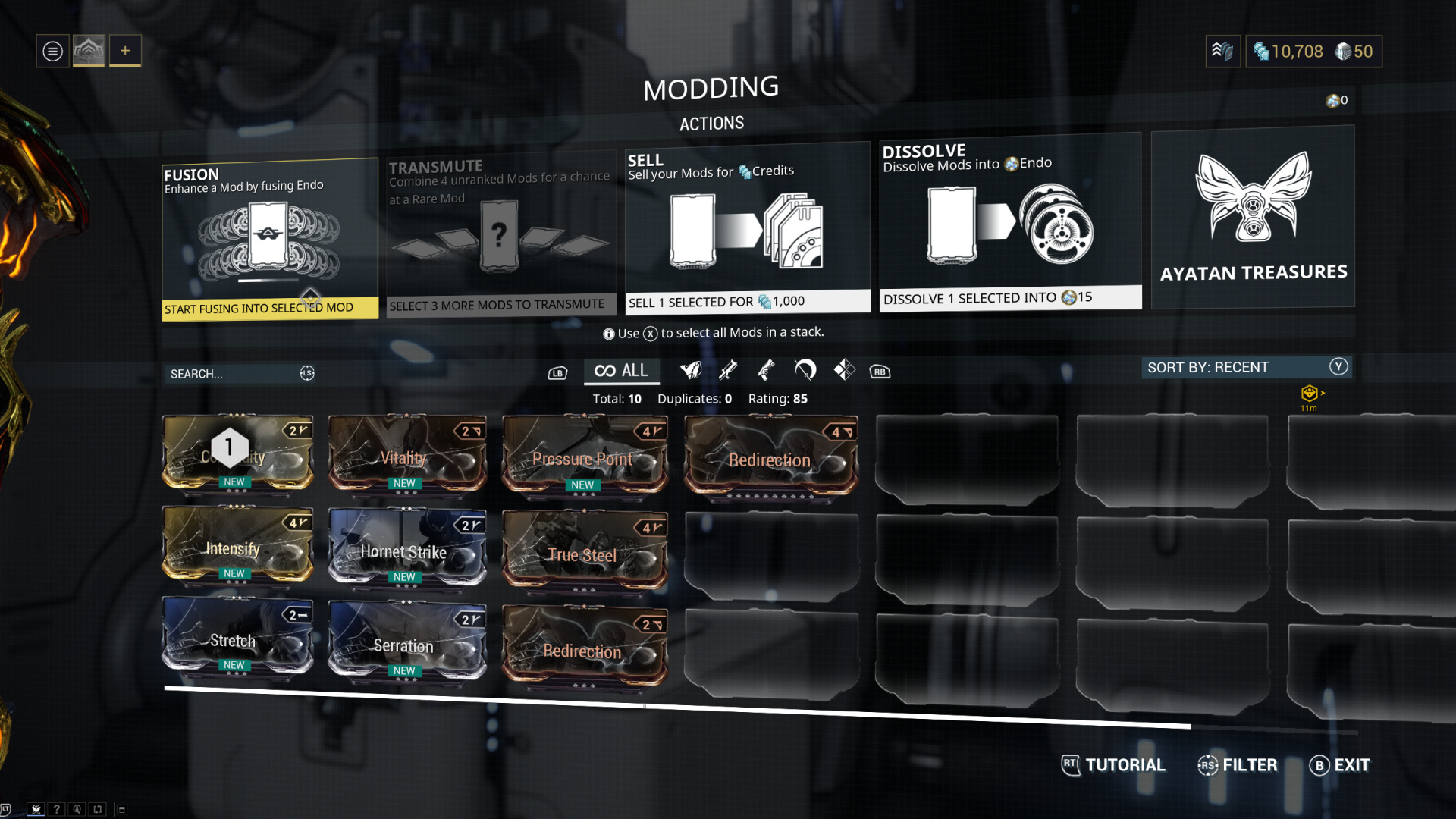 Mod detail showing how matching polarities reduce the cost of slotted mods. The capacity bar at the top shows your remaining budget. Source: Game UI Database.
Tetris but for letters, not shapes.
- Each mod has a polarity symbol (V, D, =, etc.).
- Each gear piece has slots, some pre-polarized.
- Match polarity → mod cost is halved.
- Mismatch → mod cost is +25%.
- More matching polarities = more mods fit in the same 60 budget.
The Sparklite parallel: footprint + grid is spatial; polarity + capacity is numeric + categorical. Both solve the same problem (force loadout commitment) with different math.
Forma: the permanent grind currency
This is the genuinely brilliant piece.
- Forma is a consumable that lets you set or change one slot's polarity.
- Using a Forma resets the gear's rank to 0: so adding a Forma costs a full re-leveling grind.
- A typical "endgame build" is 5–6 Forma deep on each weapon and frame.
- Aura Forma and Stance Forma are universal-polarity variants.
Why this is great design:
Forma converts "hours played" into a permanent power bump, but the bump is bounded (slot count is fixed), and the cost is more hours played. It's a self-feeding sink that converts grind directly into build expressivity without inflating raw stats.
Compare with games that make "level 50 → level 60" a power increase. Warframe's equivalent is "5 Forma → 6 Forma", but the 6th Forma fits a mod that wasn't fitting before, not a stat bump. Build expression up; raw power flat.
See permanent-grind-currency.
Riven mods: the lottery layer
- Rivens are unique-to-you mods with 2–3 random positive stats and sometimes a random negative.
- A Riven attaches to a specific weapon class (e.g. "Riven for Soma Prime").
- Re-roll their stats with Kuva (a per-account farmable currency).
- Trade Rivens with other players for Platinum.
The combination of weapon-specific Rivens + random rolls + player trade creates an entire economy layer. A "perfect roll" Riven for a popular weapon can trade for thousands of Platinum.
Riven Disposition: the floating balance lever
This is the most subtle and original piece of Warframe's balance design.
- Each weapon has a Disposition value (0.5–1.55), set by DE based on usage stats + an internal power ranking.
- Disposition multiplies Riven stat magnitudes. A B-tier weapon with disposition 1.5 can match an S-tier weapon with disposition 0.5 once a good Riven is slotted.
- Disposition rebalances quarterly, alongside each Prime Access drop.
Result: DE doesn't nerf the gun; they just reduce how much Riven it can absorb. Soft balance without touching base stats.
Why this is a design innovation:
- Direct nerfs feel like betrayals to players who built around a weapon. Disposition shifts are presented as a balance tool that "lifts up" off-meta weapons.
- The market self-adjusts: prices on Rivens for popular weapons soft-cap, prices on off-meta weapon Rivens float upward.
- The community itself becomes the balance signal: usage stats drive Disposition, which adjusts power, which shifts usage. Closed loop.
See community-driven-balance and random-perfect-roll-economy.
Patterns this exemplifies
loadout-as-budget: power lives inside a fixed mod-capacity budget.permanent-grind-currency: Forma converts time into permanent slot expansion.community-driven-balance: Riven Disposition shifts based on usage stats.random-perfect-roll-economy: Rivens as a lottery + market mechanic.