Combat
Turn-based, card-driven, single-player. The player faces 1–4 enemies at a time, each turn draws a hand and plays cards. The combat triad, energy + block + intent, is widely held up as a textbook example of "complete-information turn puzzles."
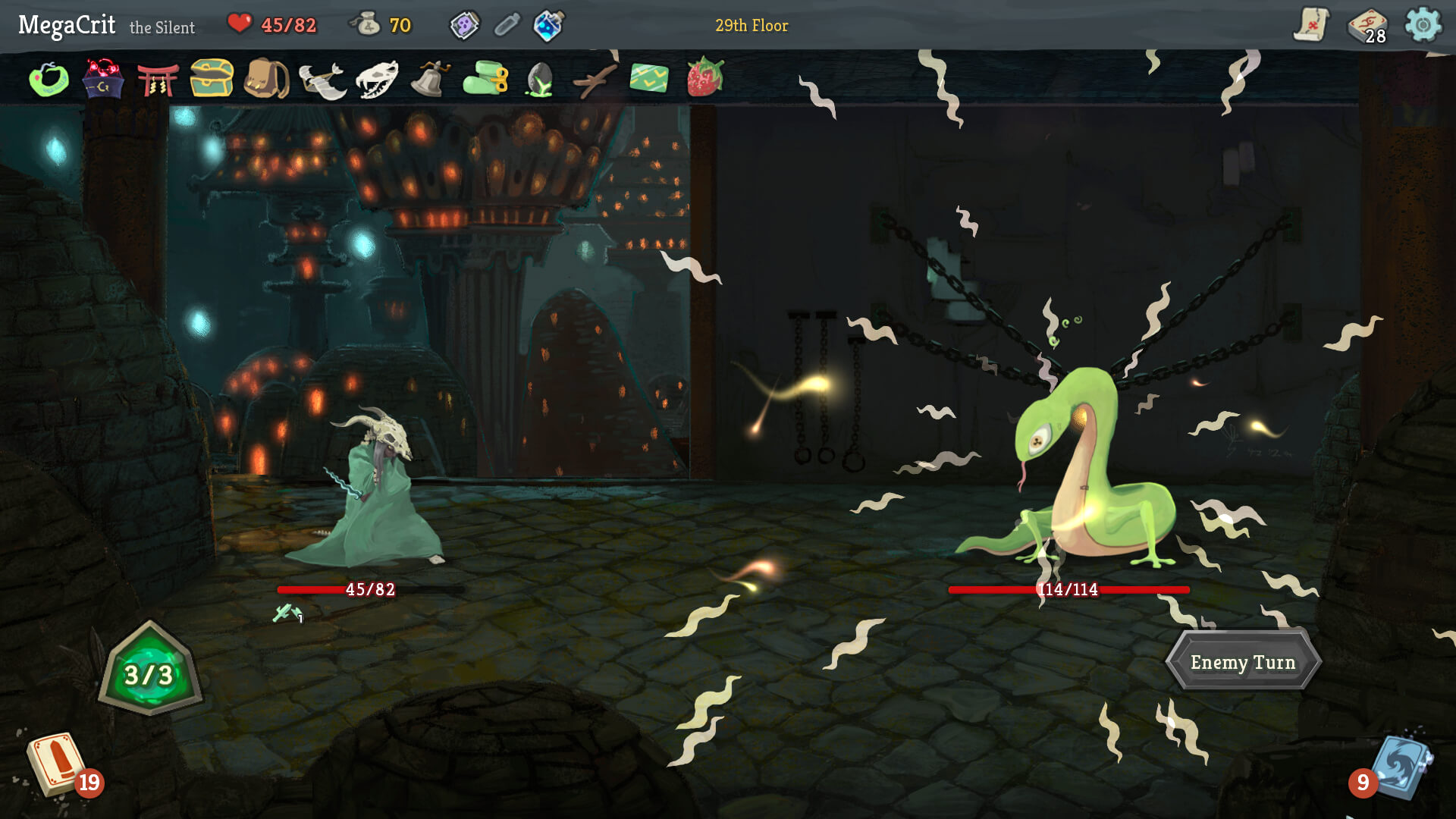 Silent combat: relics in the top row (their effects warp the run), 3/3 energy bottom-left, "Enemy Turn" indicator. The intent (just resolved here, mid-attack) is the telegraph that turns combat from RNG fight into optimization puzzle. Source: Steam.
Energy: the budget
- Start of each turn: draw 5, gain 3 Energy.
- Each card costs N energy. Play cards until you can't / don't want to.
- Unspent energy is wasted: doesn't carry to the next turn.
- Cards/relics can modify: X-cost cards spend all energy at once; certain relics give +1.
This is a tight budget. You almost never have enough energy for everything you'd like to play, so every turn is an explicit prioritization. Compare with traditional CCGs (Hearthstone, MTG) where mana grows over time, Spire's flat 3/turn forces sharp decisions every turn from turn 1.
See tight-energy-budget.
Block: defense that expires
- Block is HP-shaped damage absorption that expires at the end of your next turn.
- You block for the next attack you'll take, not for sustained defense.
- Block accumulates if you stack multiple block cards in a turn.
- Whatever block you don't use is gone.
The "use it this turn or lose it" design creates a forecasting problem: look at enemy intent, block exactly the right amount, not too much (wasted energy on overkill block) and not too little (damage through). Block is allocation, not investment.
See expiring-block.
Intent: the telegraph
Every enemy shows their next action above their head before you take your turn:
- Attack icon (with damage number)
- Buff icon
- Debuff icon
- Defend icon
- Special / unknown
- Multi-hit attacks show the count.
This is the most-imitated single mechanic in the genre. It transforms combat from "RNG fight" into a deterministic optimization puzzle each turn. The randomness is in which cards you drew, not what the enemy will do.
Why the triad is so strong
Energy + block + intent creates a complete-information per-turn puzzle with imperfect-information macro state. You know exactly what's coming this turn, but not what cards you'll draw next turn or what enemies you'll fight three nodes from now.
This is the genre-defining design move. Every modern roguelike-deckbuilder has this triad in some form. The combination is what lets Spire feel both deterministic-tactical and replayable-strategic simultaneously.
Patterns this exemplifies
tight-energy-budgetexpiring-blockenemy-intent-telegraph